
Christmas Carol Quiz
How the Scales are Structured
Who Usually Takes This Test?
See How You Compare
Below is a preview of how scores are typically distributed across each scale.
Example Questions From the Test
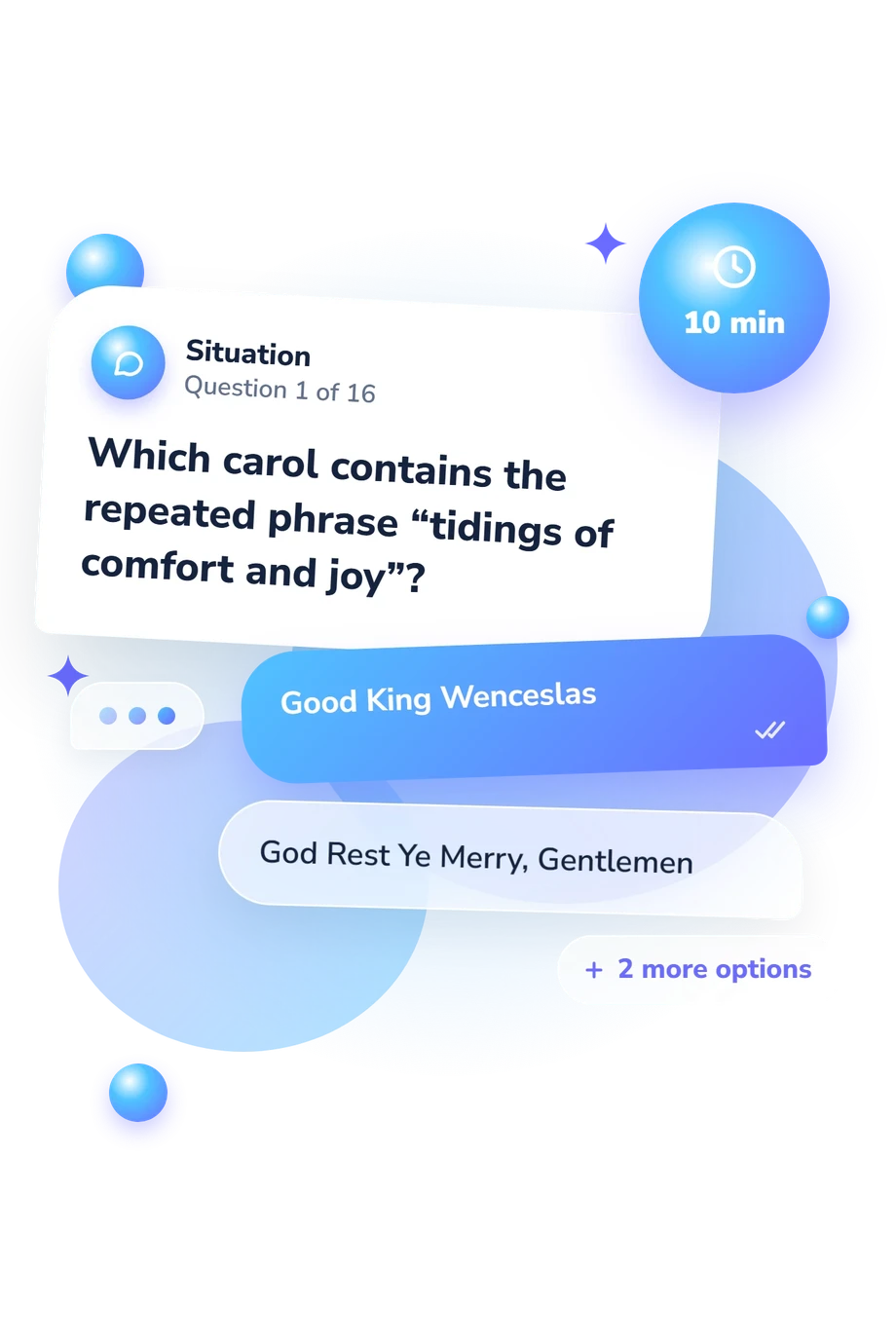
- Good King Wenceslas
- God Rest Ye Merry, Gentlemen
- Once in Royal David’s City
- We Three Kings
- Scarborough Fair
- Auld Lang Syne
- Greensleeves
- The Ash Grove
- Five gold rings
- Three French hens
- Seven swans a-swimming
- Six geese a-laying
Christmas Carol Quiz - Description and methodology of the test
Designed for readers who enjoy seasonal music and want to check what they remember, the Christmas Carol Quiz turns familiar lyrics, melodies, customs, and historical clues into a focused knowledge check. This Christmas carol trivia quiz can also suit teachers, choir members, and curious listeners who want a quick way to organize what they know. The result indicates overall knowledge breadth and encourages further exploration.
What This Assessment Measures
Rather than measuring singing skill, the assessment checks recall of familiar carols and the cultural knowledge used to identify them. Its prompts move among memorable lines, melodies, customs, translations, composers, and story references. Listeners exploring the Christmas carol repertoire can use it to test their knowledge.
The questions cover four related areas:
- Lyric recognition shows whether repeated lines lead you to the right carol.
- Melody recognition reflects familiarity with tunes and musical adaptations.
- Seasonal traditions measure knowledge of wassailing, gifts, and holiday customs.
- Origins and stories connect songs with translations, composers, poems, and biblical episodes.
Together, these themes distinguish title recognition from knowledge of a tune, custom, or origin. The single displayed scale is Christmas Carol Knowledge (0-16): Starting Notes, 0-6; Growing Repertoire, 7-12; and Carol Connoisseur, 13-16. The labels describe breadth and accuracy, not musical ability.
Methodology and Evidence Base
Each item presents a clue and four answer choices, asking you to select the carol, melody, event, or tradition that best fits. This fixed-choice format tests recognition and factual recall rather than feelings, habits, or symptoms. These Christmas carol questions are best read as an informal educational assessment rather than a measure of musical performance. A total score is reported on the single knowledge scale described above, while the result band summarizes breadth and accuracy.
The Keyte-Parrott anthology offers the closest reference point for the repertoire, bringing together carols with attention to words, melodies, sources, and performance history. Cooper’s chapter adds cultural context about carols in Christmas traditions and popular culture. The quiz is conceptually consistent with these works, but it is not an adaptation or standardized administration of either source.
Scores can reflect familiarity with English-language seasonal repertoire, recent exposure, and attention as well as retained knowledge. The bands summarize the overall accuracy and breadth of knowledge tested by the items, providing descriptive feedback for self-reflection and further exploration rather than diagnostic thresholds.
- Keyte, Hugh, Andrew Parrott, and Clifford Bartlett, eds. The New Oxford Book of Carols. Oxford: Oxford University Press, 1992.
- Cooper, Barry. “Christmas Carols.” In Christmas, Ideology and Popular Culture, edited by Sheila Whiteley, 88-97. Edinburgh: Edinburgh University Press, 2008. 10.3366/edinburgh/9780748628087.003.0006
Updated: