
Mental Math Quiz
How the Scales are Structured
Who Usually Takes This Test?
See How You Compare
Below is a preview of how scores are typically distributed across each scale.
Example Questions From the Test
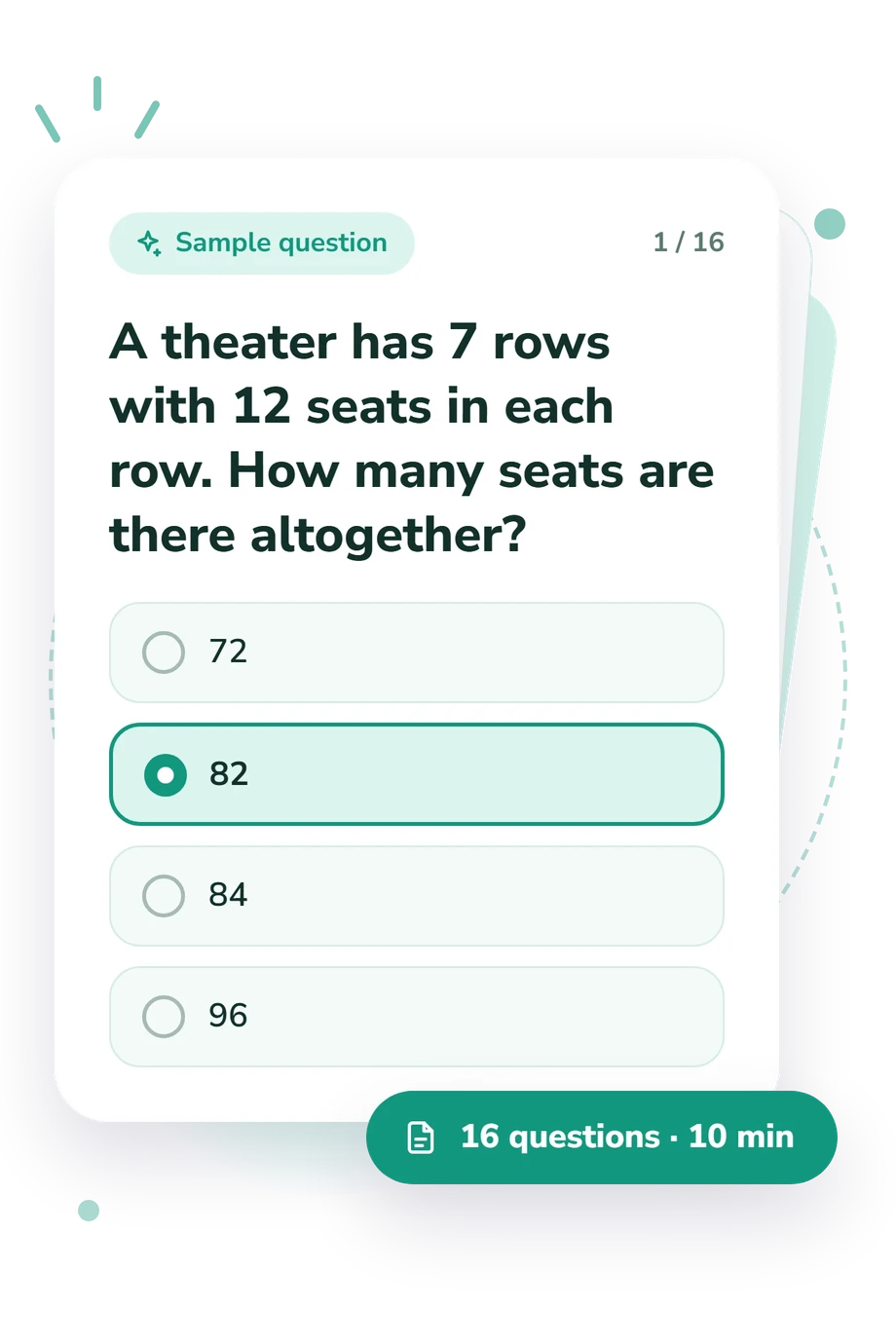
- 72
- 82
- 84
- 96
- $8
- $14
- $11
- $3
- 19
- 12
- 13
- 15
Mental Math Quiz - Description and methodology of the test
People choosing how to approach their numeracy learning can use this mental math quiz as a focused skills check. As a mental arithmetic quiz, it suits learners and adults who want a clear starting point for deciding whether to revisit fundamentals or take on more demanding work. The displayed result can support that next-step decision.
What This Assessment Explores
Items cover direct operations and familiar applications involving multiplication, subtraction, division, averages, percentages, fractions, rates, money, and estimation. The mix captures both basic fact fluency and flexible calculation when numbers appear in practical contexts.
The single Mental Math Knowledge scale runs from 0-16 and is shown in three bands:
- Foundations to Strengthen (0-6) means core calculations may need extra practice with tens, halves, and familiar facts.
- Developing Fluency (7-12) means many common problems are accurate, while percentages, fractions, or multistep work may need more consistency.
- Strong Knowledge (13-16) means calculation is accurate and flexible across direct and applied problems.
For someone using a mental calculation test to plan practice, the result indicates whether to reinforce foundations, build consistency, or extend reliable skills. It reflects current task performance, not fixed intelligence or mathematical potential.
Methodology and Scientific Basis
Each question presents a numerical problem with four answer choices. The set combines exact calculations, short equations, and applied word problems, so the respondent selects an answer rather than describing a strategy. The result is shown on the displayed scale and organized into the published bands, providing practical feedback without specifying how individual responses are weighted.
KTEA-3 provides a relevant achievement-testing comparison, while the study by Goettfried and colleagues examines arithmetic proficiency through cognitive and subjective influences. This questionnaire is conceptually consistent with those works, but it is not an adaptation of either one. The PIAAC Cycle 2 numeracy framework likewise supports reading the items as applied mathematics in everyday situations.
For a reader considering a mental math assessment, this questionnaire is an online skills check; read the result through the displayed bands because attention, anxiety, familiarity with the content, and willingness to work mentally can affect a single sitting, making it a snapshot alongside broader learning evidence.
- Kaufman, A. S., & Kaufman, N. L. (with Breaux, K. C.). (2014). Technical & interpretive manual. Kaufman Test of Educational Achievement, Third Edition. Bloomington, MN: NCS Pearson.
- Goettfried, E., Thaler, K., Delazer, M., Basso, D., Piazza, M., Knoflach, M., & Zamarian, L. (2025). Arithmetic Proficiency Across Adulthood: Cognitive and Subjective Influences. European Journal of Investigation in Health, Psychology and Education, 15(5), 84. 10.3390/ejihpe15050084
- Tout, D., Demonty, I., Díez-Palomar, J., Geiger, V., Hoogland, K., & Maguire, T. (2021). PIAAC Cycle 2 assessment framework: Numeracy. In OECD, The Assessment Frameworks for Cycle 2 of the Programme for the International Assessment of Adult Competencies. OECD Publishing. 10.1787/4bc2342d-en
Updated: