
First 30 Elements of the Periodic Table Quiz
How the Scales are Structured
Who Usually Takes This Test?
See How You Compare
Below is a preview of how scores are typically distributed across each scale.
Example Questions From the Test
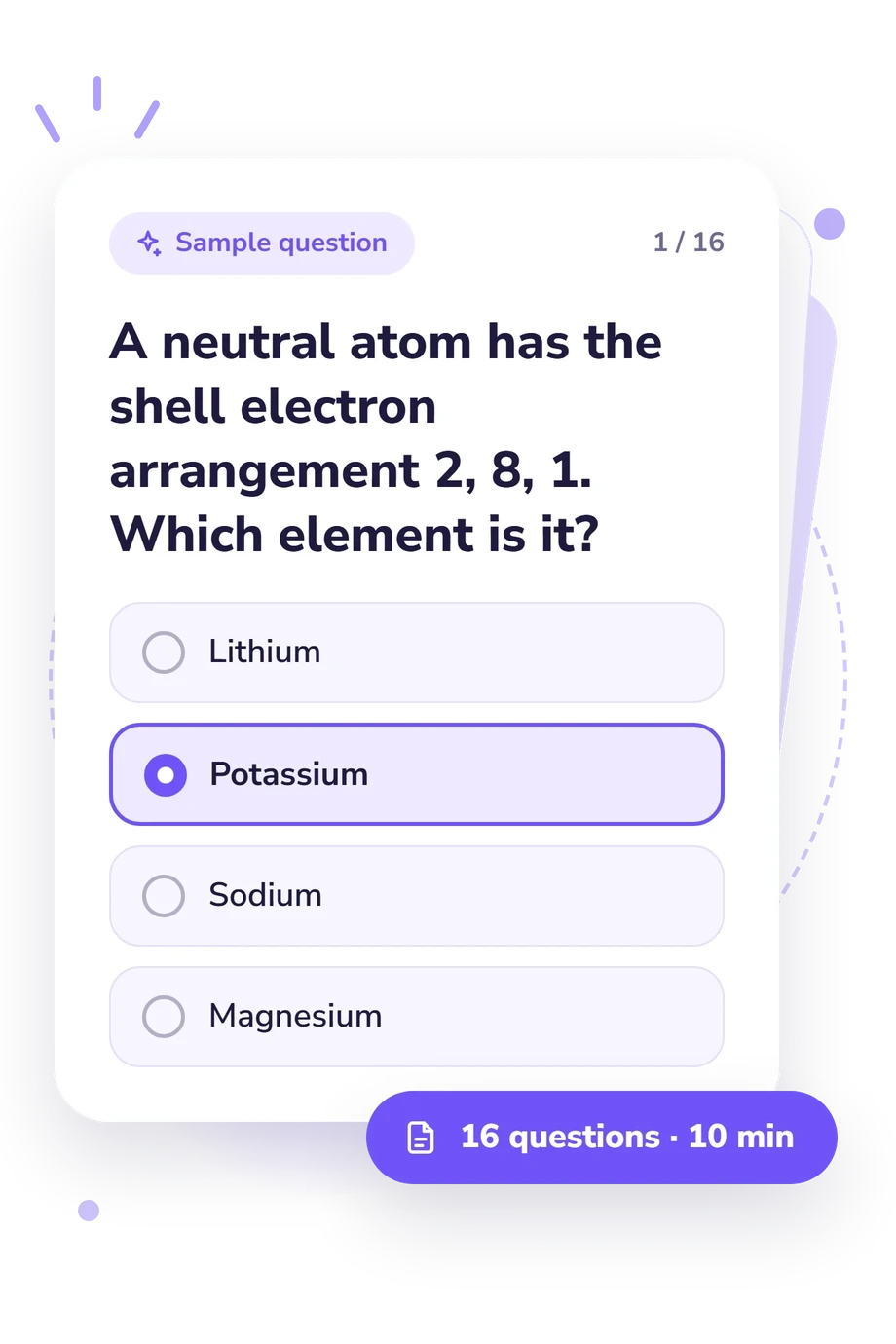
- Lithium
- Potassium
- Sodium
- Magnesium
- Copper
- Nickel
- Zinc
- Gallium
- 6
- 8
- 9
- 10
First 30 Elements of the Periodic Table Quiz - Description and methodology of the test
Learners reviewing introductory chemistry can use this first 30 elements of the periodic table quiz to decide which foundational topics deserve more study before moving on to bonding or reactivity. As a first 30 elements test, it can help identify a sensible starting point when later chemistry lessons feel less secure.
What This Test Measures
The questions focus on the knowledge needed to navigate atomic numbers 1-30. They cover element names and symbols, proton and electron counts, simple ions, occupied shells, atomic-number order, periods, groups, halogens, and early transition metals. Questions about the first 30 elements ask learners to recall and apply facts in short chemistry situations, which is the practical focus of this first 30 elements quiz.
The result uses one scale, First 30 Elements Knowledge (0-16), with three bands:
- Building Foundations (0-6) indicates recognition of some key elements but a need to review names, symbols, and order.
- Developing Knowledge (7-12) shows useful recall and application of several periodic-table patterns, with gaps remaining.
- Strong Command (13-16) reflects accurate, flexible knowledge across recall and application tasks.
Methodology and Evidence Base
Each item presents a stem with four answer choices. Some test direct recall, such as identifying hydrogen or sodium's symbol; others require inferences about ions, electron shells, group membership, or atomic-number order. This periodic table of elements quiz 1 30 mixes memory with elementary application.
Scoring is reported as one knowledge result, not separate trait scores. The displayed range and bands are stated, but no weighting for individual answers is specified; read the result as a performance category.
The evidence base is conceptual: this online questionnaire has no established reliability or norms. Okuo (2026) links periodic-table performance with retrieval demands, matching items that ask learners to retrieve names, symbols, and ordered facts. Wang et al. (2017) developed a related instrument for chemical-symbol representation, while Eggen et al. (2017) address alternative conceptions in chemistry. Together, these sources describe knowledge demands relevant to selected-response items that sample recognition and application across direct identification, relational reasoning, and ordered recall.
The resulting band can guide review of symbols, atomic-number order, ions, or periodic patterns before more advanced chemistry.
- Victor A. Okuo. "Student Familiarity with the Periodic Table of the Elements: Results from Cued-Recall and Eye-Tracking Assessments on Memory." Doctoral dissertation, University of Kentucky, 2026. 10.13023/etd.2026.310
- Zuhao Wang, Shaohui Chi, Ma Luo, Yuqin Yang, and Min Huang. "Development of an instrument to evaluate high school students' chemical symbol representation abilities." Chemistry Education Research and Practice, 18(4), 875-892, 2017. 10.1039/C7RP00079K
- Per-Odd Eggen, Jonas Persson, Elisabeth Egholm Jacobsen, and Bjørn Hafskjold. "Development of an inventory for Alternative Conceptions among students in chemistry." LUMAT: International Journal on Math, Science and Technology Education, 5(1), 1-11, 2017. 10.31129/LUMAT.5.1.115
Updated: