
Is My Crush My Soulmate Quiz
How the Scales are Structured
Who Usually Takes This Test?
See How You Compare
Below is a preview of how scores are typically distributed across each scale.
Example Questions From the Test
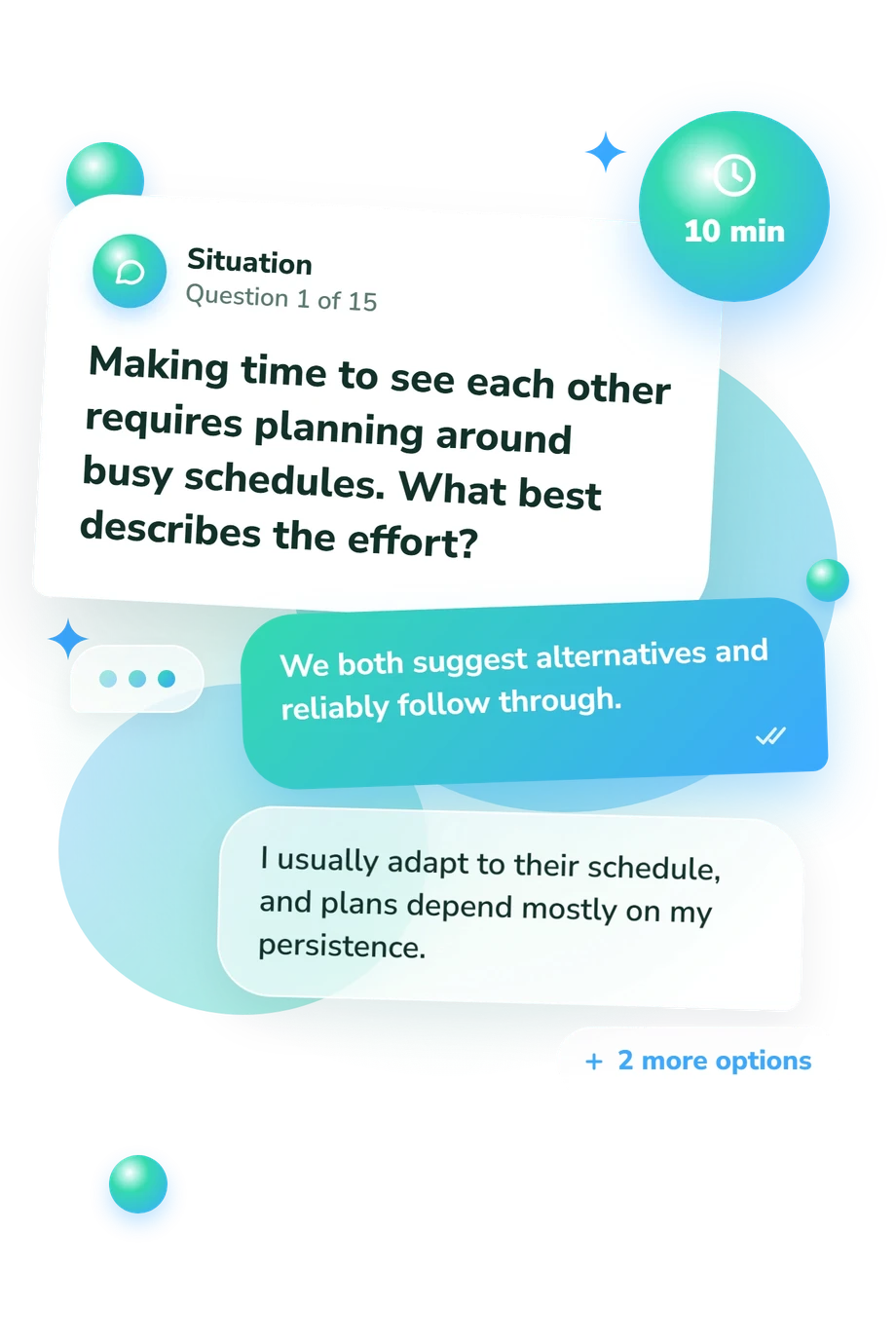
- We both suggest alternatives and reliably follow through.
- I usually adapt to their schedule, and plans depend mostly on my persistence.
- They show interest, but concrete planning is inconsistent.
- We both make some effort, although logistics occasionally interrupt momentum.
- There are signs we are both available, but one important uncertainty remains.
- At least one of us appears unavailable, committed elsewhere, or not ready to explore it.
- We both appear available and have shown openness to building something real.
- I do not yet know their situation or intentions clearly enough to tell.
- We could discuss both needs and find a rhythm that respects each person.
- I would probably hide my preference to avoid seeming demanding.
- We might find a compromise, though one of us could remain dissatisfied.
- I do not know enough about how either of us handles boundaries.
Is My Crush My Soulmate Quiz - Description and methodology of the test
People who feel strong attraction but want a reality-based view can use the Is My Crush My Soulmate Quiz to examine what is known, what is assumed, and what signs are genuinely reciprocal. It suits anyone reflecting on a developing connection, whether contact is frequent or limited. As a quiz about whether your crush is your soulmate, the assessment turns romantic uncertainty into concrete areas for reflection.
What This Assessment Explores
The questionnaire examines whether attraction has observable foundations, not whether soulmate language predicts a future. Items address values, routines, availability, boundaries, initiative, openness, awkward moments, and your view of that person beyond standout traits. It turns compatibility with a crush into questions about knowledge and two-way behavior.
The three displayed scales describe distinct parts of the result:
- Grounded Compatibility (0-15) reflects fit: Largely Imagined Fit (0-5) suggests idealization, Promising Overlap (6-10) shows fit with gaps, and Grounded Alignment (11-15) indicates workable everyday alignment.
- Mutual Connection (0-15) reflects reciprocity: Mostly Unclear (0-5) means limited evidence, Emerging Connection (6-10) means developing interest, and Strong Reciprocity (11-15) means consistent openness.
- Relationship Potential (0-15) reflects whether current timing, availability, communication, and shared effort could support an actual relationship: Limited Foundation (0-5) means barriers or one-sided effort, Possible but Unsettled (6-10) means action is still needed, and Tangible Potential (11-15) means stronger conditions.
Methodology and Scientific Basis
Each item presents a situation with four response choices describing mutual engagement, uneven effort, uncertainty, or limited knowledge. You choose the description closest to the current pattern. The answers produce three scores with displayed bands; because no per-answer point rule is stated, interpret results through the reported ranges rather than a guessed formula.
Methodologically, it is conceptually consistent with Romantic Chemistry (RoCh) Scale (Tu et al., 2026), a multidimensional account of connection. Liepmann et al. (2025) identify lay themes of attraction, reciprocity, and relational meaning. Being heard, remembered, understood, and met with openness overlaps with the Perceived Partner Responsiveness Scale (Reis et al., 2018); commitment and investment constructs from the Investment Model Scale (Rusbult et al., 1998) are not directly measured.
These sources do not make this questionnaire an adaptation, validation, or standardized administration of those instruments. For someone wondering whether a crush could become lasting, the assessment offers a snapshot of a crush’s relationship potential, not a verdict about destiny or another person’s feelings. Hope and present emotion can shape self-report, so compare the profile with observed communication.
- Tu, Eric, Alexandra Liepmann, Jenny Diem Van Le, Harry Reis, and Amy Muise. (2026). Components of Connection: Development and Validation of the Romantic Chemistry (RoCh) Scale in Single and Partnered Community Samples. PsyArXiv preprint. 10.31234/osf.io/6cxdn_v1
- Liepmann, Alexandra, Eric Tu, and Amy Muise. (2025). A Content Analysis of Lay Definitions of Romantic Chemistry. Archives of Sexual Behavior, 54(3), 943-956. 10.1007/s10508-025-03105-6
- Reis, Harry T., Dev Crasta, Ronald D. Rogge, Michael R. Maniaci, and Cheryl L. Carmichael. (2018). Perceived Partner Responsiveness Scale. In The Sourcebook of Listening Methodology & Measurement, 516-521. Wiley. 10.1002/9781119102991.ch57
- Rusbult, Caryl E., John M. Martz, and Christopher R. Agnew. (1998). The Investment Model Scale: Measuring commitment level, satisfaction level, quality of alternatives, and investment size. Personal Relationships, 5(4), 357-387. 10.1111/j.1475-6811.1998.tb00177.x
Updated: