
Electricity Quiz
How the Scales are Structured
Who Usually Takes This Test?
See How You Compare
Below is a preview of how scores are typically distributed across each scale.
Example Questions From the Test
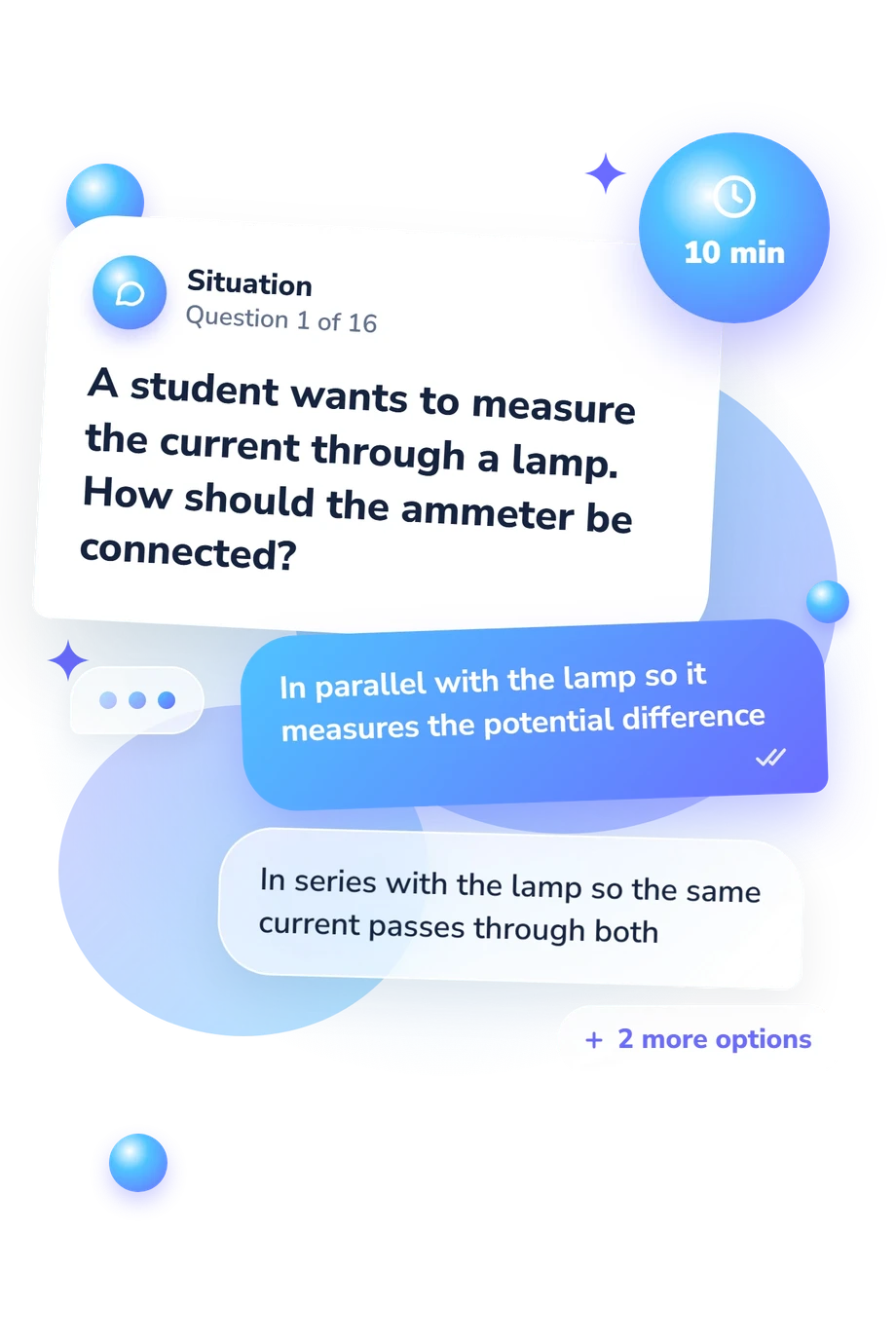
- In parallel with the lamp so it measures the potential difference
- In series with the lamp so the same current passes through both
- Across the battery without any other component
- Beside the circuit without making electrical contact
- In series before the resistor
- In parallel across the resistor
- In place of the power source
- Between two points on the same uninterrupted wire
- Farad
- Tesla
- Ohm
- Henry
Electricity Quiz - Description and methodology of the test
People checking their grasp of school-level electricity can use the electricity quiz to review core concepts and identify areas that deserve more study. As a basic electrical quiz, it suits learners revising physics, teachers wanting a compact classroom check, and curious readers seeking a structured snapshot of how they reason about familiar electrical situations. The result points to strengths and gaps across definitions, calculations, and circuit behavior.
What This Assessment Explores
The questions cover current, voltage, resistance, charge, power, and energy, linking definitions and units with calculations.
Taken together, these themes make the test an electricity concepts quiz that links formulas with physical situations. The result groups performance into areas:
- Quantities and units show how you connect terms with amperes, volts, ohms, coulombs, and watts.
- Circuit behavior indicates how you predict current and voltage in series and parallel arrangements.
- Measurement and protection reflect understanding of meter connections, fuses, short circuits, and component safety.
- Energy and applications show how you use power, energy, transformer ratios, and electrostatic ideas.
Electricity Knowledge runs from 0-16: Foundations to build (0-6) signals review of quantities, units, and circuit behavior; Developing understanding (7-12) shows many principles with some gaps; Strong command (13-16) shows consistent understanding across concepts and applications.
Methodology and Scientific Basis
Each item presents a definition, calculation, or circuit scenario with four answer choices. You select a unit, numerical result, connection method, explanation, or predicted outcome. The set combines recall with applications of Ohm’s law, power relationships, series and parallel rules, and basic electrostatic reasoning.
The scoring combines selected answers into the displayed result. Reviewing missed concepts can reveal gaps in formulas, units, circuit models, or vocabulary and guide targeted revision.
The methodology is conceptually consistent with BEAST (Groß et al., 2026), a research instrument focused on simple electric-circuit reasoning. Maloney et al. (2001) addresses conceptual electricity and magnetism knowledge, while Engelhardt and Beichner (2004) examine direct-current resistive circuits. This questionnaire is not an adaptation of those instruments or a documented standardized administration.
For readers using this electrical knowledge quiz to plan study, revisiting the principles behind missed answers is more useful than treating one band as a complete profile. Because the fixed-choice format depends on self-report, guessing, prior instruction, and wording can affect the result, which summarizes quiz performance rather than practical wiring skill or professional qualification.
- Groß, Benjamin, Lana Ivanjek, Salome Flegr, Judith Glaesser, Augustin Kelava, and Jan-Philipp Burde. “Development and validation of a two-tier test instrument on simple electric circuits.” Physical Review Physics Education Research 22, 010105 (2026). 10.1103/mf6b-5xcs
- Maloney, David P., Thomas L. O’Kuma, Curtis J. Hieggelke, and Alan Van Heuvelen. “Surveying students’ conceptual knowledge of electricity and magnetism.” American Journal of Physics 69 (7), S12-S23 (2001). 10.1119/1.1371296
- Engelhardt, Paula V., and Robert J. Beichner. “Students’ understanding of direct current resistive electrical circuits.” American Journal of Physics 72 (1), 98-115 (2004). 10.1119/1.1614813
Updated: