
Animal Identification Quiz
How the Scales are Structured
Who Usually Takes This Test?
See How You Compare
Below is a preview of how scores are typically distributed across each scale.
Example Questions From the Test
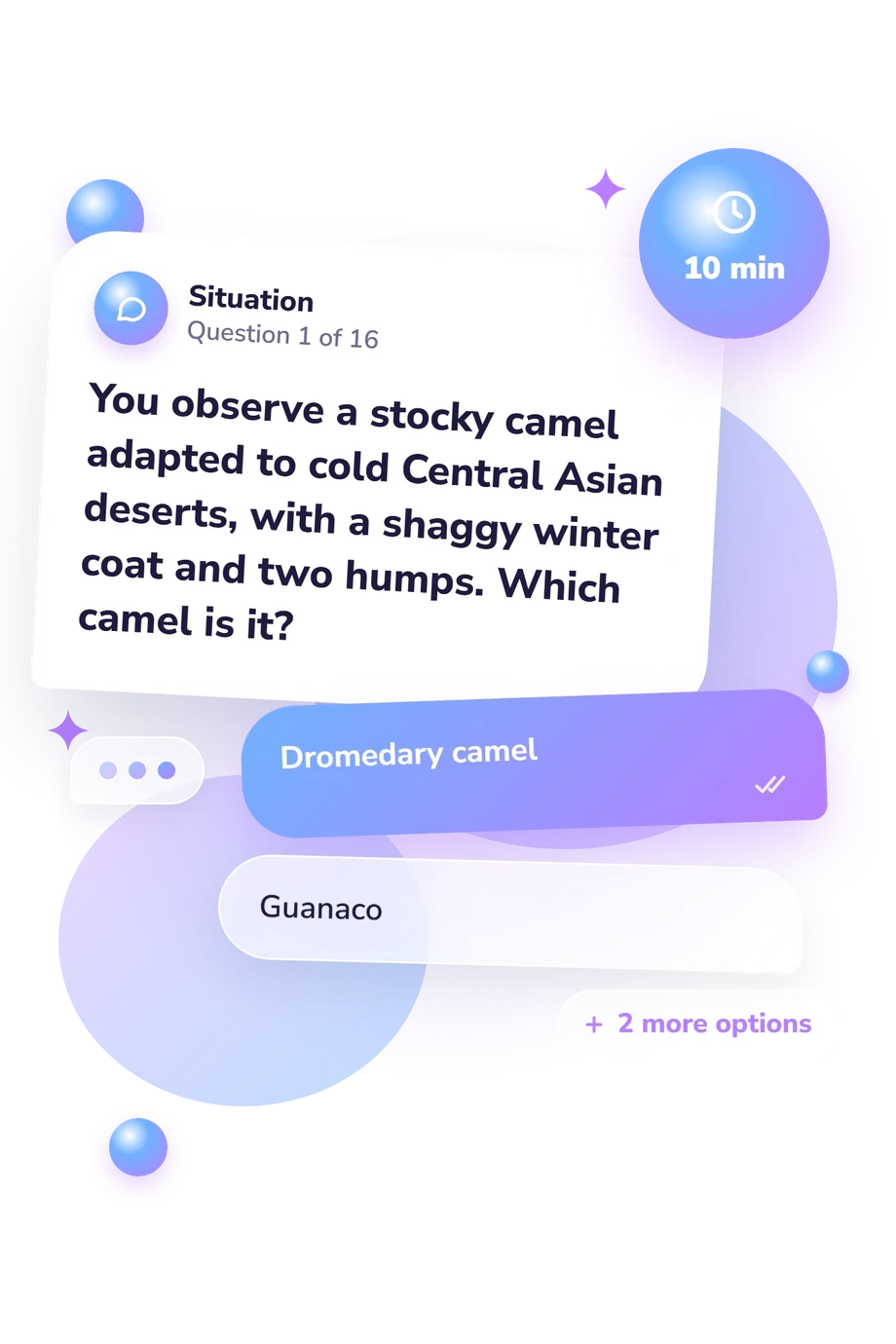
- Dromedary camel
- Guanaco
- Bactrian camel
- Llama
- Water rat
- Common wombat
- Short-beaked echidna
- Platypus
- Virginia opossum
- Striped skunk
- Raccoon
- American badger
Animal Identification Quiz - Description and methodology of the test
Deciding whether this kind of assessment suits your interests, you can use this animal identification quiz to examine clue-based recognition. It is intended for readers who enjoy natural history, field guides, or informal biology learning and want to strengthen animal recognition. Results show how reliably you connect visible evidence with an animal and which kinds of evidence deserve closer attention.
What This Assessment Explores
The breadth of the questions is central: prompts span mammals, birds, reptiles, amphibians, marine invertebrates, and insects, asking you to connect appearance, habitat, movement, life history, or tracks with the likeliest animal. That breadth makes the wildlife identification quiz useful to beginners and returning learners seeking a broad snapshot of observational knowledge.
The displayed scale is Animal Identification Knowledge (0-16). Building Foundations covers 0-6, Capable Identifier 7-12, and Skilled Identifier 13-16. These bands indicate increasing consistency in using specific clues across varied groups and habitats.
The main evidence themes are:
- Body form and coverings show how visible anatomy narrows the choices.
- Habitat, geography, and behavior reveal how context supports recognition.
- Life history, movement, tracks, and field signs show how non-appearance clues guide identification.
Methodology and Scientific Basis
Each item uses selected-response reasoning: a short description and four answer choices require you to compare alternatives rather than retrieve a label in isolation. Clues concern anatomy, adaptation, habitat, behavior, development, or tracks, making the animal id quiz a structured exercise in matching one option to the evidence presented.
Scoring is direct: every correct identification adds one point to the total. The result is descriptive feedback about current recognition performance. Species familiarity, attention, guessing, and interpretation of wording can affect performance.
The species-identification study by Hooykaas and colleagues links identification skill with deeper knowledge about species; this questionnaire is conceptually consistent with that work, not an adaptation of its study. Austen and colleagues address differences between expert and non-expert identification and the usefulness of visual evidence. The questionnaire's text-based format asks you to interpret written clues, so performance reflects matching descriptions to animals rather than observing them directly.
These descriptive bands work best as a focused learning snapshot. They can show which clues to practise, while a single result cannot represent the full breadth of field knowledge.
- Hooykaas, M. J. D., Schilthuizen, M., Albers, C. J., & Smeets, I. (2022). Species identification skills predict in-depth knowledge about species. PLOS ONE, 17(4), e0266972. 10.1371/journal.pone.0266972
- Crowley, E. J., Silk, M. J., & Crowley, S. L. (2021). The educational value of virtual ecologies in Red Dead Redemption 2. People and Nature, 3(6), 1229-1243. 10.1002/pan3.10242
- Austen, G. E., Bindemann, M., Griffiths, R. A., & Roberts, D. L. (2016). Species identification by experts and non-experts: Comparing images from field guides. Scientific Reports, 6, 33634. 10.1038/srep33634
Updated: