
Optimist or Pessimist Quiz
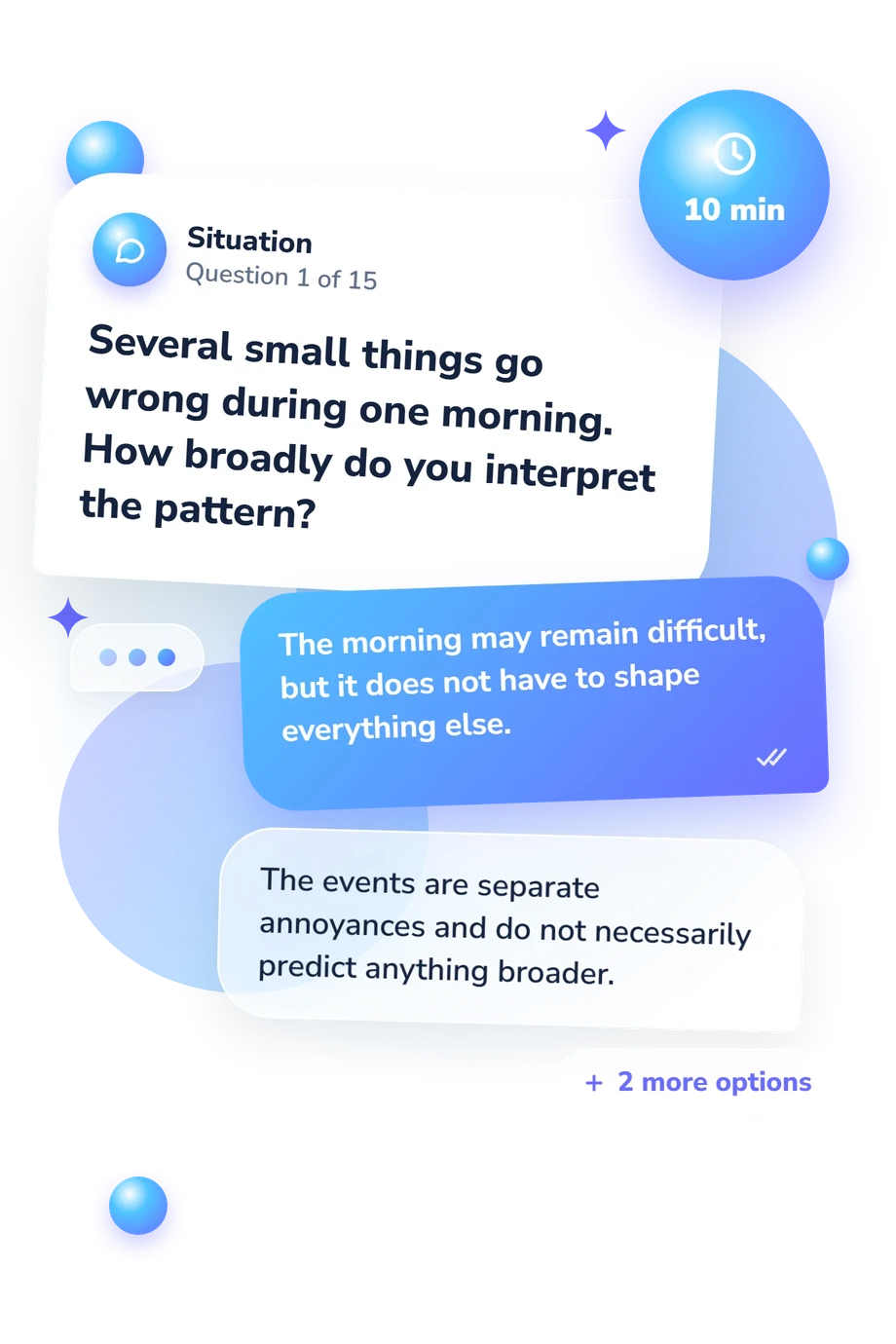
How the Scales are Structured
Who Usually Takes This Test?
See How You Compare
Below is a preview of how scores are typically distributed across each scale.
Example Questions From the Test
- I expect that someone else will get the offer.
- I think a rejection is somewhat more likely than an offer.
- I see it as a genuine toss-up until I hear back.
- I lean toward expecting a favorable response.
- Join in a low-pressure way that lets me learn gradually.
- Observe for now rather than risk feeling out of place.
- Participate only if a familiar person comes with me.
- Sign up and accept that I will be learning in front of others.
- Keep it to myself unless someone asks for suggestions.
- Share it early and invite others to help shape it.
- Test part of the idea or discuss it with one person first.
- Wait until I have stronger evidence that the group will approve.
Optimist or Pessimist Quiz - Description and methodology of the test
For readers who want to understand their everyday outlook, the optimist or pessimist quiz examines how they approach uncertainty, explain setbacks and successes, and anticipate what may happen next. It suits self-reflection when you want to notice recurring response patterns without turning them into a fixed identity label. It works as an am I optimistic quiz for readers who want the profile to reveal tendencies rather than force a single category.
What This Assessment Explores
Situations involving plans, work, relationships, goals, feedback, and uncertainty show how you engage with possibilities and explain outcomes. As an optimism quiz, it describes outlook tendencies, not competence or the wisdom of a choice. The result examines:
- Approach Under Uncertainty (0-15) shows willingness to engage: Guarded 0-5 conserves effort, Selective 6-10 takes measured chances, and Hopeful 11-15 pursues possibilities.
- Event Interpretation (0-15) shows how broadly setbacks are explained and successes credited: Pessimistic interpretation 0-5 sees setbacks as enduring, Contextual interpretation 6-10 weighs circumstances, and Optimistic interpretation 11-15 keeps setbacks specific and success repeatable.
- Future Expectations (0-15) shows what you predict: Cautious expectations 0-5 anticipate difficulty, Mixed expectations 6-10 allow for gains and problems, and Hopeful expectations 11-15 expect favorable outcomes.
The three dimensions keep those middle patterns distinct rather than combining them into one overall outlook label.
Methodology and Scientific Basis
Each item presents a familiar situation and four response options that vary in how broadly, personally, or hopefully it is interpreted. There is no factual answer to recall; the profile comes from the pattern of choices across situations. The result separates those patterns into three scores, each read through its own displayed band, rather than combining them into one overall label.
Conceptually, the questionnaire works as a pessimistic vs optimistic quiz, presenting a profile that aligns with the Positive and Negative Expectancy Questionnaire (Olason & Roger, 2001), which treats expectancy and adaptation as related but distinguishable aspects of outlook. Its themes also connect with Dember and colleagues’ optimism-pessimism measures, Scheier, Carver, and Bridges’ revised Life Orientation Test, and Peterson and colleagues’ Attributional Style Questionnaire. These works are conceptual reference points; they do not show that the online questionnaire reproduces their instruments, scoring, or validation.
The questionnaire displays defined bands for its three scores; interpret the profile alongside the situations that produced it. Self-report can be affected by current circumstances, memory, and self-awareness, so scores are best read as a context-sensitive snapshot rather than a diagnosis.
- Olason, Daniel Thor, and Derek Roger. (2001). Optimism, pessimism and “fighting spirit”: A new approach to assessing expectancy and adaptation. Personality and Individual Differences, 31(5), 755-768. 10.1016/S0191-8869(00)00176-8
- Dember, William N., Stephanie H. Martin, Mary K. Hummer, Steven R. Howe, and Richard S. Melton. (1989). The measurement of optimism and pessimism. Current Psychology, 8(2), 102-119. 10.1007/BF02686675
- Scheier, Michael F., Charles S. Carver, and Michael W. Bridges. (1994). Distinguishing optimism from neuroticism (and trait anxiety, self-mastery, and self-esteem): A reevaluation of the Life Orientation Test. Journal of Personality and Social Psychology, 67(6), 1063-1078. 10.1037/0022-3514.67.6.1063
- Peterson, Christopher, Amy Semmel, Carl von Baeyer, Lyn Y. Abramson, Gerald I. Metalsky, and Martin E. P. Seligman. (1982). The Attributional Style Questionnaire. Cognitive Therapy and Research, 6(3), 287-299. 10.1007/BF01173577
Updated: