
Lord of the Rings Race Quiz
How the Scales are Structured
Who Usually Takes This Test?
See How You Compare
Below is a preview of how scores are typically distributed across each scale.
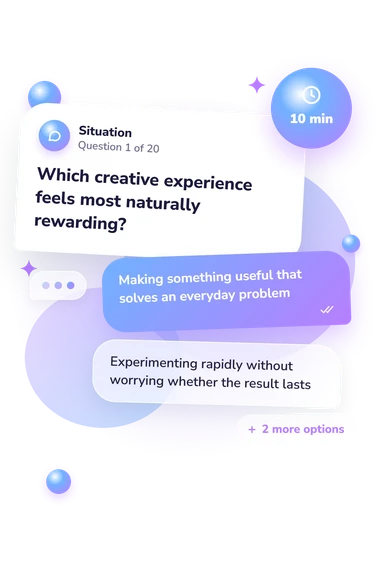
Example Questions From the Test
- Adapt it freely so it speaks to people now
- Preserve its words and history, then perform it with care
- Enjoy it once and move on to something new
- Save a copy in case someone asks about it later
- A belief that patient protection can matter across generations
- Visible short-term milestones that show the effort is working
- Steady improvement, even if the final result remains distant
- I would probably redirect my energy to a faster-moving project
- Visible enthusiasm and a steady flow of new ideas
- Quiet competence proved through demanding work
- Dependability, even when the person's skills are still developing
- A friendly manner that keeps disagreements from becoming heavy
Lord of the Rings Race Quiz - Description and methodology of the test
Readers who enjoy Tolkien’s cultures can use the Lord of the Rings Race Quiz as a playful character exercise. Its questions turn choices about craft, memory, patience, home, responsibility, and change into an affinity profile. It offers a symbolic snapshot of the qualities closest to your instincts, making this LOTR race personality quiz a reflection on values rather than a test of lore.
What This Assessment Explores
Five value patterns emerge from craft, memory, environmental care, hospitality, leadership, and change. The LOTR race quiz turns them into a symbolic profile:
- Dwarf Affinity (0-12) reflects craft, tradition, loyalty: Open-Handed Explorer 0-4; Hall-Friend 5-8; Dwarven Heart 9-12.
- Elf Affinity (0-12) reflects beauty, artistry, continuity: Mortal Tempo 0-4; Woodland Grace 5-8; Elven Spirit 9-12.
- Ent Affinity (0-12) reflects patience, rootedness, ecological care: Swift Wanderer 0-4; Forest Listener 5-8; Entish Nature 9-12.
- Hobbit Affinity (0-12) reflects home, hospitality, ordinary joys: Beyond the Shire 0-4; Shire-Kindred 5-8; Hobbit at Heart 9-12.
- Human Affinity (0-12) reflects adaptability, responsibility, hope: Outside the City Walls 0-4; Person of the Realms 5-8; Human of Middle-earth 9-12.
The highest score is strongest; scores within one point blend.
Methodology and Scientific Basis
Each item presents an everyday, ethical, or community situation with four responses. Across this Middle-earth race quiz, choosing the most natural reaction makes the exercise a structured self-report rather than a lore exam. Themes include repair, preservation, home, living systems, responsibility, and long-term purpose.
Responses produce five affinity totals, but no point value is stated for an individual option. The scoring is comparative: the highest total is strongest, while totals within one point indicate a blend. The questions ask how you balance preservation with change, personal comfort with public responsibility, and immediate action with long-term care.
The framework is literary rather than psychometric. It is conceptually consistent with Tolkien (1954-1955), Tolkien’s related Middle-earth narratives, and Dickerson and Evans’s environmental analysis. The questionnaire uses Middle-earth races as symbolic prompts; it is a Lord of the Rings quiz about Middle-earth races, not an adaptation or standardized form of Tolkien’s works.
The displayed bands are descriptive affinity labels, not population norms or clinical cutoffs; mood, circumstances, self-awareness, and self-presentation can affect self-report, so read the profile as a values snapshot rather than a diagnosis.
- Tolkien, J. R. R. The Lord of the Rings. London: George Allen & Unwin, 1954-1955.
- Tolkien, J. R. R. The Hobbit, or There and Back Again. London: George Allen & Unwin, 1937.
- Tolkien, J. R. R. The Silmarillion. Edited by Christopher Tolkien. London: George Allen & Unwin, 1977.
- Dickerson, Matthew, and Jonathan Evans. Ents, Elves, and Eriador: The Environmental Vision of J.R.R. Tolkien. Lexington: University Press of Kentucky, 2006. 10.2307/j.ctt2jctx1