
The Most Dangerous Game Quiz
How the Scales are Structured
Who Usually Takes This Test?
See How You Compare
Below is a preview of how scores are typically distributed across each scale.
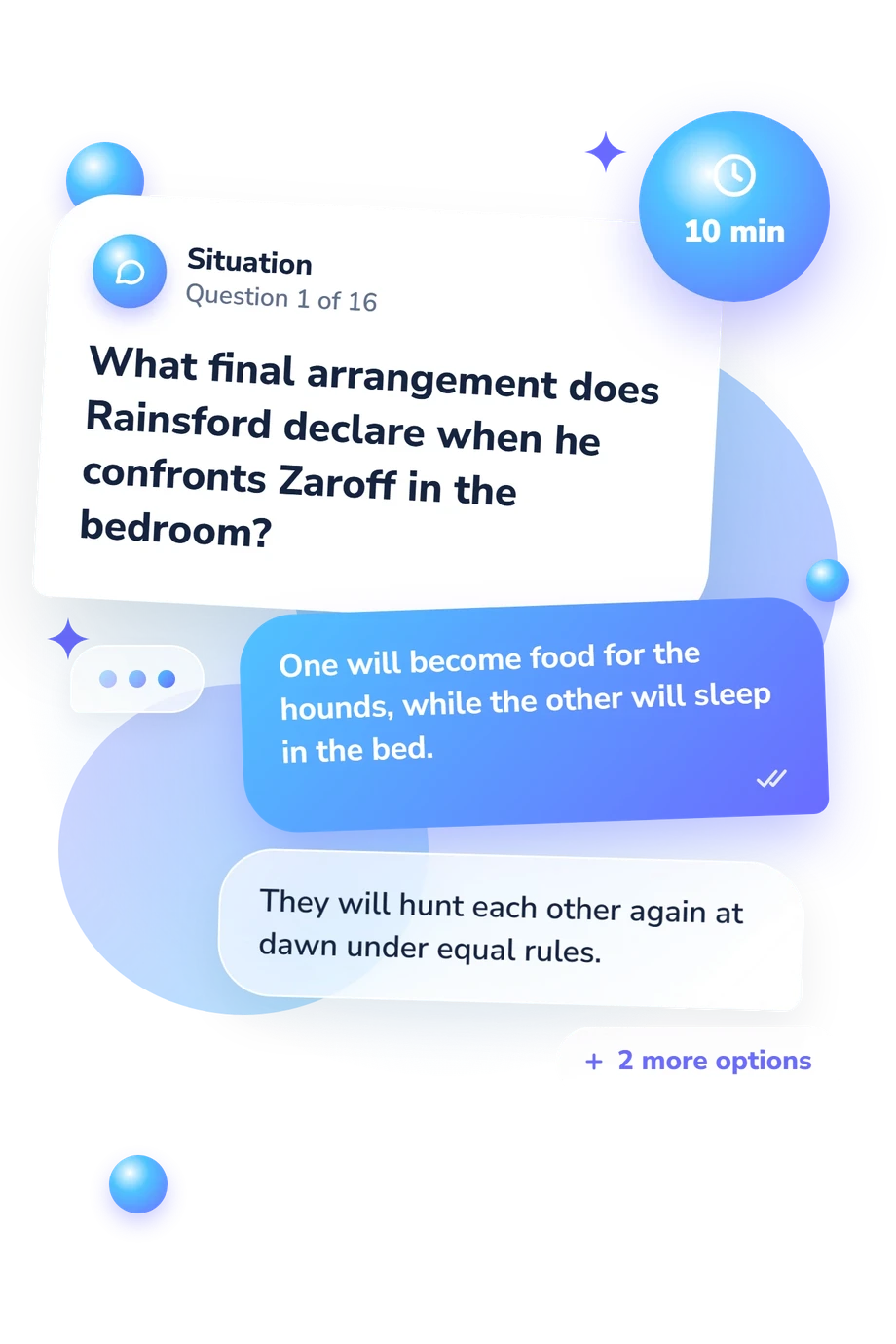
Example Questions From the Test
- Zaroff is injured badly enough to abandon the hunt.
- Ivan falls into it while leading the pack.
- One of Zaroff’s finest hunting dogs falls into it and is killed.
- The pit collapses before anyone reaches it.
- A lighthouse beam sweeping across the water
- Gunshots coming from the darkness
- Voices calling from a nearby fishing boat
- The yacht’s horn sounding behind him
- Zaroff’s younger brother and fellow hunter
- A shipwreck survivor who guides Rainsford inland
- Zaroff’s imposing Cossack servant, who cannot hear or speak
- The captain responsible for supplying Zaroff’s island
The Most Dangerous Game Quiz - Description and methodology of the test
Readers who know Richard Connell’s story can use the most dangerous game quiz to decide whether they remember its plot and understand its central ideas well enough to take the questions. With four options per item, this multiple-choice quiz on The Most Dangerous Game checks recall and interpretation. It suits students and book-club members seeking a focused check of events, motives, strategies, and irony.
What This Assessment Measures
The questionnaire tests close reading of the story’s sequence and turning points. It asks about Rainsford’s change from confident hunter to hunted survivor, Zaroff’s reasoning, Ivan’s role, the island, traps, pursuit, and the ending’s irony. The Most Dangerous Game questions examine recall and the ability to connect actions with motives or consequences. This suits readers who want to revisit the narrative and find details needing closer attention.
The displayed result uses one scale, The Most Dangerous Game Knowledge (0-16), with these bands:
- Revisit the Island (0-6) signals that key characters, events, or motives may need review.
- Tracking the Story (7-12) shows that most of the plot is understood, though some details remain elusive.
- Expert Hunter of Details (13-16) reflects strong command of events, methods, motives, and irony.
These bands summarize quiz performance, not knowledge of every adaptation.
Methodology and Evidence Base
Each item uses four answer choices and asks the reader to select the option that best matches Connell’s text. Scoring is direct: one point is awarded for each correct response, so the total reflects performance on story details and inferences, not a personality trait or clinical construct. The Most Dangerous Game test is an online literary-comprehension quiz drawn directly from the narrative.
Connell’s 1924 story supplies the content, including the plot, motives, hunting methods, setting, and final reversal tested by the questions. Thompson’s 2002 discussion helps frame the irony and role reversal, while Li Zao-xia and Luo Yong’s 2008 analysis supports attention to predator-prey relations and the moral consequences of treating life as sport. Together, these sources clarify the quiz’s literary focus; they do not establish psychometric properties for it.
Interpret results as a snapshot of recall and text-based reasoning. Rereading, memory, familiarity with an edition, or reliance on a film adaptation can affect performance. Its bands are descriptive performance levels for this set of questions, summarizing quiz results rather than establishing broader reading ability.
- Connell, Richard. "The Most Dangerous Game." In O. Henry Memorial Award Prize Stories of 1924, pp. 71-92. Garden City, NY: Doubleday, Page & Company, 1925.
- Thompson, Terry W. "Connell's The Most Dangerous Game." The Explicator, vol. 60, no. 2, 2002, pp. 86-88. 10.1080/00144940209597665
- Li Zao-xia and Luo Yong. "Eco-criticism on The Most Dangerous Game." Journal of Chang'an University (Social Science Edition), vol. 10, no. 1, 2008, pp. 121-124.
Updated: