
Cigar Quiz
How the Scales are Structured
Who Usually Takes This Test?
See How You Compare
Below is a preview of how scores are typically distributed across each scale.
Example Questions From the Test
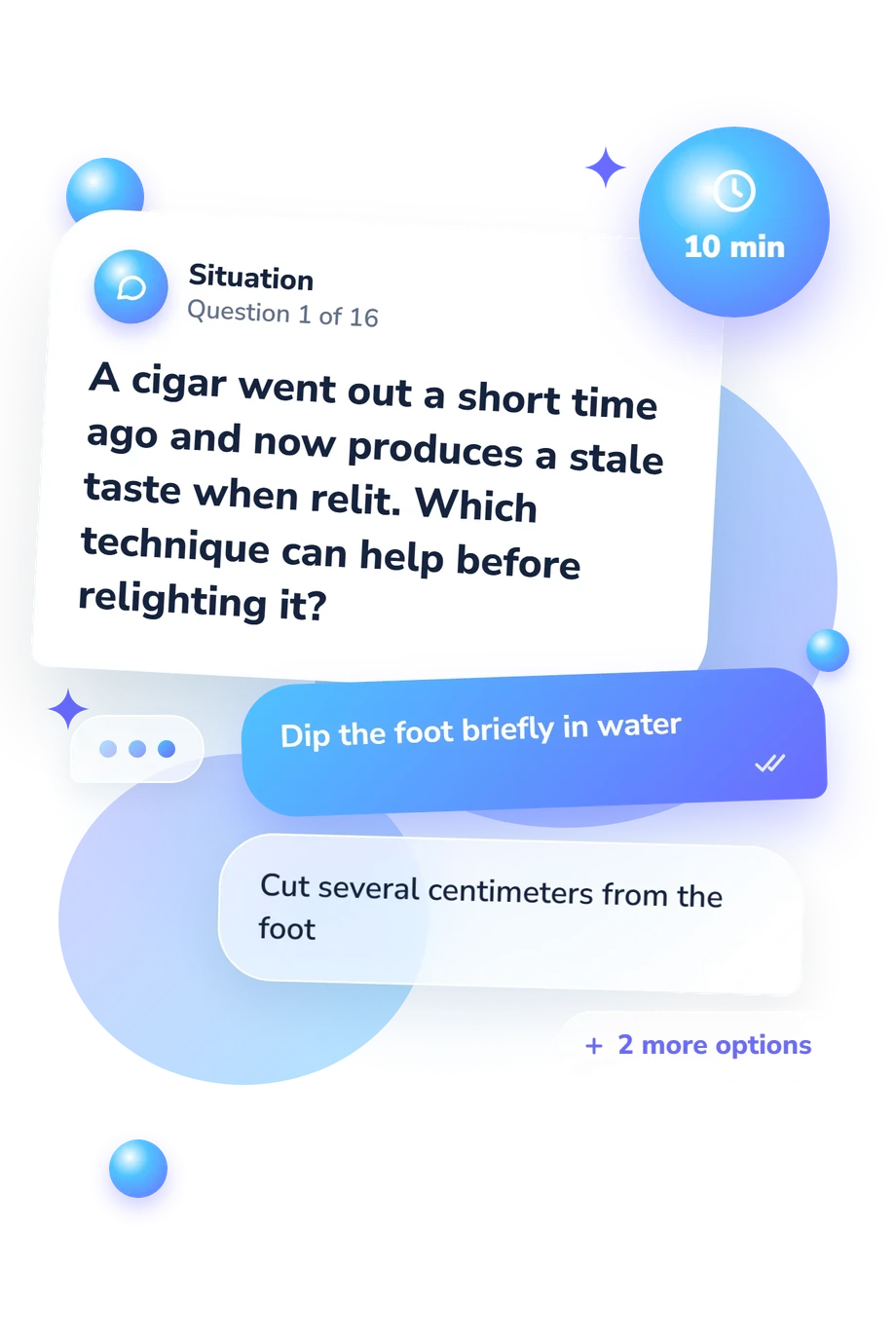
- Dip the foot briefly in water
- Cut several centimeters from the foot
- Gently blow through the cigar to purge trapped stale smoke
- Remove the wrapper from the extinguished section
- It was stored with too little tobacco nearby
- It has likely absorbed excessive moisture
- It was cut too close to the center of the cap
- Its wrapper is naturally darker than its filler
- It forms the cigar's central tobacco core
- It seals the smoking end before cutting
- It creates the finished outer appearance
- It protects the cigar from humidity changes
Cigar Quiz - Description and methodology of the test
People who want a clearer grasp of cigar basics can use this cigar quiz to check practical knowledge before choosing, preparing, storing, or tasting a cigar. It suits beginners and curious enthusiasts who want an educational result, not a personality profile. Readers can use the What Cigar Is Right for Me Quiz to identify which construction, storage, and handling facts matter when making a choice.
What This Assessment Explores
The questions cover practical knowledge of a traditional cigar: the head, foot, wrapper, binder, filler, ring gauge, fermentation, long-filler construction, cutting, lighting, retrohaling, and humidor conditions. Other items distinguish strength from body and recognize storage problems such as excess moisture or dryness. The practical focus lets this cigar basics quiz identify knowledge gaps rather than recommend a brand.
The displayed result uses one educational scale:
- Cigar Knowledge (0-16) shows how well the respondent recognizes cigar anatomy, handling, storage, terminology, and health facts. Foundations to build covers 0-6, Developing knowledge covers 7-12, and Strong knowledge covers 13-16.
This helps the reader choose what to review next. Lower bands point to foundational learning; higher bands indicate broader command of the tested concepts, not nicotine exposure or personal health risk.
Methodology and Scientific Basis
Each item uses a multiple-choice, one-best-answer format, mixing practical scenarios with direct knowledge questions about terminology, care, technique, construction, or health information. The options test recognition rather than personal preferences. The displayed result is an educational summary of performance interpreted through its displayed bands, not a cigar finder quiz for matching a reader with a product.
The cigar terminology and care content are conceptually consistent with Armenteros (2020), while the health statements are consistent with the National Cancer Institute (1998) and Baker et al. (2000), including their discussion of nicotine and harmful exposure associated with cigar smoking; avoiding intentional inhalation does not erase that exposure.
As a cigar knowledge test, the format depends on selected answers, so guessing, memory, familiarity with terminology, and current understanding can affect the result. The score summarizes performance on these topics only; it does not measure smoking behavior or establish medical risk. Careful reading of distinctions between answer options makes the score more useful for focused learning.
- Armenteros, Jorge. The Tobacconist Handbook: An Essential Guide to Cigars & Pipes. Skyhorse Publishing, 2020.
- National Cancer Institute. Cigars: Health Effects and Trends. Tobacco Control Monograph No. 9. Bethesda, MD: U.S. Department of Health and Human Services, National Institutes of Health, National Cancer Institute, 1998. NIH Publication No. 98-4302.
- Baker, Frank, Stuart R. Ainsworth, Joseph T. Dye, Corinne Crammer, Michael J. Thun, Dietrich Hoffmann, James L. Repace, Jack E. Henningfield, John Slade, John Pinney, Thomas Shanks, David M. Burns, Gregory N. Connolly, and Donald R. Shopland. "Health Risks Associated With Cigar Smoking." JAMA 284, no. 6 (2000): 735-740. DOI 10.1001/jama.284.6.735
Updated: