
What Holiday Am I Quiz
How the Scales are Structured
Who Usually Takes This Test?
See How You Compare
Below is a preview of how scores are typically distributed across each scale.
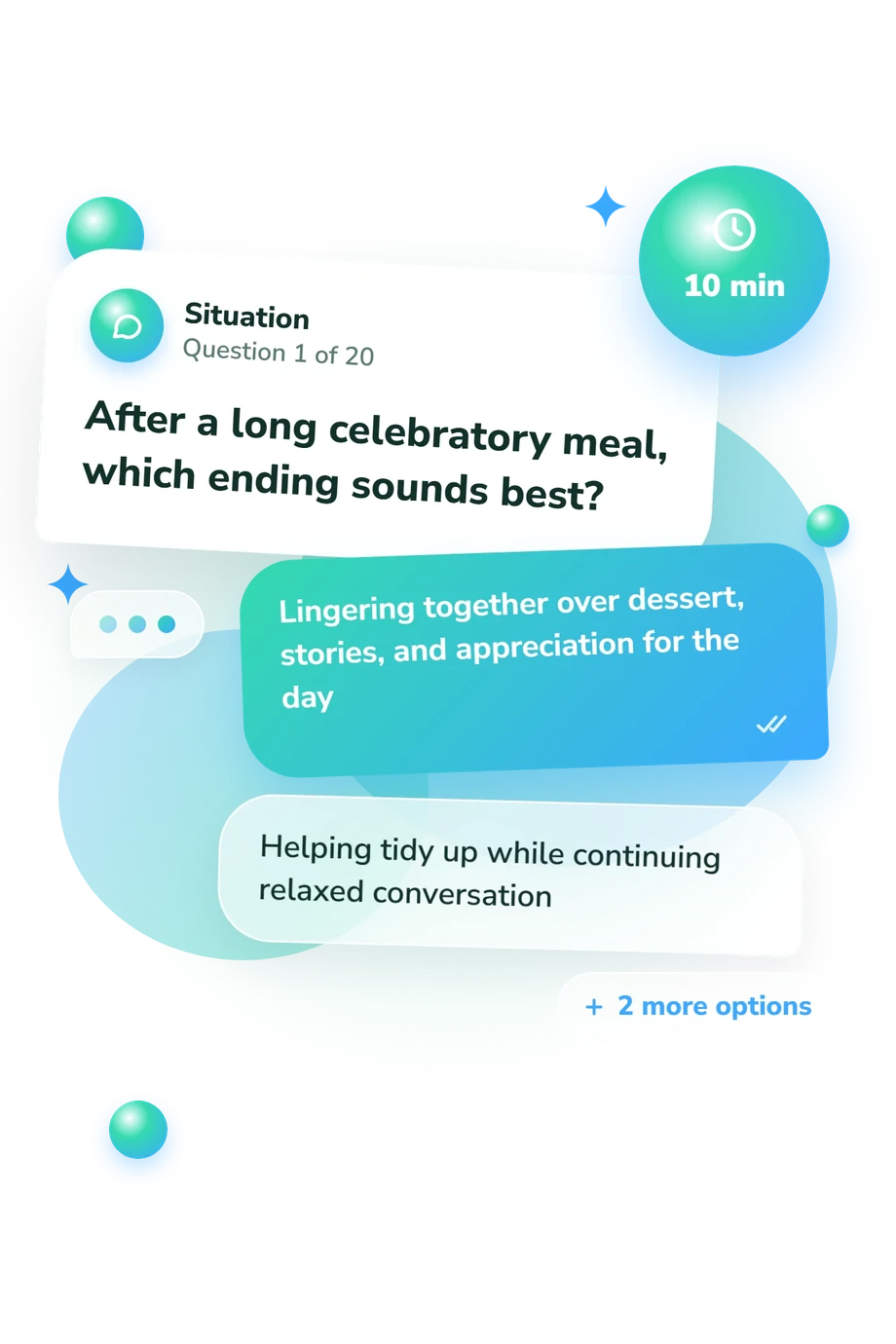
Example Questions From the Test
- The collective rush of crossing a symbolic threshold together
- The hopeful atmosphere and permission to imagine something new
- The novelty of the moment, even if it changes little afterward
- I find quieter, less scheduled transitions more meaningful
- An immersive scene with lighting, props, and a surprising detail
- A bold display built around one spooky or whimsical theme
- A few autumn accents with a subtle Halloween reference
- A clean seasonal arrangement without costumes or spooky imagery
- Adapt it carefully so its meaning and familiar features remain
- Create a cozy alternative that captures some of the same feeling
- Keep one small piece of it while embracing the changed plan
- Welcome the chance to do something completely different
What Holiday Am I Quiz - Description and methodology of the test
For people who enjoy comparing the feelings and rituals behind major celebrations, the What Holiday Am I Quiz offers a structured way to see which occasions fit their preferences. As a holiday personality quiz, it suits anyone wondering whether they lean toward tradition, theatrical play, affection, gratitude, or renewal. The result gives a comparative profile rather than assigning a single identity or ranking one holiday above another.
What This Assessment Explores
People connect with celebrations through meanings. These scenarios sample meals, rituals, decorations, costumes, countdowns, gifts, gratitude, and affection. The scales describe preferences, not holiday knowledge or personality types.
The dimensions are:
- Christmas measures warmth, generosity, and tradition-Independent Spirit 0-4; Cozy Celebrant 5-8; Christmas Kindred 9-12.
- Halloween measures imagination, transformation, and playful eeriness-Grounded Observer 0-4; Curious Creator 5-8; Halloween Kindred 9-12.
- New Year’s Eve measures renewal, anticipation, and celebratory momentum-Steady Navigator 0-4; Fresh-Start Fan 5-8; New Year Kindred 9-12.
- Thanksgiving measures gratitude, hospitality, and shared abundance-Flexible Gatherer 0-4; Gracious Guest 5-8; Thanksgiving Kindred 9-12.
- Valentine’s Day measures affection, symbolism, and intentional appreciation, including non-romantic love-Everyday Affection 0-4; Thoughtful Heart 5-8; Valentine Kindred 9-12.
As a holiday preference quiz, it compares themes; close results suggest a blended occasion.
Methodology and Scientific Basis
Each question presents a social or seasonal situation with four response choices. The options span strong engagement with a celebratory theme, moderate participation, low-key involvement, or preference for an unrelated activity. This self-report format asks respondents to recognize their reactions rather than demonstrate holiday knowledge. In this what holiday are you quiz, the choices become a comparative profile across the displayed dimensions.
Results are reported separately for each dimension. Because the questionnaire does not specify a universal point value for every answer, scoring should be read through the shown bands rather than reverse-engineered. Outcomes within one point may be combined, allowing a blended match.
The closest named comparison is the Holiday Preference Scale (Eachus, 2004), but this online questionnaire is not presented as its adaptation or standardized version. Research by Sezer and colleagues on family rituals and by Hobson and colleagues on ritual processes provides context for repetition, symbolism, anticipation, and shared participation.
Scores can vary with mood, memories, relationships, culture, and self-awareness, so the result is best treated as a current preference profile. It is an online self-reflection questionnaire, not a diagnostic method.
- Eachus, Peter. “Using the Brief Sensation Seeking Scale (BSSS) to predict holiday preferences.” Personality and Individual Differences, vol. 36, no. 1, 2004, pp. 141-153. 10.1016/S0191-8869(03)00074-6
- Sezer, Ovul, Michael I. Norton, Francesca Gino, and Kathleen D. Vohs. “Family Rituals Improve the Holidays.” Journal of the Association for Consumer Research, vol. 1, no. 4, 2016, pp. 509-526. 10.1086/688495
- Hobson, Nicholas M., Juliana Schroeder, Jane L. Risen, Dimitris Xygalatas, and Michael Inzlicht. “The Psychology of Rituals: An Integrative Review and Process-Based Framework.” Personality and Social Psychology Review, vol. 22, no. 3, 2018, pp. 260-284. 10.1177/1088868317734944
Updated: