
Drink Quiz
How the Scales are Structured
Who Usually Takes This Test?
See How You Compare
Below is a preview of how scores are typically distributed across each scale.
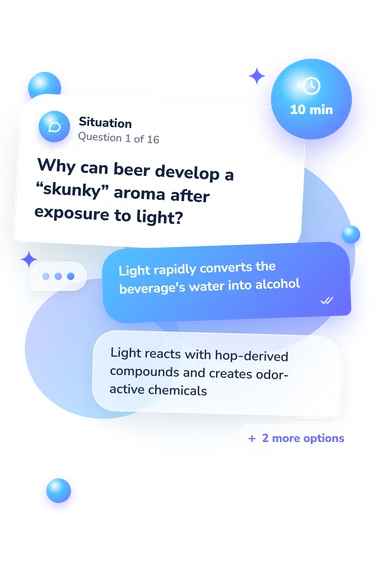
Example Questions From the Test
- Quinine
- Juniper
- Tannic acid
- Gingerol
- Place a metal spoon in the neck instead of sealing it
- Leave it upright and uncovered at room temperature
- Seal it with a sparkling-wine stopper and refrigerate it
- Pour it into a wide decanter before refrigerating it
- Jigger
- Hawthorne strainer
- Muddler
- Bar spoon
Drink Quiz - Description and methodology of the test
For learners who want to connect everyday beverage decisions with the reasons behind them, this drink quiz offers a focused check of practical understanding. It is intended for curious consumers, students, home drink makers, and anyone reviewing preparation or storage basics. The result can show which topics feel secure and where a beverage knowledge quiz points toward useful further study.
What This Assessment Measures
Questions cover beverage chemistry, preparation, equipment, storage, and everyday choices rather than taste preferences or drinking frequency. Scenarios test light exposure, fermentation, cocktail tools, brewing, chilling, hydration, lactose, caffeine, carbonation, and ingredient checks when alcohol must be avoided.
The result brings these themes into one educational profile:
- Drink Knowledge (0-16) measures preparation, ingredients, storage, and handling: Foundation (0-6) marks basics to review, Developing (7-12) shows useful coverage, and Strong (13-16) indicates broad, reliable understanding.
- Preparation and technique show whether tools and methods are linked to the intended result.
- Ingredients and chemistry show how well components and processes are connected to flavor, safety, or function.
- Storage and choices show practical judgment about light, sealing, hydration, and alcohol content.
Used as a drink knowledge test, the profile highlights confident topics and areas for targeted review. Its educational bands do not measure expertise, sobriety, tolerance, or clinical or legal safety.
Methodology and Evidence Base
Each item presents a factual question or brief scenario with four answer choices. The respondent selects the best answer, and the displayed score is interpreted within the stated range; no separate weighting rule is documented, so point values should not be inferred from band widths. This is a straightforward knowledge-check format rather than a personality or drinking-behavior inventory.
Varnam and Sutherland (1994) provide the closest conceptual reference for beverage composition, processing, microbiology, and storage. Mosher and Trantham (2021) support the brewing and fermentation content, while Morgenthaler and Holmberg (2014) support cocktail tools and techniques. The questionnaire is conceptually consistent with these works, not an adaptation of them.
The alcohol-related items make it a quiz about alcoholic drinks in a limited sense: they test fermentation, ingredient review, and preparation choices that help a person avoid unintended alcohol. That topic area does not make the score a measure of drinking behavior or safety.
Standards from AERA, APA, and NCME (2014) guide cautious interpretation of educational scores. This online questionnaire is not standardized or norm-referenced. Results can vary with guessing, attention, prior experience, and current context, so they are best used to direct learning and identify subjects for broader review.
- Varnam, Alan H., and Jane P. Sutherland. Beverages: Technology, Chemistry and Microbiology. Chapman & Hall, 1994. 10.1007/978-1-4615-2508-0
- Mosher, Michael, and Kenneth Trantham. Brewing Science: A Multidisciplinary Approach. 2nd ed. Springer, 2021. 10.1007/978-3-030-73419-0
- Morgenthaler, Jeffrey, with Martha Holmberg. The Bar Book: Elements of Cocktail Technique. Chronicle Books, 2014.
- American Educational Research Association, American Psychological Association, and National Council on Measurement in Education. Standards for Educational and Psychological Testing. AERA, 2014.