
West Coast EMT Block 3 Quiz
How the Scales are Structured
Who Usually Takes This Test?
See How You Compare
Below is a preview of how scores are typically distributed across each scale.
Example Questions From the Test
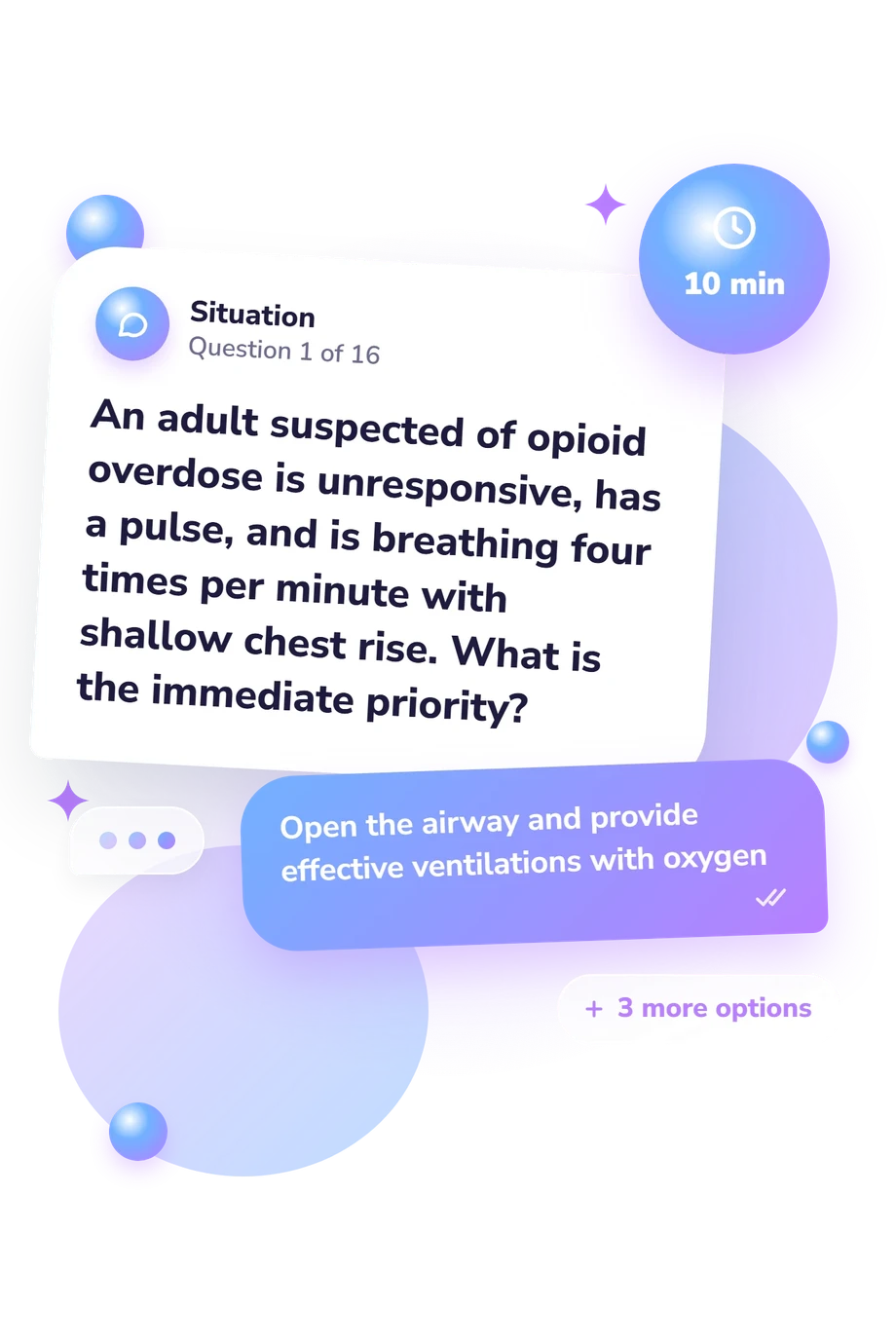
- Open the airway and provide effective ventilations with oxygen
- Administer naloxone before supporting breathing
- Place the patient upright to improve alertness
- Perform a detailed neurologic examination before intervening
- The patient reports a previous severe allergic reaction to aspirin
- The patient has prescribed nitroglycerin
- The discomfort began during physical activity
- The discomfort radiates into the left arm
- The last time the patient was known to be without these symptoms
- The time the patient last ate a full meal
- The time the patient went to bed, regardless of symptom status
- The time the ambulance arrived at the scene
West Coast EMT Block 3 Quiz - Description and methodology of the test
For learners deciding whether a written Block 3 self-check would help before revising specific topics, this assessment offers a focused way to test recognition and treatment-priority knowledge. The West Coast EMT Block 3 Quiz can support preparation for instructor discussion, skills practice, or protocol review. Used as an EMT Block 3 study guide, it can reveal concepts for another pass without treating the result as proof of field competence.
What This Assessment Explores
These items focus on medical emergencies where early recognition, ABC support, contraindications, deterioration, reversible mimics, and transport priorities matter. They also test time-sensitive assessment, including blood glucose checks and identifying the last-known-well time. The result describes practical knowledge of assessment and supportive care, not hands-on performance.
The displayed result uses the West Coast EMT Block 3 Knowledge scale (0-16) and three bands:
- Foundation to build (0-6) signals a need to review recognition clues, assessment priorities, and basic supportive care.
- Developing knowledge (7-12) shows many core concepts while pointing to less familiar presentations and protocol-sensitive decisions.
- Strong knowledge (13-16) reflects consistent command of common Block 3 principles, with course materials and local protocols confirming details.
This EMT Block 3 quiz suits learners who want to target revision before instructor discussion.
Methodology and Scientific Basis
Pollak and colleagues provide the closest educational reference for the priorities represented here, including airway and breathing support, shock recognition, medication assistance, glucose assessment, poisoning guidance, and transport. The questionnaire is conceptually consistent with that text, NHTSA’s EMS education standards, and NREMT examination specifications; it is not presented as an adaptation of any of them.
Each item uses a short patient scenario followed by four answer choices, requiring the best EMT action, interpretation, or next assessment. Responses are summarized into a knowledge snapshot, while the questionnaire does not state additional weighting or partial-credit rules.
As a West Coast EMT practice quiz, it produces a study snapshot of written knowledge and can support retrieval practice. Use the written scenario score to guide review of the listed Block 3 principles: revisit recognition clues, assessment priorities, and basic supportive care where gaps appear, then confirm less familiar presentations and protocol-sensitive decisions against current course materials and local protocols.
- American Academy of Orthopaedic Surgeons. Emergency Care and Transportation of the Sick and Injured. 12th ed. Edited by Andrew N. Pollak, Alfonso Mejia, Kim McKenna, and Dennis Edgerly. Burlington, MA: Jones & Bartlett Learning, 2021. ISBN 9781284204308.
- National Highway Traffic Safety Administration. National EMS Education Standards 2021. Washington, DC: U.S. Department of Transportation, 2021; amended February 24, 2025.
- National Registry of Emergency Medical Technicians. National Registry Emergency Medical Technician Examination Specifications. 2025.
- Gage CB, Terry M, McKenna KD, Powell JR, Hollern M, Ozanich M, Richards CT, Martin-Gill C, Panchal AR. Consensus Standard for Evidence Integration into EMS Education and High-Stakes Testing. Prehospital and Disaster Medicine. 2023;38(3):338-344. 10.1017/S1049023X2300047X
Updated: