
Will I Be Successful Quiz
How the Scales are Structured
Who Usually Takes This Test?
See How You Compare
Below is a preview of how scores are typically distributed across each scale.
Example Questions From the Test
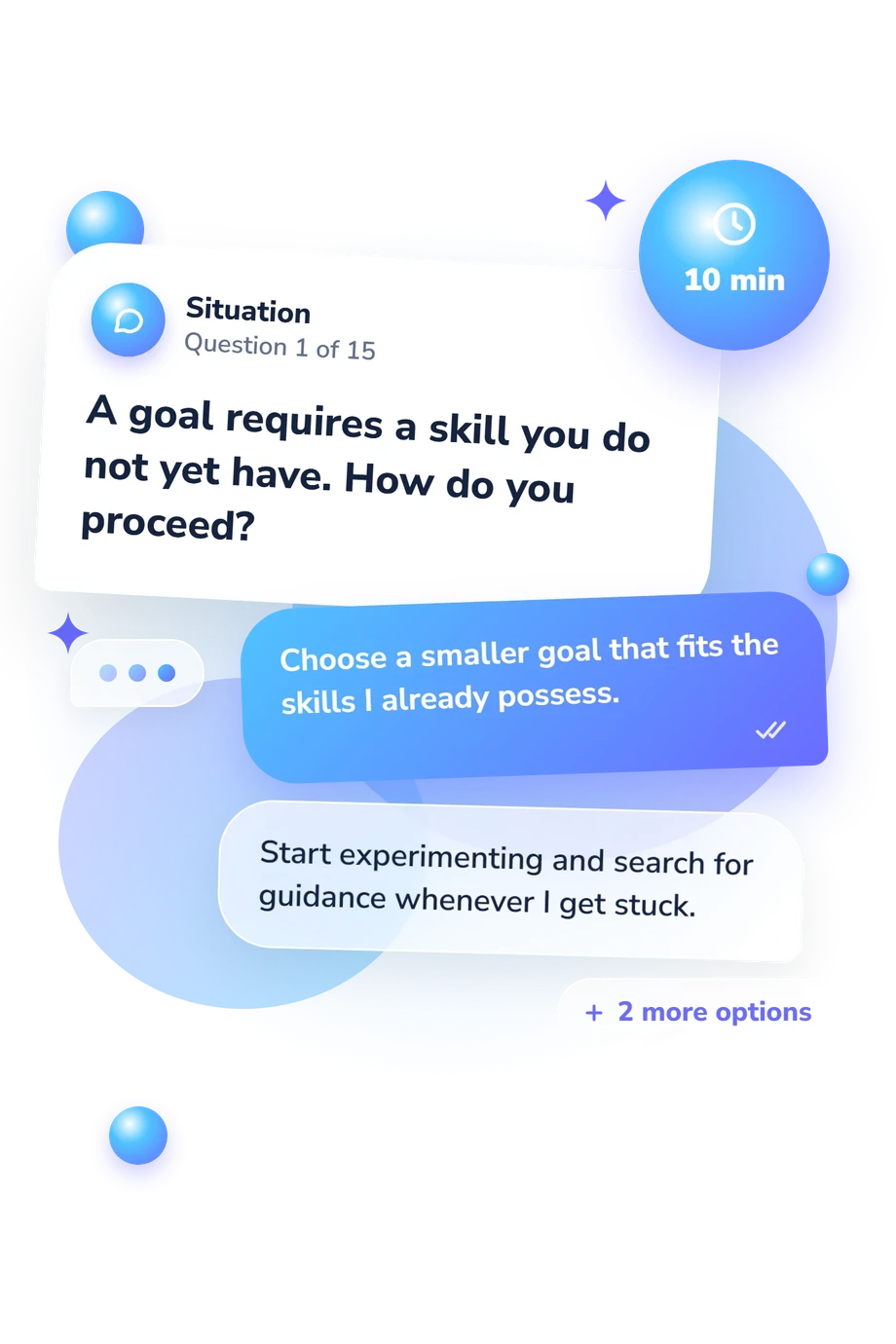
- Choose a smaller goal that fits the skills I already possess.
- Start experimenting and search for guidance whenever I get stuck.
- Complete a broad course or guide before attempting the real task.
- Identify the specific skill gap, find a suitable resource, and practice it in context.
- Accept it first and try to fit my own goal around it later.
- Check its urgency and negotiate the timing or scope before committing.
- Accept it if it seems useful, even if my original timetable slips.
- Compare its value with my planned goal, then protect whichever matters more.
- I notice whether I feel busier or more confident than before.
- I occasionally compare where I am with my original intention.
- I record activity, such as time spent or tasks completed.
- I review measures tied to the result and adjust my next actions accordingly.
Will I Be Successful Quiz - Description and methodology of the test
People who want to turn broad ambitions into workable next steps can use this questionnaire to examine the habits behind progress. The Will I Be Successful Quiz is intended for self-reflection: it maps responses to skill gaps, competing demands, feedback, uncertainty, and interruptions. As a will i be successful in life quiz, it keeps attention on patterns that can be reviewed and adjusted.
What This Assessment Explores
The result avoids a fixed label and examines how present habits may support progress. As an are you successful quiz, this questionnaire considers responses to skill gaps, competing demands, feedback, repetitive work, uncertainty, and interruptions. The three dimensions are:
- Adaptive Resourcefulness (0-15) shows how you learn from evidence, revise methods, and use support; its bands are Untapped options (0-5), Growing adaptability (6-10), and Resourceful adaptation (11-15).
- Consistent Execution (0-15) shows how you sustain necessary work, track movement, and restart after disruption; its bands are Irregular momentum (0-5), Developing follow-through (6-10), and Reliable execution (11-15).
- Direction and Prioritization (0-15) shows how you turn aims into milestones and make trade-offs; its bands are Emerging direction (0-5), Selective direction (6-10), and Focused direction (11-15).
Together, these results describe current ways of working. They do not predict success or measure personal worth; use them to choose one pattern to observe and adjust.
Methodology and Evidence Base
Each item presents a practical situation with four response options about skill gaps, competing demands, feedback, uncertain routes, and disrupted routines. The questionnaire reports three separate scores, each paired with a descriptive band. The bands describe current patterns and can be used to choose a specific behavior to observe or adjust.
Structurally, it is conceptually consistent with the Proactive Coping Inventory (Greenglass et al., 1999), especially proactive planning, resource use, and preparation for obstacles, but it is not an adaptation of that instrument. Self-starting adjustment also relates to the personal initiative framework of Frese and Fay (2001), while goal clarity, milestones, feedback, and trade-offs connect with Locke and Latham (2002).
Here, quiz success means leaving with one concrete adjustment to test, turning questions about success into a starting point for action. Self-reported answers may shift with mood, recent setbacks, self-awareness, and social desirability; compare the result with repeated behavior in real situations.
- Greenglass, Esther R., Ralf Schwarzer, Dagmara Jakubiec, Lisa Fiksenbaum, and Steffen Taubert. "The Proactive Coping Inventory (PCI): A Multidimensional Research Instrument." Paper presented at the 20th International Conference of the Stress and Anxiety Research Society, Cracow, Poland, 1999, pp. 1-18.
- Frese, Michael, and Doris Fay. "Personal Initiative: An Active Performance Concept for Work in the 21st Century." Research in Organizational Behavior, vol. 23, 2001, pp. 133-187. 10.1016/S0191-3085(01)23005-6.
- Locke, Edwin A., and Gary P. Latham. "Building a Practically Useful Theory of Goal Setting and Task Motivation: A 35-Year Odyssey." American Psychologist, vol. 57, no. 9, 2002, pp. 705-717. 10.1037/0003-066X.57.9.705.
Updated: