
Am I Dateable Quiz
How the Scales are Structured
Who Usually Takes This Test?
See How You Compare
Below is a preview of how scores are typically distributed across each scale.
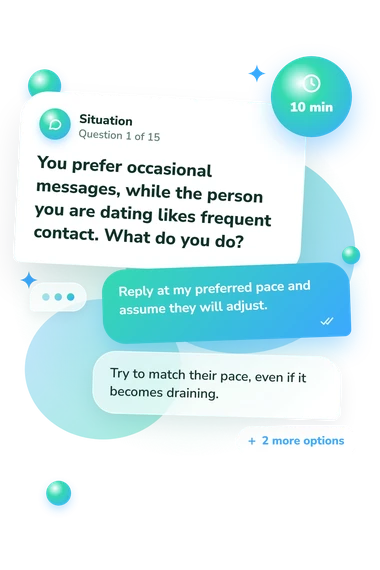
Example Questions From the Test
- Reply at my preferred pace and assume they will adjust.
- Try to match their pace, even if it becomes draining.
- Mention that I communicate less often and see how they respond.
- Compare what contact means to each of us and agree on a rhythm neither person has to fake.
- Avoid the subject for now because the connection feels good.
- Assume one of us may naturally change if the relationship becomes serious.
- Learn how firm each preference is before deciding what the difference means.
- Continue dating while keeping the difference in mind as a possible concern.
- I detach from the connection so I do not have to feel exposed.
- I stay involved but hide most signs that the connection matters to me.
- I acknowledge my feelings privately and take time to see how things develop.
- I remain engaged and express interest in a measured way without demanding certainty.
Am I Dateable Quiz - Description and methodology of the test
People who want a more grounded view of their dating habits can use this self-report assessment to examine how they communicate, handle vulnerability, and judge mutual fit. The Am I Dateable Quiz offers a structured way to explore those patterns without reducing partnership to charm, popularity, or a fixed personal trait. Its how dateable am i quiz framing helps identify strengths, friction points, and choices that may change with practice.
What This Assessment Explores
Questions cover contact preferences, rejection, physical affection, disclosure, scheduling, conflict, and unequal effort. They examine whether you express needs, tolerate vulnerability, and assess mutual fit rather than focus only on being chosen. The result describes current patterns, not attractiveness, worth, or guaranteed relationship success.
The displayed dimensions capture different parts of that pattern:
- Communication and Boundaries (0-15) shows how clearly you state limits, preferences, and concerns: Mostly indirect (0-5), Developing clarity (6-10), or Clear and responsive (11-15).
- Emotional Availability (0-15) reflects your capacity for connection, uncertainty, and paced self-disclosure: Guarded (0-5), Selectively open (6-10), or Emotionally available (11-15).
- Mutuality and Compatibility (0-15) reflects reciprocal effort, authentic fit, and respect for mismatch: Approval-focused (0-5), Compatibility-aware (6-10), or Mutuality-centered (11-15).
Together, these dimensions make this test's are you dateable quiz framing practical: they focus on communication and fit rather than universal appeal.
Methodology and Scientific Basis
Each item presents a dating dilemma with four response options. The choices vary in directness, disclosure, flexibility, reciprocity, and willingness to address discomfort, making this situational self-report rather than a factual test. Answers combine into a profile across the dimensions; the bands summarize a pattern, not a pass-fail grade.
Interpretation is conceptually linked to the Romantic Competence Interview (Davila et al., 2009), which examines insight, mutuality, and emotion regulation. It is not a direct administration or validation of that interview. Robinson, Penzel, and Persich (2020) emphasize context-specific romantic decisions, while Davila et al. (2017) connect romantic competence with relationship functioning and well-being. These studies support the themes, not norms for this online tool.
Current mood, recent rejection, unresolved feelings, and impression management can influence self-report. Because this dating self-assessment has no stated clinical cutoffs or population norms, use the profile to reflect on repeated choices and concrete communication practice.
- Joanne Davila, Sara J. Steinberg, Melissa Ramsay Miller, Catherine B. Stroud, Lisa R. Starr, and Athena Yoneda (2009). Assessing romantic competence in adolescence: The Romantic Competence Interview. Journal of Adolescence, 32(1), 55-75. 10.1016/j.adolescence.2007.12.001
- Michael D. Robinson, Ian B. Penzel, and Michelle R. Persich (2020). What if your partner…? A situated decision-making approach to romantic competence in young adulthood. Journal of Research in Personality, 88, 104012. 10.1016/j.jrp.2020.104012
- Joanne Davila, Jonathan Mattanah, Vickie Bhatia, Jessica A. Latack, Brian A. Feinstein, Nicholas R. Eaton, Jennifer S. Daks, Shaina A. Kumar, Edward F. Lomash, Melody McCormick, and Jiaqi Zhou (2017). Romantic competence, healthy relationship functioning, and well-being in emerging adults. Personal Relationships, 24(1), 162-184. 10.1111/pere.12175