
What Crystal Am I Quiz
How the Scales are Structured
Who Usually Takes This Test?
See How You Compare
Below is a preview of how scores are typically distributed across each scale.
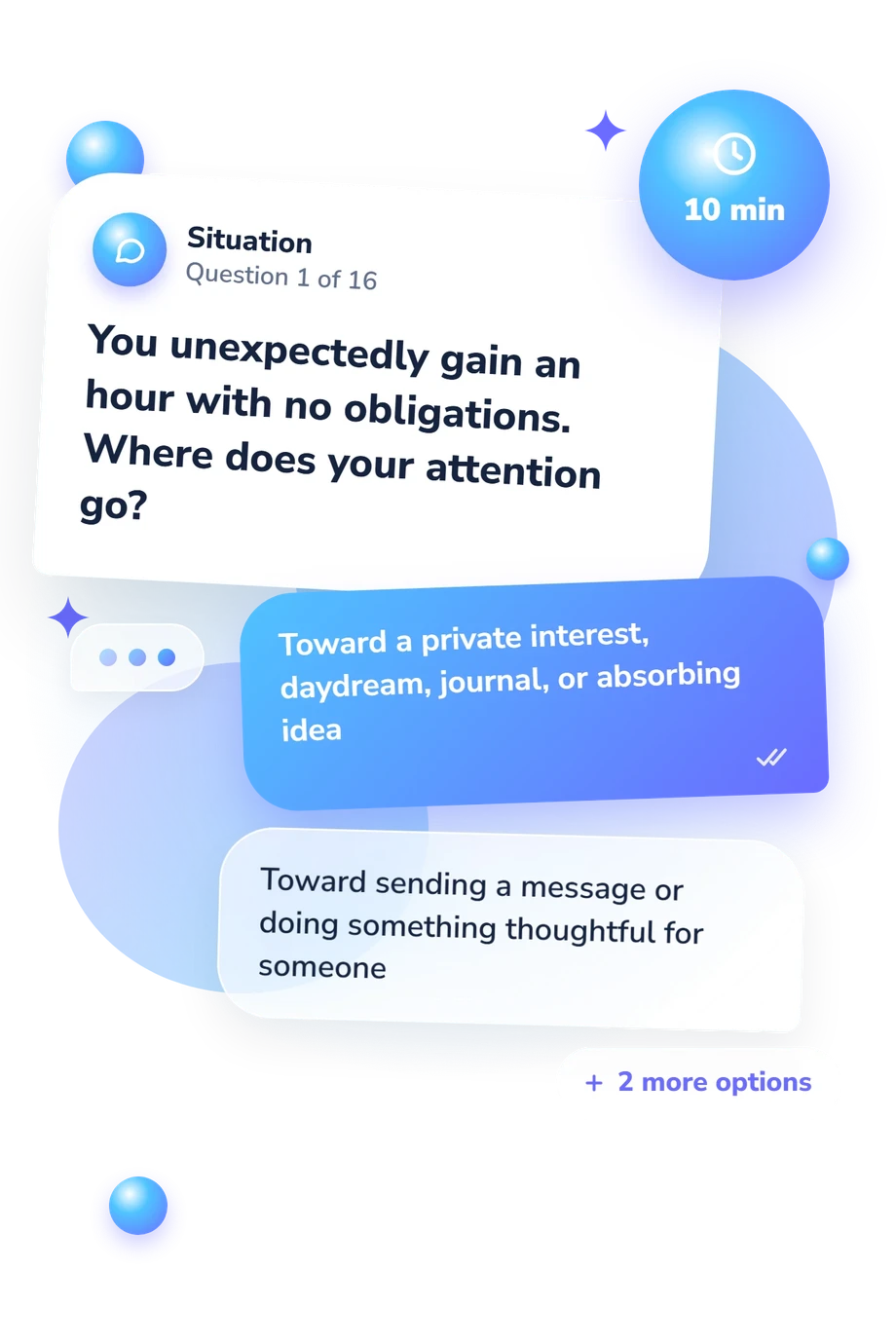
Example Questions From the Test
- That the evening has lively energy and memorable moments
- That everyone feels noticed, included, and comfortable
- That there is room for unusual or meaningful conversation
- That expectations are clear and no one crosses my limits
- Address the pattern directly and state what needs to change
- Speak privately with them while trying to preserve goodwill
- Document my contribution and wait for a strategic moment
- Put my energy into a new opportunity where my work can stand out
- Enjoy the mood without needing to analyze it further
- Turn over its symbols and possible meanings in my mind
- Ask others how the ending made them feel
- Decide which interpretation is most consistent with the evidence
What Crystal Am I Quiz - Description and methodology of the test
People curious about how they think, connect, act, and protect their boundaries can use this questionnaire as a symbolic profile exercise. The What Crystal Am I Quiz turns everyday preferences and reactions into a comparison among four crystal-associated styles. It may appeal to anyone exploring a crystal personality quiz as a playful prompt for self-observation, not a fixed identity.
What This Assessment Explores
The questions examine responses to solitude, initiative, difficult truths, affection, trust, ambiguity, and setbacks. Framed as a what crystal are you quiz, it maps these situations onto four symbolic orientations. The highest total is the strongest match, while scores within one point create a blended result without forcing a single label.
Four result dimensions organize the profile:
- Amethyst (0-12) reflects contemplation and imagination; Grounded Elsewhere (0-4), Reflective Current (5-8), and Amethyst Affinity (9-12) show increasing inward focus.
- Citrine (0-12) reflects optimism and initiative; Measured Spark (0-4), Gathering Momentum (5-8), and Citrine Affinity (9-12) show increasing forward energy.
- Obsidian (0-12) reflects candor and boundaries; Open Edges (0-4), Clear-Eyed Core (5-8), and Obsidian Affinity (9-12) show increasing directness.
- Rose Quartz (0-12) reflects affection and harmony; Independent Orbit (0-4), Warm Presence (5-8), and Rose Quartz Affinity (9-12) show increasing relational warmth.
Methodology and Scientific Basis
Each item presents four response options, with each option expressing a different approach. Choose the response that feels most characteristic, rather than the one that seems admirable. The result compares four profile totals: the highest is the strongest match, and totals within one point form a blend. As a crystal profile quiz, it organizes symbolic associations rather than measuring an established trait.
The questionnaire is a symbolic self-report exercise, not a standardized clinical scale, and its profile totals have no published norms. Teidearu (2023) offers relevant context for crystals as carriers of personal and material meaning in new spirituality. That source supports the symbolic framing only; it does not validate these four profiles, and this questionnaire is not an adaptation of that work.
Forer (1949) and Dickson and Kelly (1985) describe personal validation and the Barnum effect, in which broad statements can feel accurate. Mood, recent experiences, self-presentation, and self-awareness may influence choices. Read the strongest or blended result as a starting point for reflection, with its meaning kept flexible rather than treated as a personality account.
- Teidearu, Tenno (2023). The Material Agency of Crystals in New Spirituality: Significance of Decay and Failure of Materials. Ethnologia Fennica, 50(1), 168-191. 10.23991/ef.v50i1.120977
- Forer, Bertram R. (1949). The fallacy of personal validation: A classroom demonstration of gullibility. Journal of Abnormal and Social Psychology, 44(1), 118-123. 10.1037/h0059240
- Dickson, D. H., and Kelly, I. W. (1985). The ‘Barnum Effect’ in Personality Assessment: A Review of the Literature. Psychological Reports, 57(2), 367-382. 10.2466/pr0.1985.57.2.367
Updated: