
BDSM Archetype Quiz
How the Scales are Structured
Who Usually Takes This Test?
See How You Compare
Below is a preview of how scores are typically distributed across each scale.
Example Questions From the Test
- Responding to the direction being given to me
- Participating in a shared flow without one clear director
- Guiding a specific element while other choices remain mutual
- Directing the flow and noticing how the other person responds
- Being trusted to hold and direct the negotiated authority
- Taking authority for part of the encounter while staying flexible
- Keeping authority light and mostly collaborative
- Receiving direction rather than holding authority
- Who will hold the negotiated authority
- The role structure first, with a few sensory accents
- A balance of role dynamics and carefully chosen sensations
- The specific textures, intensity changes, sounds, and pacing
BDSM Archetype Quiz - Description and methodology of the test
For people curious about how they relate to negotiated power, sensation, and role direction, this assessment offers a structured way to notice recurring preferences. The questionnaire maps several kink archetypes by helping partners or individuals put language around what feels engaging, without treating one role as more authentic than another. The BDSM Archetype Quiz is most useful when answers reflect your actual interests rather than an idealized persona.
What This Assessment Explores
The assessment maps BDSM role dimensions alongside sensory attraction: directing negotiated structure and pacing, receiving direction, switching roles, and sensation that can appeal independently of hierarchy. The result describes current preferences, not skill, permission, or readiness. The dimensions are:
- Dominant Affinity (0-12) reflects attraction to consensually directing roles, structure, and pacing: Background affinity (0-4), Situational affinity (5-8), Strong affinity (9-12).
- Sensation-Centered Affinity (0-12) reflects texture, rhythm, atmosphere, and bodily sensation independently of authority roles: Secondary focus (0-4), Meaningful focus (5-8), Strong focus (9-12).
- Submissive Affinity (0-12) reflects attraction to receiving direction or yielding negotiated control: Background affinity (0-4), Situational affinity (5-8), Strong affinity (9-12).
- Switch Affinity (0-12) reflects attraction to moving between directing and receiving: Stable-role affinity (0-4), Flexible affinity (5-8), Strong switch affinity (9-12).
Partner, context, trust, and mood can change what feels appealing.
Methodology and Evidence Base
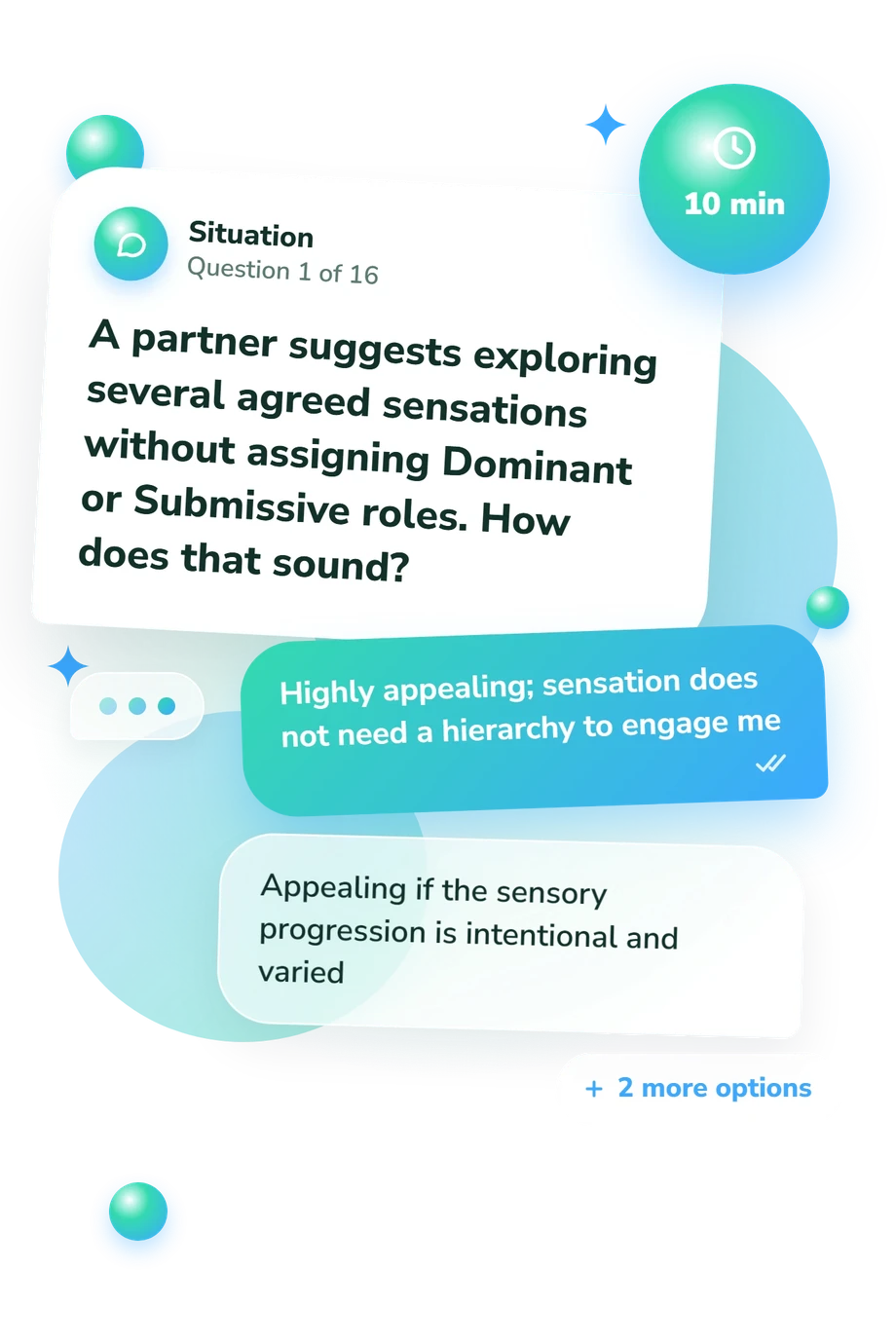
The items use scenarios about limits, pacing, direction, structure, role reversal, and sensory detail. Four response choices present different patterns across role and sensation, and the respondent selects the one that best fits their reaction. The scenarios ask respondents to evaluate reactions within power exchange rather than agree with abstract statements.
Results show four separate scale scores; point assignment is unspecified. Each score describes its own affinity. The displayed bands are descriptive categories, not validated cutoffs. Treat the four results as separate indications, not a required ranking among preferences. A profile says nothing by itself about experience, technique, consent, pain tolerance, or obligations.
Conceptually, the questionnaire is consistent with the Sadomasochism Checklist (SMCL; Weierstall & Giebel, 2017), but it is not presented as an adaptation of that instrument. Martinez (2018) offers relevant context for role fluidity, and Schuerwegen et al. (2021) for sensation seeking and coping in BDSM-related interests. It is not presented as a standardized or normed instrument. Self-report results can shift with current mood, self-awareness, and social desirability, so they are descriptive rather than diagnostic.
- Weierstall, R., & Giebel, G. (2017). The Sadomasochism Checklist: A Tool for the Assessment of Sadomasochistic Behavior. Archives of Sexual Behavior, 46(3), 735-745. 10.1007/s10508-016-0789-0
- Martinez, K. (2018). BDSM Role Fluidity: A Mixed-Methods Approach to Investigating Switches Within Dominant/Submissive Binaries. Journal of Homosexuality, 65(10), 1299-1324. 10.1080/00918369.2017.1374062
- Schuerwegen, A., Huys, W., Coppens, V., De Neef, N., Henckens, J., Goethals, K., & Morrens, M. (2021). The Psychology of Kink: A Cross-Sectional Survey Study Investigating the Roles of Sensation Seeking and Coping Style in BDSM-Related Interests. Archives of Sexual Behavior, 50(3), 1197-1206. 10.1007/s10508-020-01807-7
Updated: