
Communist Quiz
How the Scales are Structured
Who Usually Takes This Test?
See How You Compare
Below is a preview of how scores are typically distributed across each scale.
Example Questions From the Test
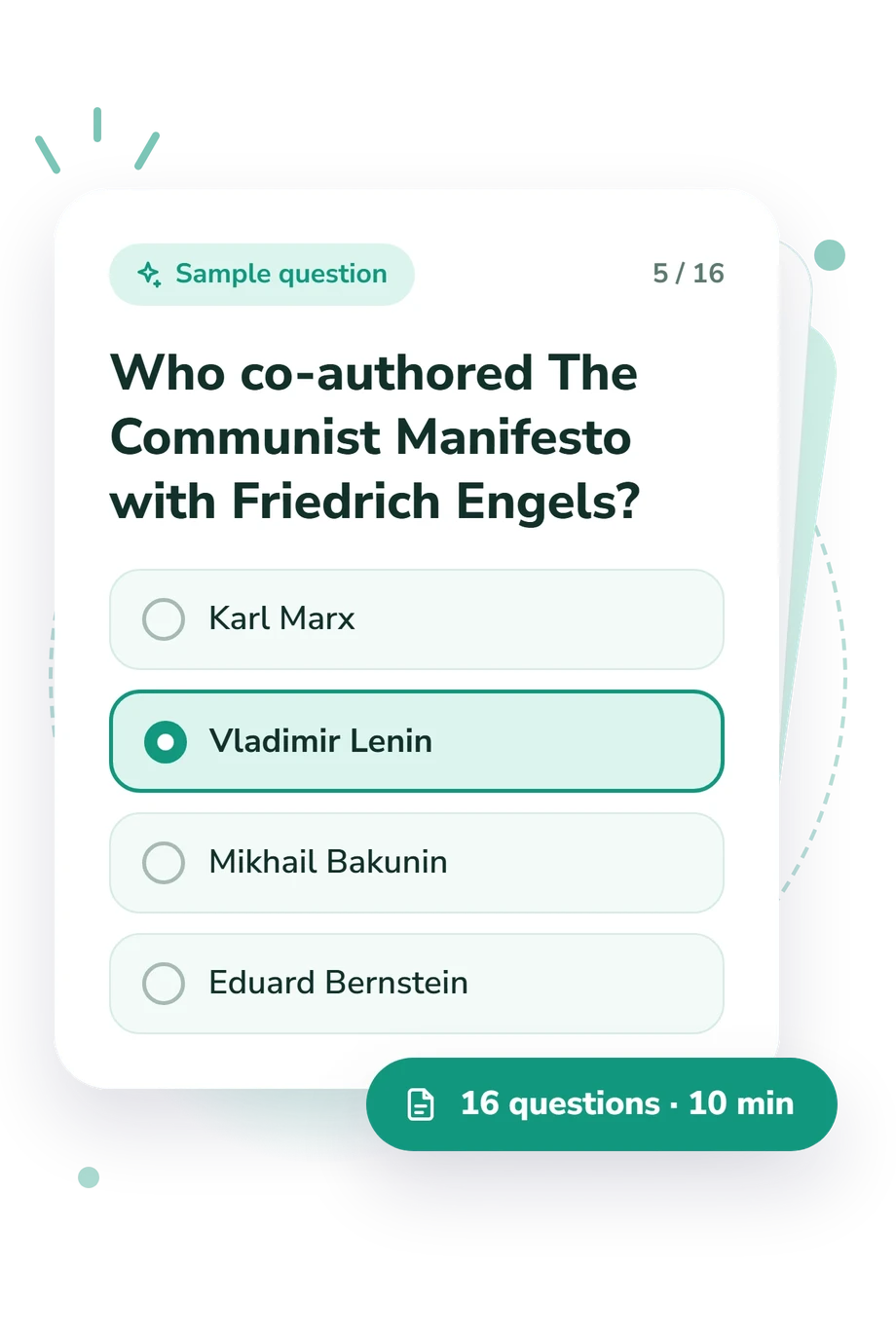
- Karl Marx
- Vladimir Lenin
- Mikhail Bakunin
- Eduard Bernstein
- People who manage government ministries
- Owners who receive income primarily from productive property
- Wage workers who do not own the major means of production
- Independent farmers who produce only for their own households
- Alexander Kerensky
- Mikhail Gorbachev
- Nicholas II
- Vladimir Lenin
Communist Quiz - Description and methodology of the test
Readers checking their grasp of communist theory, political vocabulary, and major historical events can use this communist quiz as a focused assessment. It suits students, curious learners, and anyone distinguishing an ideology from an economic arrangement or from governments that claimed communist aims. This communist theory quiz tests factual knowledge and does not assign a political label.
What This Assessment Explores
The questions examine foundational Marxist concepts, political organization, economic arrangements, and selected historical contexts. They ask the reader to distinguish ideas such as the proletariat, alienation, surplus value, class consciousness, the means of production, social ownership, central planning, democratic centralism, and the withering away of the state. As a communism quiz, it emphasizes recognition of definitions and applications rather than personal opinion or political affiliation.
The displayed result contains one knowledge scale, Communism Knowledge (0-16), presented with three bands:
- Foundation Building (0-6) indicates that some core terms and historical ideas are recognized but need review.
- Developing Knowledge (7-12) indicates understanding of many central concepts while finer distinctions remain to clarify.
- Strong Knowledge (13-16) indicates a well-developed grasp of theory, terminology, and major historical contexts.
Together, these bands reflect factual knowledge, not support for or opposition to communism.
Methodology and Scientific Basis
Each item presents a short prompt followed by four answer choices. The format is selected-response knowledge testing: the respondent identifies the best-fitting definition, historical explanation, or application, such as recognizing alienation in repetitive work or collectivization in a village setting. The questionnaire reports a knowledge result, but no item-level weighting or scoring rule is documented. The result should therefore be read at the level of the reported knowledge result rather than as a finely calibrated index.
The conceptual framework is consistent with Marx and Engels, particularly their treatment of class and communist social aims. It also corresponds with Marx’s account of productive property and surplus value, Lenin’s analysis of the state and party organization, and Fitzpatrick’s historical study of agricultural collectivization. This communist knowledge quiz is conceptually consistent with those works, not presented as a standardized adaptation or replacement for any of them.
As an online selected-response knowledge assessment, performance can vary with memory, prior learning, guessing, attention, and interpretation of wording. Its descriptive bands are not population norms, and a result cannot establish complete mastery of communist history or theory.
- Marx, Karl, and Friedrich Engels. The Communist Manifesto. Edited by Gareth Stedman Jones. London: Penguin Classics, 2004. Original work published 1848.
- Marx, Karl. Capital: A Critique of Political Economy, Volume 1. Translated by Ben Fowkes; introduction by Ernest Mandel. London: Penguin Classics, 1990. Original work published 1867.
- Lenin, Vladimir. The State and Revolution. Translated and edited by Robert Service. London: Penguin Classics, 2009. Original work written in 1917; first published in 1918.
- Fitzpatrick, Sheila. Stalin's Peasants: Resistance and Survival in the Russian Village after Collectivization. New York: Oxford University Press, 1994. 10.1093/oso/9780195069822.001.0001
Updated: