
Which Hawaiian Island to Visit Quiz
How the Scales are Structured
Who Usually Takes This Test?
See How You Compare
Below is a preview of how scores are typically distributed across each scale.
Example Questions From the Test
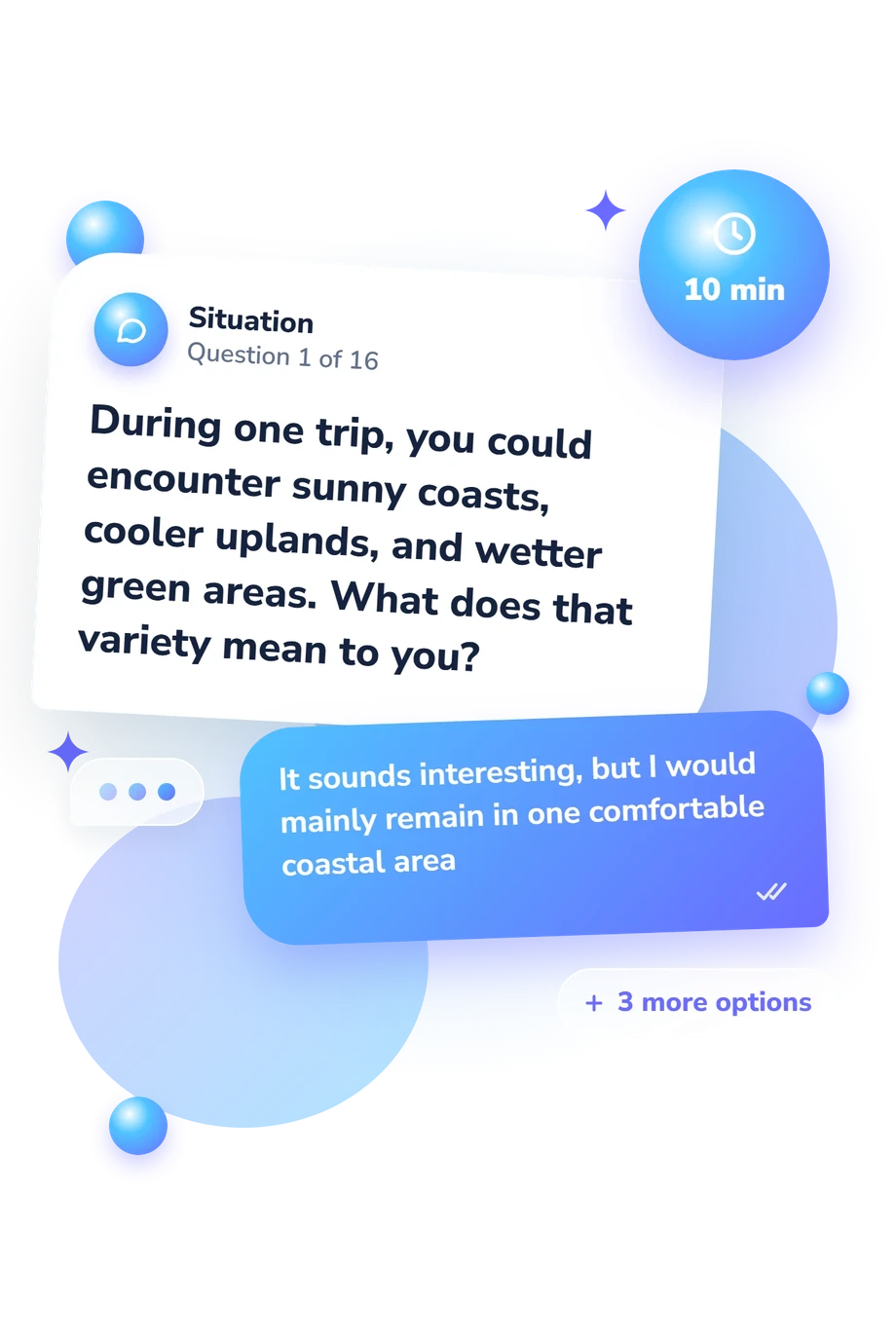
- It sounds interesting, but I would mainly remain in one comfortable coastal area
- I prefer a more consistent setting that requires fewer clothing and route adjustments
- I would plan around several environments because the contrasts are a major attraction
- I like the variety and would explore two or three distinct areas at an easy pace
- I would rather choose a compact destination where most plans are close together
- I would accept some driving but keep the itinerary focused on one side of the island
- I would tolerate it for a special stop, though changing bases sounds inconvenient
- The scale excites me, and I would plan routes or multiple bases to explore more
- Mostly spontaneous days in one quiet place, with few headline excursions
- One or two signature outings, balanced with beach time and comfortable meals
- A similar balance sounds pleasant, but I would prioritize another island’s defining features
- Planned scenic outings and downtime appeal to me, although I would keep the schedule flexible
Which Hawaiian Island to Visit Quiz - Description and methodology of the test
Travelers comparing Hawaiʻi’s four main visitor islands can use the Which Hawaiian Island to Visit Quiz to match preferences about scenery, pace, amenities, and activities with a practical destination profile. It suits first-time planners and returning visitors who want to understand which setting fits their trip rather than receive a universal ranking. For anyone asking which Hawaiian island should I visit, the result offers a starting point for an itinerary.
What This Assessment Explores
The questions compare attraction to distinct travel styles: geology and driving, lush outdoor exploration, polished comfort, or urban convenience. This Hawaiian island quiz shows which environments most closely fit your priorities.
These are the four result profiles:
- Hawaiʻi Island (0-12) reflects volcanic terrain, climate variety, long drives, and science-rich outdoor interests: Limited pull (0-4), Mixed match (5-8), Strong affinity (9-12).
- Kauaʻi (0-12) reflects lush scenery, dramatic coastlines, outdoor exploration, and subdued evenings: Limited pull (0-4), Mixed match (5-8), Strong affinity (9-12).
- Maui (0-12) reflects scenic outings, beach downtime, dining, and comfortable amenities: Limited pull (0-4), Mixed match (5-8), Strong affinity (9-12).
- Oʻahu (0-12) reflects beaches, food, history, culture, and urban convenience: Limited pull (0-4), Mixed match (5-8), Strong affinity (9-12).
The highest total is the strongest affinity; totals within one point indicate a blended match.
Methodology and Evidence Base
Each item presents a travel situation with four response options about driving, weather, trails, nightlife, culture, beaches, dining, and visitor services. There are no right answers; choices express different preferences and practical tolerances. The format helps answer which Hawaiian island should I go to; choices should reflect likely behavior rather than an idealized holiday.
Responses are aggregated into four island totals. The highest total indicates the strongest affinity, while totals within one point suggest a blended match. This comparison is relative, not a population norm or clinical threshold.
Basala and Klenosky (2001) offer a close comparison of novelty, familiarity, and travel-style preferences in destination choice; this questionnaire is conceptually consistent with it, not an adaptation. Its focus on organized and exploratory travel also relates to the tourist-role typology tested by Mo, Howard, and Havitz (1993) and validated by Jiang, Havitz, and O’Brien (2000).
Because it is self-report and has no population norms, results may shift with season, companions, budget, or current priorities, so use the profile as a planning aid rather than a verdict.
- Basala, Sandra L., and David B. Klenosky. (2001). Travel-Style Preferences for Visiting a Novel Destination: A Conjoint Investigation across the Novelty-Familiarity Continuum. Journal of Travel Research, 40(2), 172-182. 10.1177/004728750104000208
- Jiang, Jeff, Mark E. Havitz, and Robert M. O'Brien. (2000). Validating the International Tourist Role Scale. Annals of Tourism Research, 27(4), 964-981. 10.1016/S0160-7383(99)00111-5
- Mo, Chul-Min, Dennis R. Howard, and Mark E. Havitz. (1993). Testing an International Tourist Role Typology. Annals of Tourism Research, 20(2), 319-335. 10.1016/0160-7383(93)90058-B
Updated: