
Vet Quiz
How the Scales are Structured
Who Usually Takes This Test?
See How You Compare
Below is a preview of how scores are typically distributed across each scale.
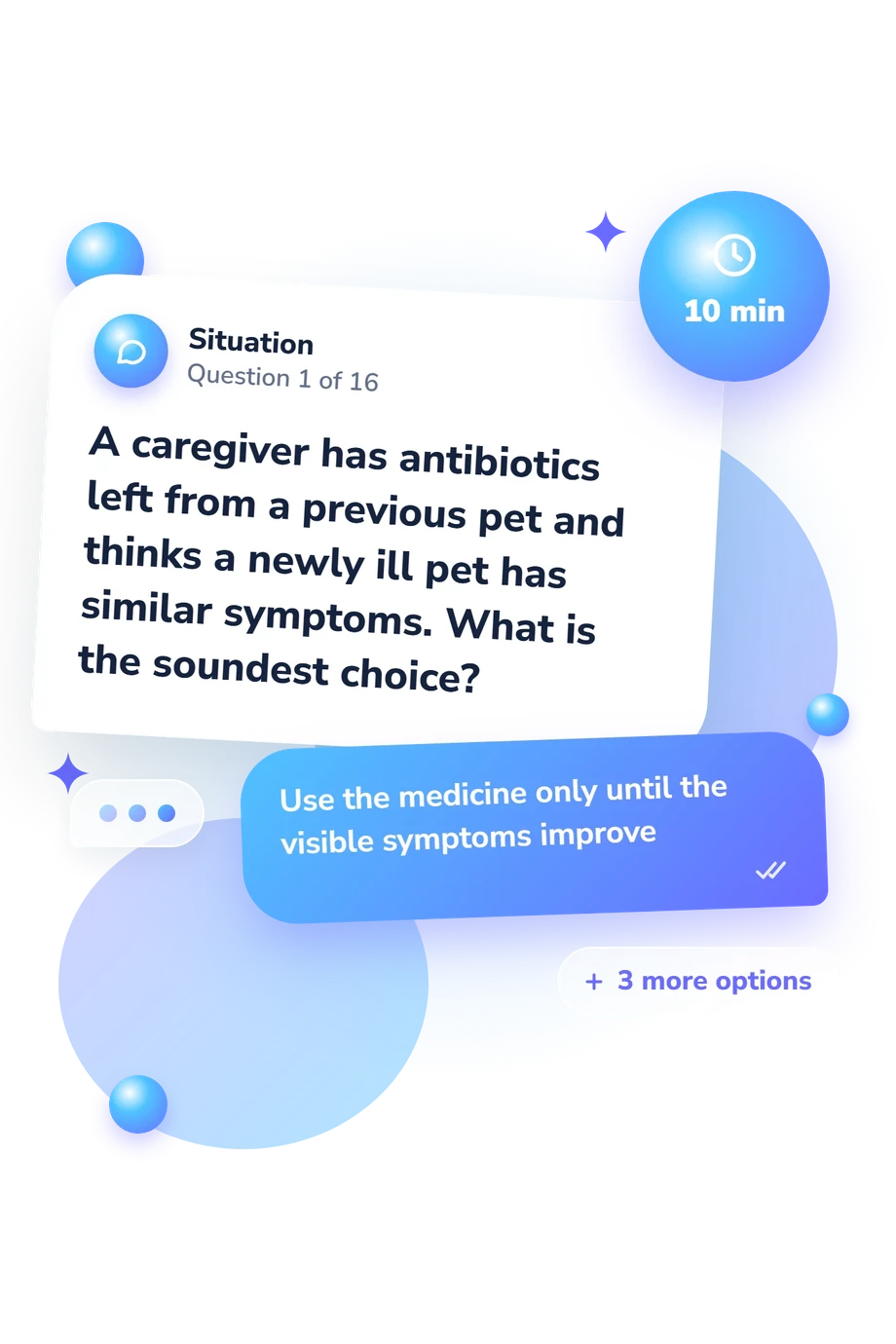
Example Questions From the Test
- To cure an infection that is already advanced
- To eliminate the need for routine health examinations
- To guarantee that an animal can never carry a pathogen
- To prepare the immune system to respond to particular diseases
- Treating every animal species with the same medication
- Keeping human medicine separate from environmental science
- Focusing veterinary care exclusively on companion animals
- Recognizing links among human, animal, and environmental health
- Training an animal to respond to behavioural cues
- Providing routine grooming and coat trimming
- Diagnosing disease and prescribing treatment for an animal
- Selling commercial pet food and accessories
Vet Quiz - Description and methodology of the test
Whether you care for a companion animal, keep livestock, or want to strengthen practical animal-health knowledge, this vet quiz offers a focused way to identify what you recognize and where uncertainty remains. Caregivers, animal owners, and learners can use the veterinary knowledge quiz to identify which everyday decisions feel secure and which topics need more study.
What This Assessment Measures
The questions sample practical knowledge rather than advanced diagnosis. They cover medication safety, vaccination, quarantine, species-specific care, professional roles, and urgent warning signs. Together, these topics make the veterinary quiz a practical check on everyday decisions across species.
The displayed scale is Veterinary Knowledge (0-16): Foundation Building (0-6), Developing Knowledge (7-12), and Strong Knowledge (13-16). It describes educational performance, not clinical competence.
The main content areas contributing to that profile are:
- Preventive knowledge shows whether you recognize vaccination, zoonoses, One Health, and quarantine as risk-reduction concepts.
- Nutrition and husbandry knowledge shows whether care choices fit species needs.
- Safety judgment shows whether you notice emergencies and avoid unsafe self-treatment or delay.
- Role awareness shows what belongs to veterinary diagnosis and prescribing versus everyday caregiving.
Methodology and Evidence Base
Each item uses a single-best-answer multiple-choice format. Scenarios ask for the safest or most accurate response, combining factual recall, recognition, and applied judgment in single-best-answer situations. The test reports a descriptive total with displayed educational bands, without a documented norm-referenced comparison or separate weighting scheme.
Methodologically, the design is conceptually consistent with the VetRepos item repository, which used reviewed veterinary knowledge items and psychometric calibration for educational progress testing. This questionnaire is not an adaptation of that repository.
Research on canine care-seeking by Farrow, O’Neill, and Packer and on companion-animal preventive care by Evason, McGrath, and Stull provides relevant context for those topics, but neither study establishes this questionnaire’s validity or norms.
Use the result as a learning snapshot by reviewing missed areas. Presented as veterinary quiz questions and answers, the items can reveal gaps, but performance may shift with self-awareness, current context, and wording interpretation. Because the items span companion animals, livestock, and horses, species-specific familiarity may influence performance; urgent signs require prompt professional help regardless of score.
- Schaper, Elisabeth, Theo van Haeften, Jakob Wandall, Antti Iivanainen, Johanna Penell, Charles McLean Press, Pierre Lekeux, and Peter Holm. "Development of a shared item repository for progress testing in veterinary education." Frontiers in Veterinary Science 10 (2023): 1296514. 10.3389/fvets.2023.1296514
- Farrow, Michelle, Dan G. O'Neill, and Rowena M. A. Packer. "To see or not to see the vet: A vignette-based study of decision-making by UK dog owners regarding seeking veterinary care for commonly presenting conditions." PLOS ONE 21, no. 1 (2026): e0339723. 10.1371/journal.pone.0339723
- Evason, Michelle, Melissa McGrath, and Jason Stull. "Companion animal preventive care at a veterinary teaching hospital - Knowledge, attitudes, and practices of clients." Canadian Veterinary Journal 62, no. 5 (2021): 484-490
Updated: