
Verb Quiz
How the Scales are Structured
Who Usually Takes This Test?
See How You Compare
Below is a preview of how scores are typically distributed across each scale.
Example Questions From the Test
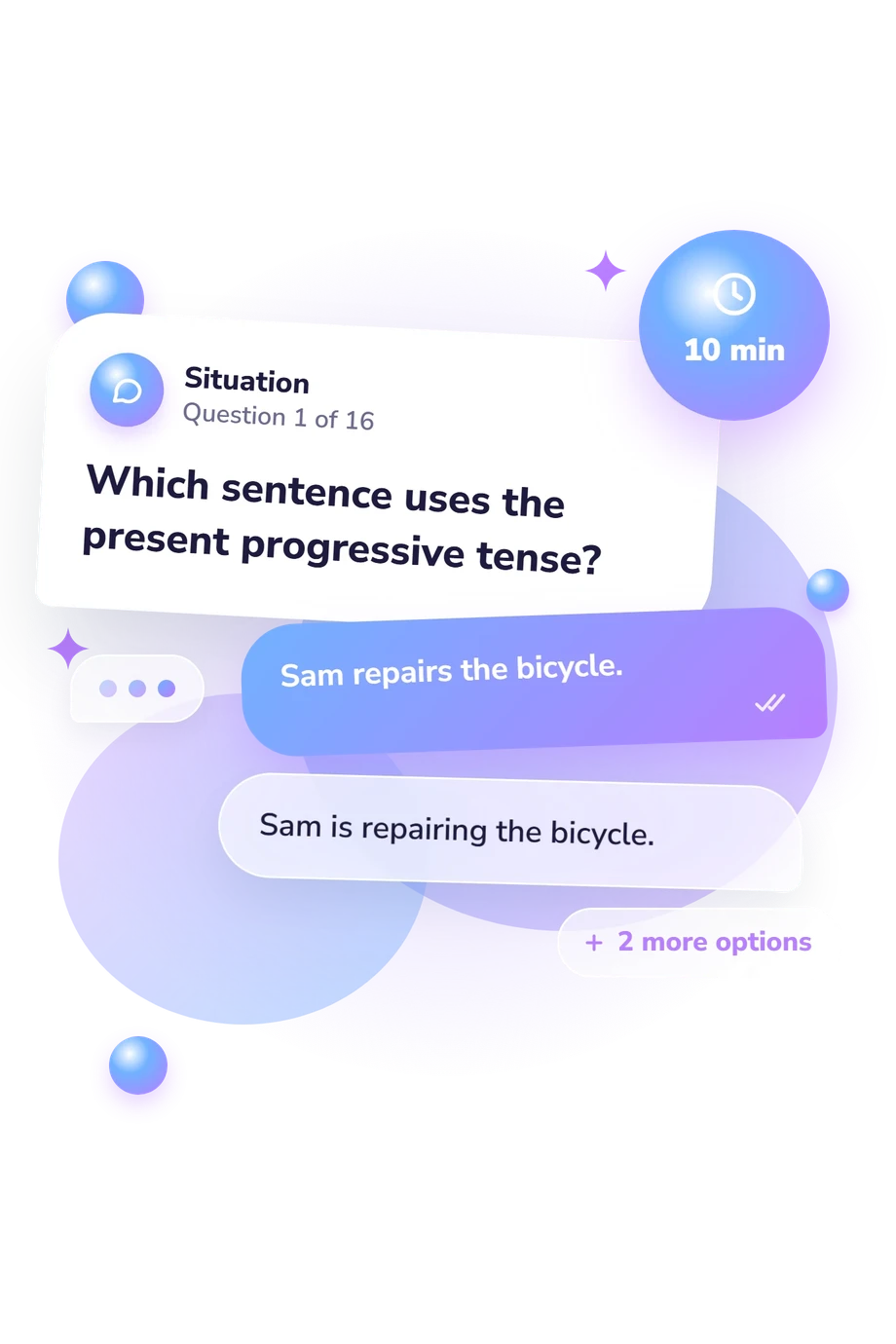
- Sam repairs the bicycle.
- Sam is repairing the bicycle.
- Sam will repair the bicycle.
- Sam repaired the bicycle.
- Mina is reading a novel.
- The train is arriving now.
- The room is quiet.
- The dog is barking outside.
- a language
- patience
- takes
- to learn
Verb Quiz - Description and methodology of the test
Designed for learners who want a clearer picture of their English grammar, this verb quiz examines the practical decisions involved in identifying and using verbs in sentences. It suits students, writers, and independent learners who want to see which sampled verb patterns they handle and which may need further practice. As a verb practice quiz, it also suggests which grammar topics deserve attention next.
What This Assessment Explores
Across this English verbs quiz, the tasks focus on grammatical function rather than vocabulary breadth. They sample tense, verb roles, forms, agreement, and links between verbs and sentence parts. The questions ask learners to distinguish present progressive and simple past, identify main, helping, linking, modal, and action verbs, select appropriate forms, and notice how subjects connect with verb choices.
The result is organized as one educational scale:
- Verb Knowledge (0-16) measures knowledge of identifying and using English verbs in the sampled patterns. Foundations to build (0-6) suggests that core review would strengthen your base; Developing knowledge (7-12) indicates familiarity with many common patterns and room to practice less familiar forms and functions; Strong knowledge (13-16) reflects a solid command of the tested skills.
The score is a broad educational snapshot of sampled grammar decisions, not overall language ability.
Methodology and Evidence Base
Each item presents a sentence or prompt with four answer choices. Learners choose one option for each sentence or prompt, and responses are combined into one total rather than separate subscores. That total reflects the grammatical decisions sampled by the items, giving learners a basis for English verb practice in tense recognition, verb classification, inflection, and agreement.
The framework is conceptually consistent with Huddleston, Pullum, and Reynolds (2022), and aligns with the syntactic analysis of Huddleston and Pullum (2002) and the morphology described by Bauer, Lieber, and Plag (2013). This questionnaire is not presented as an adaptation of those publications; they supply terminology and analytical distinctions, not validation, norms, or formal standardization for this online version.
Interpret the outcome as a broad educational snapshot. A stronger band suggests accuracy across the tested patterns, while a lower band points to areas for review. Because isolated selected-response items cannot show verb use in extended writing, spontaneous speech, or unfamiliar contexts, the result is not a formal language assessment or complete measure of English ability.
- Huddleston, Rodney, Geoffrey K. Pullum, and Brett Reynolds. A Student’s Introduction to English Grammar. 2nd ed. Cambridge University Press, 2022. DOI 10.1017/9781009085748
- Huddleston, Rodney, and Geoffrey K. Pullum. The Cambridge Grammar of the English Language. Cambridge University Press, 2002. DOI 10.1017/9781316423530
- Bauer, Laurie, Rochelle Lieber, and Ingo Plag. The Oxford Reference Guide to English Morphology. Oxford University Press, 2013. DOI 10.1093/acprof:oso/9780198747062.001.0001
Updated: