
Spanish Colors Quiz
How the Scales are Structured
Who Usually Takes This Test?
See How You Compare
Below is a preview of how scores are typically distributed across each scale.
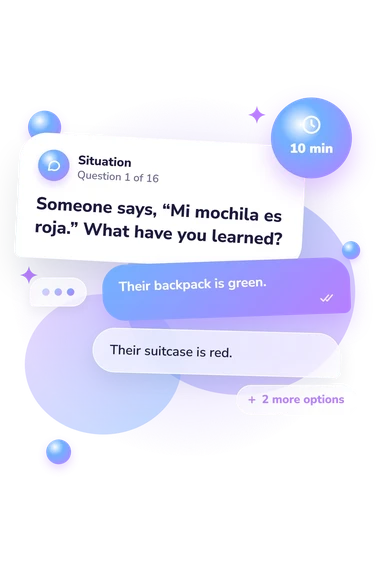
Example Questions From the Test
- Their backpack is green.
- Their suitcase is red.
- Their backpack is red.
- Their backpack is white.
- rojo
- amarillo
- verde
- blanco
- blanco
- amarillo
- azul
- rojo
Spanish Colors Quiz - Description and methodology of the test
People beginning Spanish or revisiting classroom basics can use Spanish Colors Quiz to check how securely they recognize color terms in practical examples. This focused quiz on colors in Spanish suits learners who want elementary vocabulary and grammar practice rather than a broad estimate of fluency. The result can show which everyday descriptive patterns deserve more review.
What This Assessment Explores
The questions combine direct color-word recognition with phrase completion, sentence interpretation, and adjective-agreement tasks. They use azul, negro, verde, gris, rojo, amarillo, and blanco in descriptions of clothing, body parts, animals, and objects. Other items check adjective agreement with noun gender and number, connecting vocabulary recall to the grammar of familiar descriptions.
For beginners and learners reviewing foundations, this Spanish color vocabulary test shows how securely these sampled skills are developing. It does not measure broad speaking, writing, or advanced syntax. The three connected skill areas covered by the questions are:
- Vocabulary recognition shows whether common color terms are identified accurately.
- Contextual meaning shows whether a learner connects each term with the described object or feature.
- Agreement control shows whether color forms match nouns in gender and number; Spanish Colors Knowledge (0-16) places the total in Starter Palette (0-6), Developing Color Knowledge (7-12), or Strong Color Knowledge (13-16).
Methodology and Evidence Base
Each item presents a translation prompt, sentence, phrase completion, or meaning-in-context task with four answer choices. Responses are combined into one displayed total and the bands organize interpretation; they are descriptive categories for this questionnaire rather than population norms.
The language focus is conceptually consistent with Lichtman (2009), which examines adjective agreement in additional-language Spanish learning. The reference grammar describes the gender, number, and adjective rules tested, and the questionnaire is conceptually consistent with those rules without implying that it was derived from the book. The questionnaire applies these principles to beginner-level color examples; it is not an adaptation, replication, or validation of either source.
As a Spanish adjective agreement quiz, it lets learners see whether forms such as azules, negras, or blancos are recognized when the surrounding noun changes. A higher result suggests firmer control of the tested vocabulary and patterns, while a lower result identifies useful review targets. Because this is performance measured in a brief online format, guessing, attention, previous instruction, and familiarity with the examples can affect the score, so it should be read as a snapshot rather than a complete measure of Spanish proficiency.
- Lichtman, Karen. "Acquisition of Attributive and Predicative Adjective Agreement in L2 Spanish." In Proceedings of the 10th Generative Approaches to Second Language Acquisition Conference (GASLA 2009), edited by Melissa Bowles et al., 231-247. Cascadilla Proceedings Project, 2009.
- Butt, John, Carmen Benjamin, and Antonia Moreira Rodríguez. A New Reference Grammar of Modern Spanish. 6th ed. Routledge, 2019. 10.4324/9781315648446