
Comphet Quiz
How the Scales are Structured
Who Usually Takes This Test?
See How You Compare
Below is a preview of how scores are typically distributed across each scale.
Example Questions From the Test
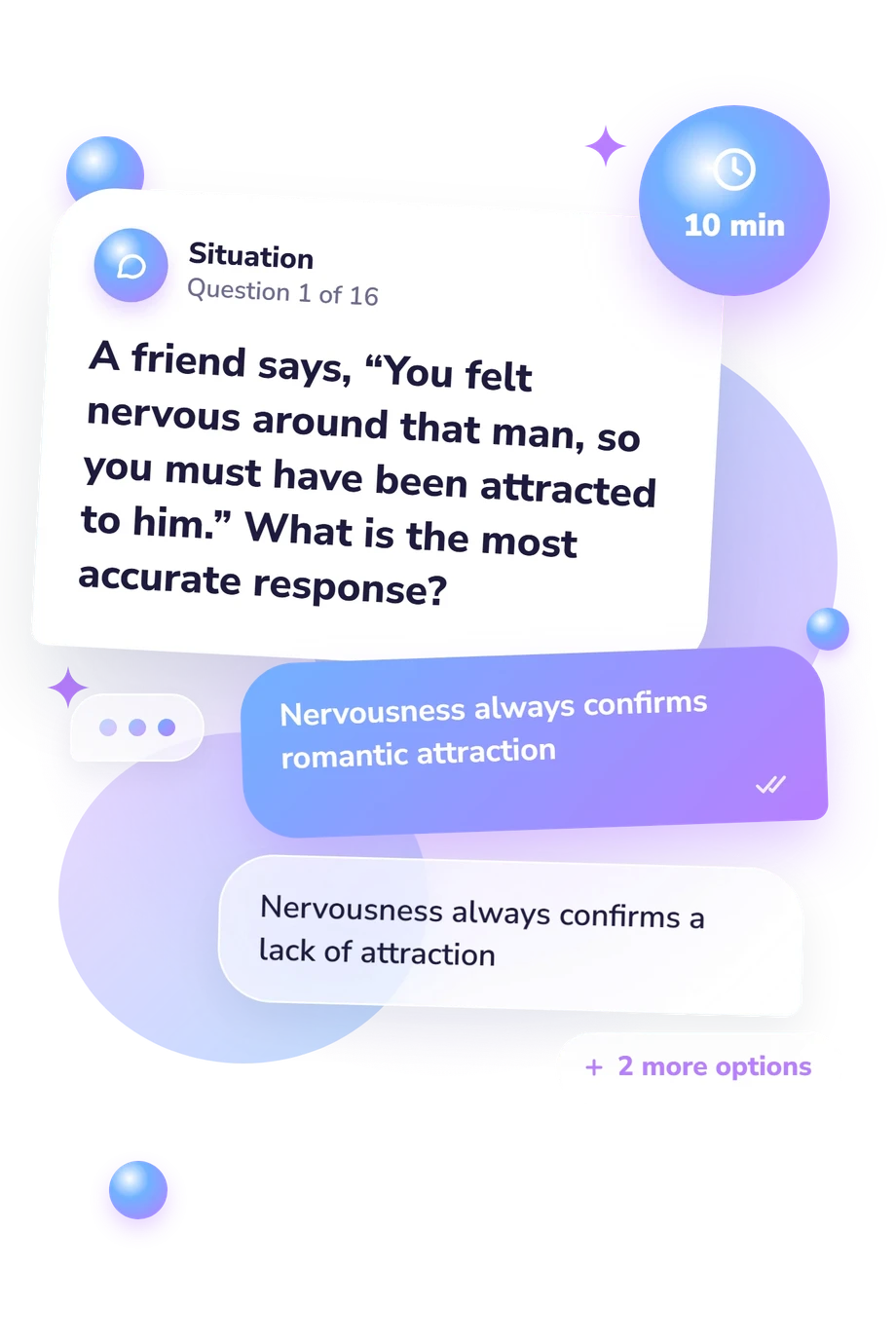
- Nervousness always confirms romantic attraction
- Nervousness always confirms a lack of attraction
- Selecting an identity label would reveal what the nervousness meant
- Anxiety and bodily arousal can have multiple causes, so context and felt desire also matter
- A relationship’s duration determines the participants’ orientations
- Relationship behavior or history is not identical to internal attraction
- Discomfort in past relationships necessarily indicates a preference for celibacy
- A person’s orientation is assigned by the partners they have dated
- Notice recurring patterns of desire, comfort, obligation, and validation without forcing a conclusion
- Avoid dating anyone until every feeling can be categorized with certainty
- Choose a permanent identity label immediately to prevent ambiguity
- Treat one online checklist item as decisive evidence
Comphet Quiz - Description and methodology of the test
People reflecting on the difference between social expectation and personal desire may use this comphet quiz to examine the concepts without forcing an identity label. It is intended for readers who want a clearer framework for thinking about dating history, validation, attraction, and pressure. This quiz can help organize these questions about social pressure and attraction while leaving orientation to readers.
What This Assessment Explores
Compulsory heterosexuality is a social pattern in which family, media, institutions, or peers make heterosexual partnership seem natural or expected. The questions separate pressure from attraction, comfort, desire, intimacy, and validation. That makes these distinctions useful when examining social expectations without forcing identity labels. As a quiz about compulsory heterosexuality, it addresses concepts rather than assigning identity.
The scenarios focus on four distinctions:
- Social pressure may shape expectations without proving desire.
- Dating history may differ from internal attraction and cannot establish orientation alone.
- Validation may involve enjoying approval without wanting intimacy.
- Heterosexuality may receive greater recognition through social norms.
Comphet Knowledge (0-16) measures conceptual understanding: Foundation to Build (0-6) means concepts need development; Developing Understanding (7-12) means the main idea is understood but nuanced; Strong Understanding (13-16) means the distinctions are applied consistently.
Methodology and Evidence Base
Each item presents a short scenario or concept with four answer choices. One point is awarded for each correct response, so the total reflects conceptual knowledge rather than orientation. The items test conceptual understanding, not sexual orientation.
The conceptual anchor is Compulsory heterosexuality (Rich, 1980), which describes heterosexuality as socially organized and enforced as a default while allowing genuine attraction to coexist with pressure. Konik and Stewart (2004) connect the framework with sexual identity development, while Vooris (2021) treats questioning heterosexual assumptions as an educational exercise. The questionnaire is conceptually consistent with Rich and the related studies, but it is not an adaptation of those works; its score is educational rather than norm-referenced.
Interpret the result as educational feedback about answer accuracy. Scores may reflect familiarity with terminology, reading of scenarios, current context, self-awareness, or pressure to choose an expected response. A high band does not establish an identity, and a low band does not disprove one; consider the result alongside the person’s own account of desire and experience.
- Rich, Adrienne. "Compulsory Heterosexuality and Lesbian Existence." Signs: Journal of Women in Culture and Society 5, no. 4 (1980): 631-660. 10.1086/493756
- Konik, Julie, and Abigail Stewart. "Sexual Identity Development in the Context of Compulsory Heterosexuality." Journal of Personality 72, no. 4 (2004): 815-844. 10.1111/j.0022-3506.2004.00281.x
- Vooris, Jessica Ann. "When Did You Know You Were Straight? Teaching with the Heterosexual Questionnaire." Radical Teacher 119 (2021): 75-77. 10.5195/rt.2021.819
Updated: