
Naming Ionic Compounds Quiz
How the Scales are Structured
Who Usually Takes This Test?
See How You Compare
Below is a preview of how scores are typically distributed across each scale.
Example Questions From the Test
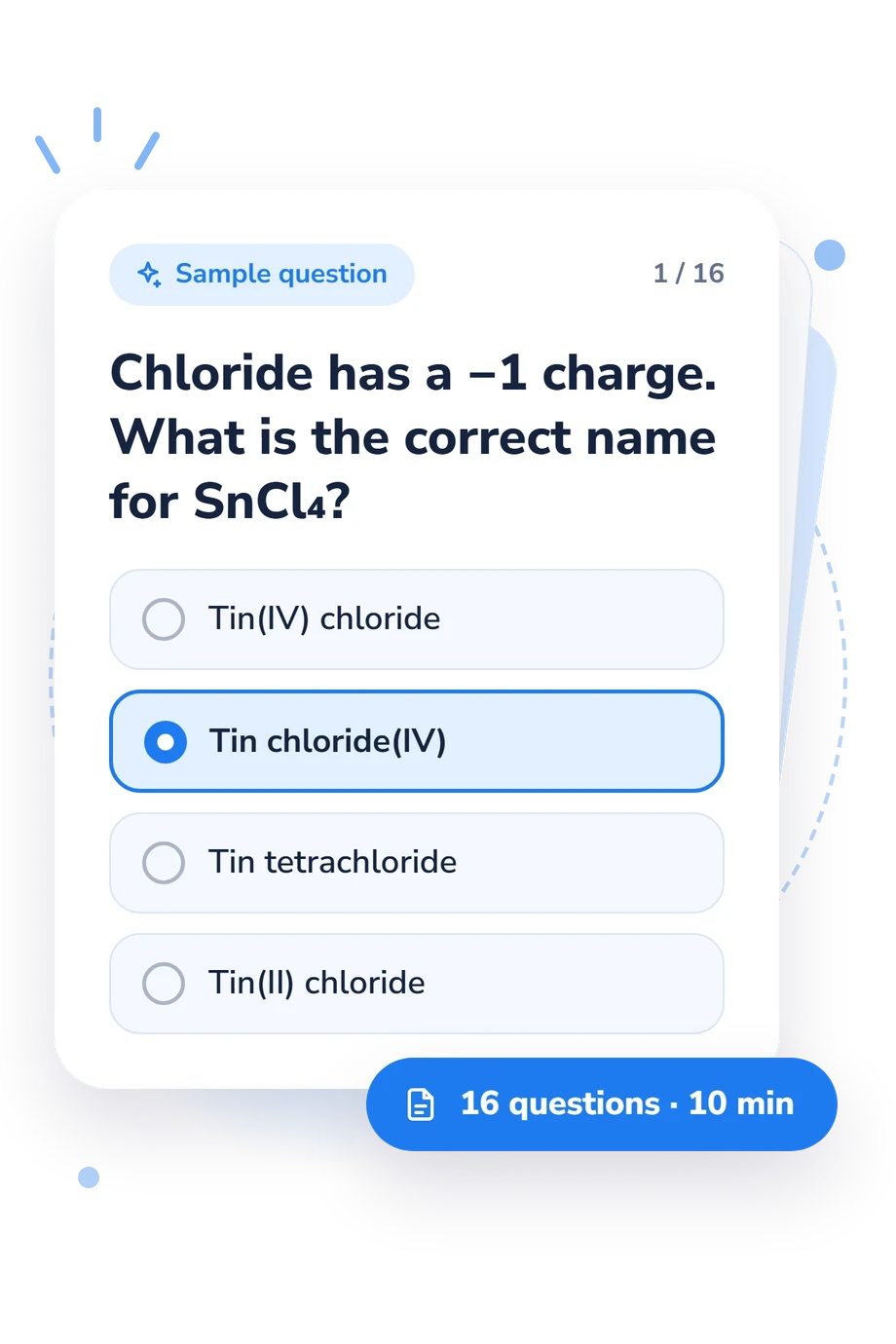
- Tin(IV) chloride
- Tin chloride(IV)
- Tin tetrachloride
- Tin(II) chloride
- Na₂SO₃ — sodium sulfate
- Mg(OH)₂ — magnesium(II) hydroxide
- Co(NO₃)₂ — cobalt(II) nitrate
- NH₄Cl — ammonium chlorate
- Iron(III) chloride
- Iron(I) chloride
- Iron trichloride
- Iron(III) chlorate
Naming Ionic Compounds Quiz - Description and methodology of the test
Students who want to strengthen introductory chemistry can use the naming ionic compounds quiz to check whether they move reliably between chemical names, formulas, ion charges, and standard conventions. This quiz on ionic compounds suits learners reviewing classroom material, preparing for an assessment, or identifying a rule that needs practice. The result gives a focused picture of naming knowledge rather than a broad measure of chemistry achievement.
What This Assessment Measures
These questions examine the linked decisions required for introductory ionic nomenclature: identifying ions, reading charges, choosing conventional names, and constructing neutral formulas. They suit learners who need to distinguish fixed-charge from variable-charge metals and recognize when a polyatomic ion remains intact.
The formula questions include ionic formula quiz tasks testing charge balance, Roman numerals, anion endings, and parentheses in neutral formulas. One scale, Naming Ionic Compounds Knowledge, runs from 0-16; its bands are Foundations to Review (0-6), Developing Knowledge (7-12), and Strong Knowledge (13-16). The result reflects four connected abilities:
- Recognizing names shows whether you apply common anion endings and standard ionic conventions.
- Assigning charges shows whether you use Roman numerals for variable-charge metals.
- Preserving polyatomic ions shows whether you keep grouped ions intact and add parentheses when needed.
- Balancing formulas shows whether you choose the smallest neutral whole-number ratio.
Methodology and Evidence Base
Each item uses four answer choices. Prompts ask for a name from a formula, a formula from a name, a charge calculation, or a correction of a naming error. This tests rule application and recall. It is a structured knowledge check.
Alongside naming, it offers quiz practice in writing formulas for ionic compounds through neutral charge totals, correct subscripts, and parentheses around repeated polyatomic ions. Distractors include prefixes used for ionic compounds, omitted Roman numerals, wrong oxyanion names, and unbalanced formulas.
Its content is conceptually consistent with Deleña and Marasigan (2023), who examined misconceptions in formula writing and ionic naming. Baah and Christian Anthony-Krueger (2012) address related difficulties with IUPAC nomenclature, while the IUPAC recommendations edited by Connelly and colleagues supply the conventions reflected here. These sources provide conceptual and nomenclature references; this online version is neither validated nor standardized.
Results are presented as one summary score, but the displayed information does not specify how each response contributes to that total. Prior instruction, terminology familiarity, and detail orientation can affect performance, so use the score to target further study.
- Russel F. Deleña and Arlyne C. Marasigan. "Understanding Students’ Misconceptions about Chemical Formula Writing and Naming Ionic Compounds." International Journal of Academic Studies in Technology and Education, 1(2), 156-173, 2023. 10.55549/ijaste.15
- Rexford Baah and Christian Anthony-Krueger. "An Investigation into Senior High School Students’ Difficulties and Understanding in Naming Inorganic Compounds by IUPAC Nomenclature." International Journal of Scientific Research in Education, 5(3), 214-222, 2012.
- Neil G. Connelly, Ture Damhus, Richard M. Hartshorn, and Alan T. Hutton, editors. Nomenclature of Inorganic Chemistry: IUPAC Recommendations 2005. Royal Society of Chemistry, 2005. ISBN 0-85404-438-8
Updated: