
AP Bio Photosynthesis Quiz
How the Scales are Structured
Who Usually Takes This Test?
See How You Compare
Below is a preview of how scores are typically distributed across each scale.
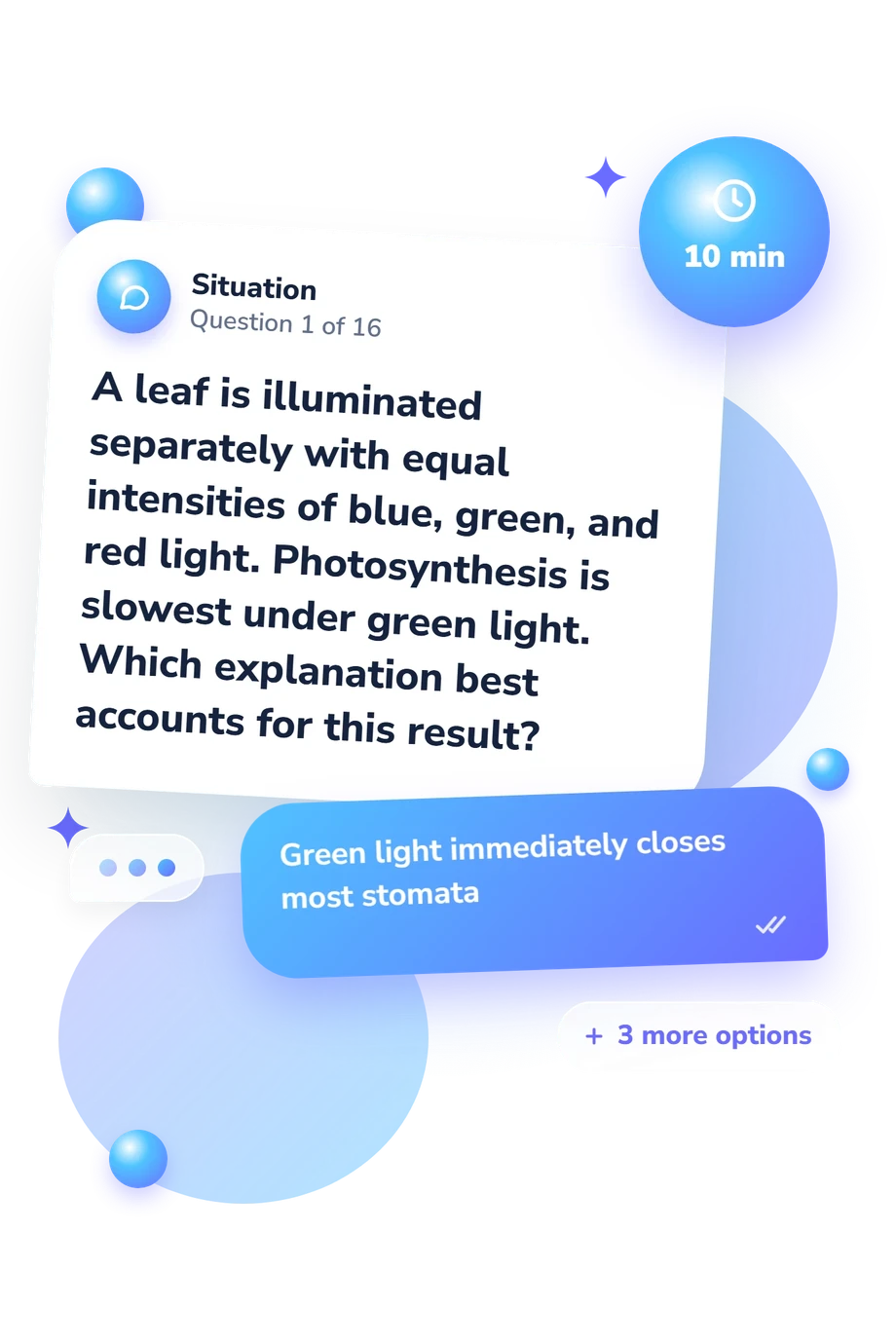
Example Questions From the Test
- Green light immediately closes most stomata
- Green photons lack enough energy to excite electrons
- Green light is absorbed primarily by Rubisco rather than chlorophyll
- Major leaf pigments absorb less green light and reflect or transmit more of it
- It splits water to provide electrons and protons
- It catalyzes the attachment of carbon dioxide to RuBP
- It transfers electrons from photosystem I to NADP+
- It converts G3P directly into carbon dioxide
- The thylakoid membrane
- The outer chloroplast membrane
- The stroma
- The space between the chloroplast membranes
AP Bio Photosynthesis Quiz - Description and methodology of the test
Students who want to consolidate plant-energy concepts can use the AP Bio Photosynthesis Quiz as a focused check of AP-level understanding. It is intended for learners reviewing how light capture, electron transfer, carbon fixation, and environmental adaptations work together. As an AP photosynthesis quiz, it connects vocabulary with mechanisms, evidence, and experimental reasoning before classwork or exam preparation.
What This Assessment Measures
Questions move from structures and pigments to experimental application. They ask you to infer limiting factors, trace atoms and electrons, and distinguish C3, C4, and CAM strategies. These questions make this a focused photosynthesis practice quiz.
The questions cover four connected themes:
- Light reactions show how photosystems, water splitting, proton gradients, ATP, and NADPH work together.
- Carbon fixation shows how Rubisco, RuBP, G3P, ATP, and NADPH support carbohydrate formation.
- Pigments and spectra show how wavelength and chlorophyll absorption affect photosynthetic activity.
- Plant adaptations show how C3, C4, and CAM pathways respond to heat, drought, and carbon dioxide.
AP Biology Photosynthesis Knowledge ranges from 0-16: Foundations to Review is 0-6, Developing Knowledge is 7-12, and Strong Knowledge is 13-16. The bands distinguish review needs, developing connections, and confident application.
Methodology and Evidence Base
Each item presents a biology scenario or conceptual prompt with four answer choices. Many items require applying a mechanism to a scenario or data pattern, while others assess direct knowledge or recognition; several ask you to predict changes after light, carbon dioxide, water, electron carriers, or stomata shift.
Questions address topics in the AP Biology CED, including energy transfer, photosynthesis, experimental analysis, and environmental context. Zedalis and Eggebrecht offer an AP-level conceptual reference, while Blankenship and Johnson support the molecular account of pigments, electron transport, proton gradients, carbon fixation, and photorespiration. The questions are aligned with these AP Biology topics and conceptually consistent with those photosynthesis sources, which provide curricular and scientific context for AP Biology photosynthesis review.
The result is a total from selected responses, interpreted through the three displayed bands. A lower result signals a need to rebuild foundations; a higher one suggests stronger application across contexts. Guessing, prior exposure, and momentary concentration can affect a self-administered multiple-choice result, so use it with explanations, classwork, and unfamiliar-data practice.
- College Board. AP Biology Course and Exam Description, Effective Fall 2025. New York, NY: College Board, 2025.
- Zedalis, Julianne, and John Eggebrecht. Biology for AP Courses. Houston, TX: OpenStax, 2018.
- Blankenship, Robert E. Molecular Mechanisms of Photosynthesis. 2nd ed. Chichester, West Sussex: Wiley-Blackwell, 2014.
- Johnson, Matthew P. “Photosynthesis.” Essays in Biochemistry 60, no. 3 (2016): 255-273. 10.1042/EBC20160016.
Updated: