
Anime Boyfriend Quiz
How the Scales are Structured
Who Usually Takes This Test?
See How You Compare
Below is a preview of how scores are typically distributed across each scale.
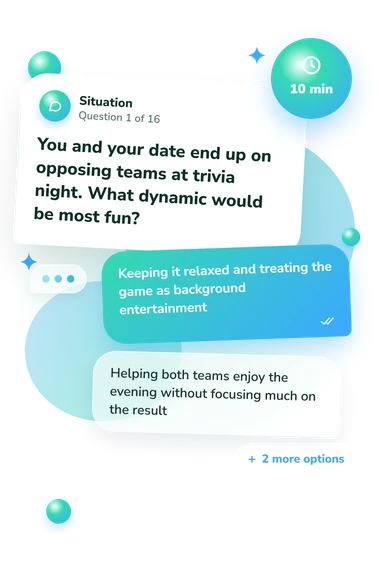
Example Questions From the Test
- Keeping a comfortable routine at a favorite local place
- Returning to somewhere familiar but adding one new activity
- Booking a themed event neither of you has tried before
- Taking an unplanned day trip and deciding each stop along the way
- A late-night arcade tournament with a running scorecard
- A bustling festival where you choose attractions as you go
- A picnic for which he remembers your favorite snacks
- A relaxed bookshop visit followed by a quiet café table
- He challenges you to an energetic activity that clears your head
- He helps you make a practical plan for tackling the problem
- He offers a fun distraction, then checks whether you want to talk
- He brings something comforting and listens without rushing you
Anime Boyfriend Quiz - Description and methodology of the test
For fans curious about how different fictional relationship styles fit their own tastes, this anime boyfriend quiz turns choices about chemistry, communication, and everyday companionship into a playful preference profile. Its anime bf quiz format ties the result to recognizable dating situations, helping readers connect fictional archetypes with their everyday preferences. The outcome suggests which qualities feel most appealing, from lively challenge to quiet attentiveness.
What This Assessment Explores
This questionnaire makes abstract partner preferences easier to recognize in everyday relationship situations. Readers considering an anime boyfriend personality test encounter scenarios about flirting, silence, planning, setbacks, encouragement, disagreement, and affection, showing which relationship rhythm feels most appealing.
The four result dimensions are:
- Fiery Rival (0-12) reflects attraction to ambition, lively debate, and playful rivalry: Softer Chemistry (0-4), Situational Spark (5-8), or Strong Affinity (9-12).
- Gentle Senpai (0-12) reflects comfort with patience, encouragement, and thoughtful care: Different Rhythm (0-4), Warm Possibility (5-8), or Strong Affinity (9-12).
- Playful Adventurer (0-12) reflects interest in spontaneity, humor, and new experiences: Steadier Pace (0-4), Welcome Adventure (5-8), or Strong Affinity (9-12).
- Quiet Strategist (0-12) reflects appreciation for observation, planning, and subtle affection: More Expressive Match (0-4), Intriguing Connection (5-8), or Strong Affinity (9-12).
Methodology and Scientific Basis
Each item presents a relationship scenario with four response options, letting you choose the reaction or gesture closest to your preference. The result reports four scale scores for comparison. The highest is your strongest affinity; totals within one point form a blended result, and the displayed bands show how pronounced each affinity is.
The method is a preference-mapping approach, not a clinical assessment. Its themes are conceptually consistent with Partner and Relationship Ideal Scales (Fletcher et al., 1999), which treats relationship ideals as multidimensional; this questionnaire is not an adaptation of that instrument. Botwin, Buss, and Shackelford (1997) connect mate preferences with personality, while Lukaszewski and Roney (2010) emphasize that preferred traits can depend on the partner considered.
The result is expressed through the displayed category bands, making the comparison useful for reflecting on the kinds of chemistry and everyday support you prefer; self-report can shift with current mood, self-awareness, or the wish to present yourself favorably. A fictional boyfriend quiz can prompt reflection without reducing your preferences to one permanent type.
- Fletcher, Garth J. O., Simpson, Jeffry A., Thomas, Geoff, & Giles, Louise. (1999). Ideals in intimate relationships. Journal of Personality and Social Psychology, 76(1), 72-89. 10.1037/0022-3514.76.1.72
- Botwin, Michael D., Buss, David M., & Shackelford, Todd K. (1997). Personality and mate preferences: Five factors in mate selection and marital satisfaction. Journal of Personality, 65(1), 107-136. 10.1111/j.1467-6494.1997.tb00531.x
- Lukaszewski, Aaron W., & Roney, James R. (2010). Kind toward whom? Mate preferences for personality traits are target specific. Evolution and Human Behavior, 31(1), 29-38. 10.1016/j.evolhumbehav.2009.06.008