
6th Grade Science Quiz
How the Scales are Structured
Who Usually Takes This Test?
See How You Compare
Below is a preview of how scores are typically distributed across each scale.
Example Questions From the Test
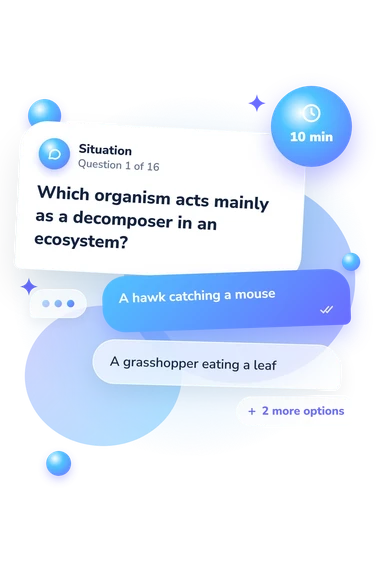
- A hawk catching a mouse
- A grasshopper eating a leaf
- A mushroom breaking down a fallen log
- A sunflower making sugar from sunlight
- They are locked into fixed positions.
- They are tightly packed and only vibrate.
- They are far apart and move freely in many directions.
- They have no mass and take up no space.
- Sedimentary rock
- Igneous rock
- Magma
- Metamorphic rock
6th Grade Science Quiz - Description and methodology of the test
Designed for learners who want to check their grasp of middle-school science, the 6th grade science quiz turns familiar classroom concepts into a focused knowledge check. It suits independent review, homework preparation, or use as a classroom-style science quiz for class 6. The result offers an overall snapshot of performance across the material sampled by the questions.
What This Assessment Explores
The questionnaire checks whether a learner can recognize core ideas and apply them to brief situations. The grade-6 science questions cover ecosystems, matter, Earth and space, cells, forces, circuits, energy, and experimental design, making this a quiz in science for grade 6 with a broad subject range. Its result gives a broad picture of sampled grade-level knowledge, indicating whether general review may be useful rather than reporting separate topic scores.
These are the main content areas represented by the questions:
- Life and Earth systems are examined through food webs, decomposition, rocks, seasons, deposition, and the Moon’s reflected light.
- Matter, cells, energy, forces, and circuits are linked to particles, density, changes, photosynthesis, motion, and electrical paths.
- Scientific investigation is represented by identifying variables, controls, and fair comparisons in plant-growth experiments.
Together, these themes define the scope of the overall result, rather than producing separate topic feedback.
Methodology and Scientific Basis
Each item presents a statement, observation, or scenario with four options; the learner selects a conclusion, process, variable, or prediction in this science quiz for a 6th-grade class.
Each correct answer adds one point to the 6th Grade Science Knowledge scale, which runs from 0-16. Results are grouped as Foundations to Revisit (0-6), Developing Knowledge (7-12), or Strong Knowledge (13-16). These bands describe this set’s performance, not population norms or a universal curriculum standard.
Conceptually, the questionnaire is consistent with Knowledge Integration (Liu et al., 2008), which emphasizes connecting ideas and applying them in context. It also reflects the National Research Council’s K-12 framework and principles from Pellegrino, Wilson, Koenig, and Beatty (2014), particularly core ideas, practices, and application. This relationship is conceptual, not a claimed adaptation or validation.
In this 6th-grade science quiz with answers presented as choices, the learner selects a response; distractors can expose misunderstandings without revealing the reasoning behind it. Guessing, reading difficulty, prior instruction, and limited topic coverage can affect results, so use the outcome to set review priorities rather than represent total scientific ability.
- Liu, Ou Lydia, Hee-Sun Lee, Carolyn Hofstetter, and Marcia C. Linn. (2008). Assessing Knowledge Integration in Science: Construct, Measures, and Evidence. Educational Assessment, 13(1), 33-55. 10.1080/10627190801968224
- National Research Council. (2012). A Framework for K-12 Science Education: Practices, Crosscutting Concepts, and Core Ideas. Washington, DC: The National Academies Press. 10.17226/13165
- Pellegrino, James W., Mark R. Wilson, Judith A. Koenig, and Alexandra S. Beatty, editors. (2014). Developing Assessments for the Next Generation Science Standards. Washington, DC: The National Academies Press. 10.17226/18409