
Dental Assistant Quiz
How the Scales are Structured
Who Usually Takes This Test?
See How You Compare
Below is a preview of how scores are typically distributed across each scale.
Example Questions From the Test
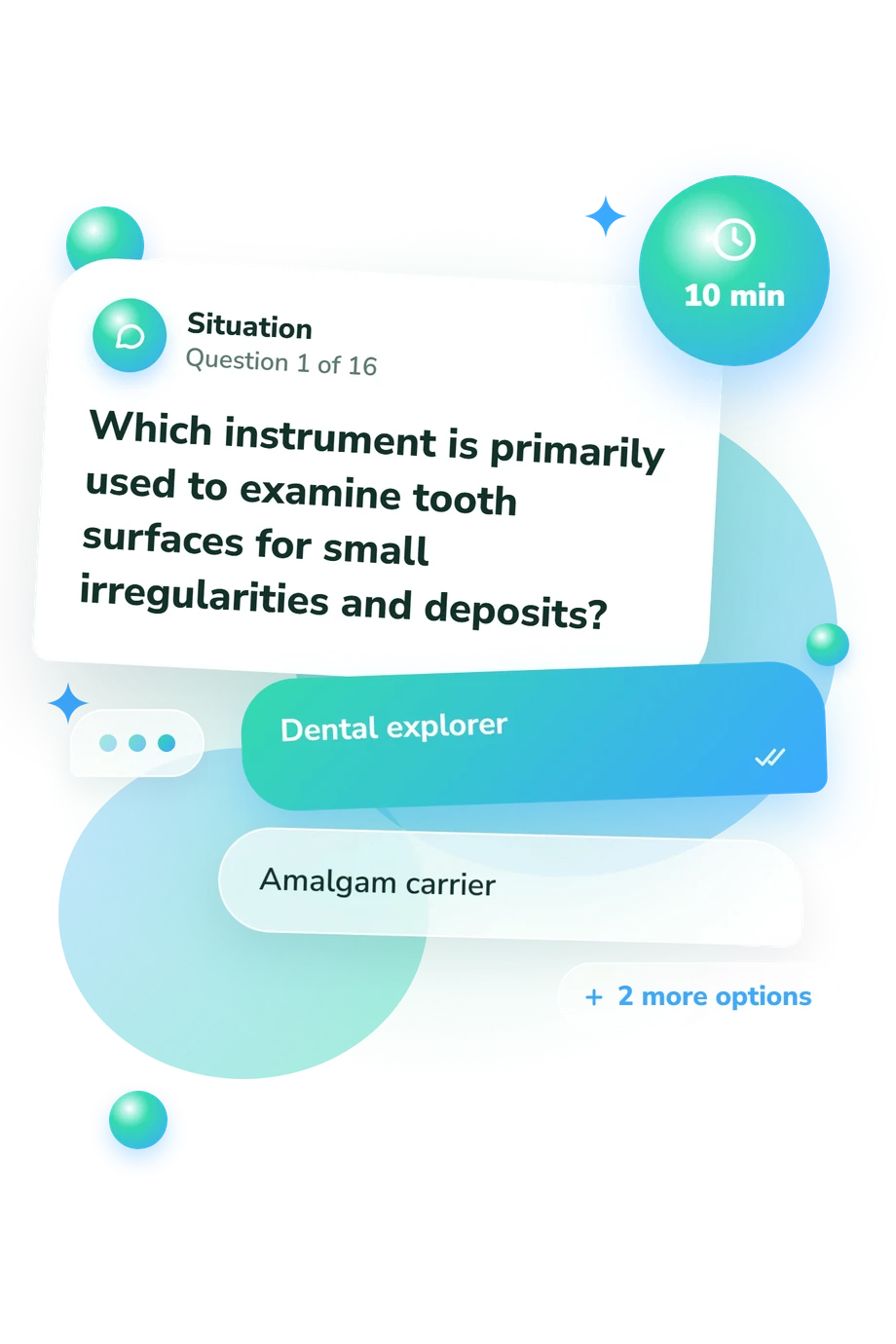
- Dental explorer
- Amalgam carrier
- Ball burnisher
- Impression tray
- Toward the cheek or lips
- Toward the tongue
- Toward the dental arch's midline
- Away from the dental arch's midline
- Toward the cheek
- Toward the tongue
- On the chewing surface
- Toward the dental arch's midline
Dental Assistant Quiz - Description and methodology of the test
People preparing for dental assisting work can use this assessment to check whether core knowledge is ready for revision or needs reinforcement. The dental assistant quiz focuses on practical understanding, helping learners see how well they can apply foundational knowledge across terminology, instruments, prevention, radiography, materials, and chairside responses. It can help direct study before coursework, workplace orientation, or a dental assistant exam preparation plan.
What This Assessment Measures
Questions cover situations a dental assistant may face in examination, treatment, documentation, and instrument processing. They assess oral anatomy and terminology, common instruments, infection prevention, radiography, restorative materials, and immediate chairside responses. Four answer choices ask for the most appropriate option rather than a free-text explanation.
For learners, this dental assistant knowledge quiz indicates whether their overall grasp of foundational concepts is still developing or relatively strong. The Dental Assistant Knowledge scale runs from 0-16, with these displayed bands:
- Foundation Building (0-6) means core ideas may need review, especially terminology, infection prevention, and chairside procedures.
- Developing Knowledge (7-12) means many fundamentals are understood, while less familiar topics need reinforcement.
- Strong Knowledge (13-16) means the result shows a solid grasp of common dental assisting concepts.
Methodology and Evidence Base
Methodologically, the questionnaire uses a structured multiple-choice format: each item presents a dental situation, definition, or procedure with four answer choices. The content moves from recall of mesial and buccal to applied judgment involving anticoagulants, fainting, sharps exposure, aerosol control, sterilization, radiographic errors, and impression handling. This questionnaire is a dental assisting practice test: respondents should read each item carefully and select the most appropriate answer from the four choices using current knowledge rather than guessing from wording.
Its content is conceptually consistent with the General Chairside Assisting (GC) outline, Robinson’s 2024 dental assisting textbook, CDC infection-control guidance, and Harte’s discussion of standard and transmission-based precautions. These sources support the subject areas and professional context; this online questionnaire is not an adaptation or validation study of those publications.
Results are presented through the displayed bands. This educational score is not certification or clinical authorization. Results may reflect recent study, attention, guessing, and interpretation of a short scenario, so use the overall result to plan further study alongside supervised learning.
- Dental Assisting National Board, Inc. General Chairside Assisting (GC) Exam Outline and References. Effective July 1, 2022.
- Robinson, Debbie S. Modern Dental Assisting. 14th ed. Elsevier; 2024.
- Kohn, William G., Amy S. Collins, Jennifer L. Cleveland, Jennifer A. Harte, Kathy J. Eklund, and Dolores M. Malvitz; Centers for Disease Control and Prevention. Guidelines for Infection Control in Dental Health-Care Settings-2003. MMWR Recommendations and Reports. 2003;52(RR-17):1-61.
- Harte, Jennifer A. Standard and Transmission-Based Precautions: An Update for Dentistry. Journal of the American Dental Association. 2010;141(5):572-581. 10.14219/jada.archive.2010.0232.
Updated: