
Horror Personality Quiz
How the Scales are Structured
Who Usually Takes This Test?
See How You Compare
Below is a preview of how scores are typically distributed across each scale.
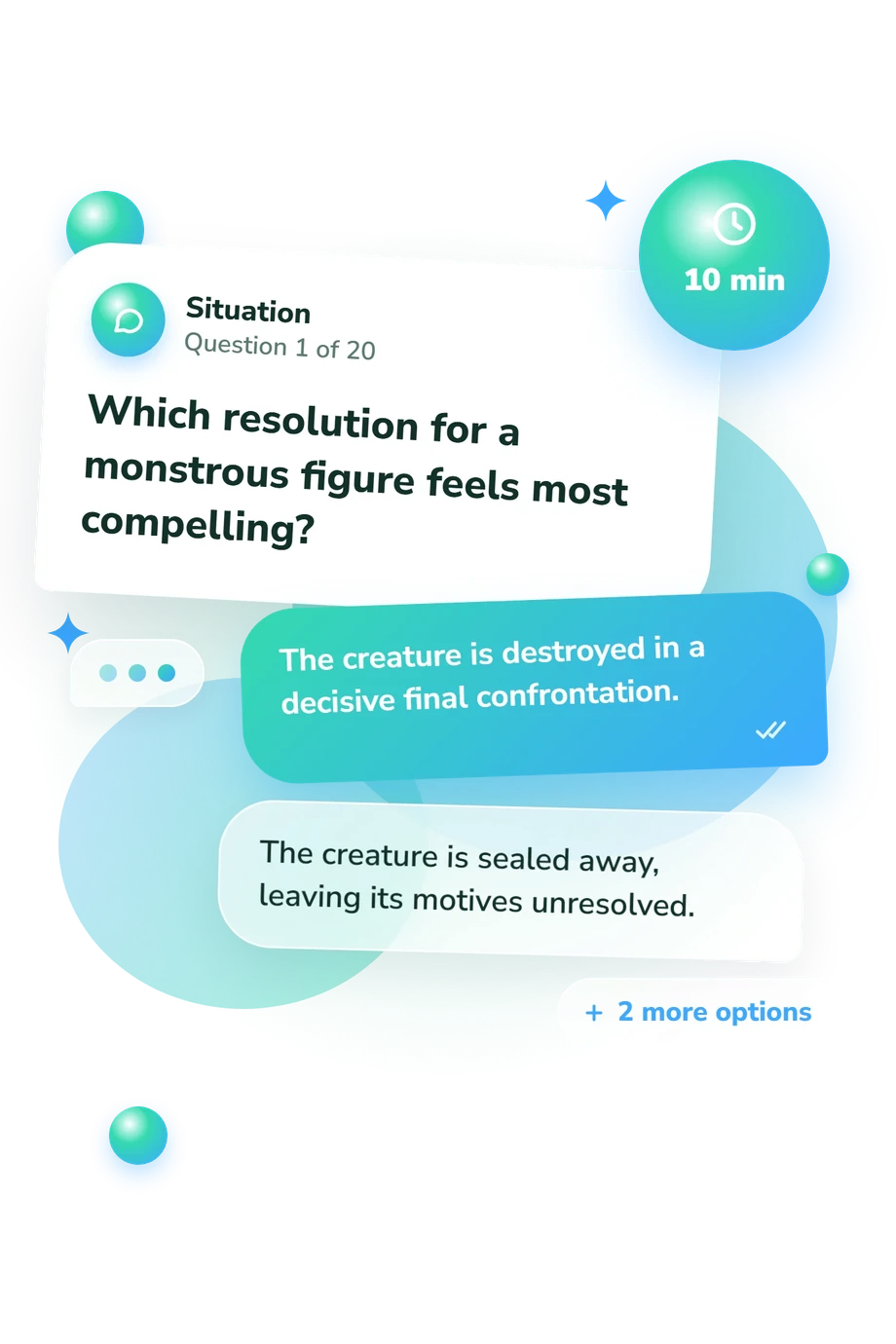
Example Questions From the Test
- A battered survival kit with one vital tool missing.
- A case file containing a photograph that should not exist.
- A protective relic whose powers come with strict conditions.
- A forbidden manuscript that changes meaning each time it is read.
- Choosing the explanation that sounds most plausible overall.
- Supporting the person who appears most shaken.
- Remembering the inconsistency in case later events clarify it.
- Comparing both accounts with physical evidence and timing.
- Scout ahead alone so the disagreement does not waste time.
- Let each person choose the route that feels right to them.
- Create pairs and check who needs the most support.
- Keep everyone together and agree on one coordinated plan.
Horror Personality Quiz - Description and methodology of the test
Designed for viewers who enjoy imaginative horror scenarios, this horror personality quiz maps affinities across five horror personas and narrative priorities involving danger, clues, supernatural rules, loyalty, and monsters. It suits readers who want a playful horror character quiz connecting story preferences with personal reactions. The result offers a profile of roles that can combine rather than a fixed label, helping you notice what holds your attention in frightening fiction.
What This Assessment Explores
Five horror personas shape the result, combining affinities for survival, investigation, loyalty, supernatural meaning, and an outsider’s viewpoint. Linking fictional choices with preferred roles, this horror movie character quiz maps narrative priorities rather than assigning one archetype. The profile includes:
- Final Survivor (0-12) measures affinity for adaptable self-preservation: Supporting Role (0-4), Escape Artist (5-8), Final Survivor (9-12).
- Occult Seeker (0-12) measures affinity for forbidden lore, ritual meaning, and uncanny systems: Earthbound Outlook (0-4), Lore Curious (5-8), Occult Seeker (9-12).
- Protective Guardian (0-12) measures affinity for loyalty and group safety: Independent Instinct (0-4), Steady Ally (5-8), Protective Guardian (9-12).
- Relentless Investigator (0-12) measures affinity for evidence and pattern-seeking: Atmosphere First (0-4), Clue Tracker (5-8), Relentless Investigator (9-12).
- Shadow Sympathizer (0-12) measures affinity for transformation, alienation, and the threat’s point of view: Threat Focused (0-4), Ambiguity Reader (5-8), Shadow Sympathizer (9-12).
Methodology and Scientific Basis
Each item presents a fictional situation with four options. You choose the action, interpretation, or viewpoint that feels natural; choices map to five persona affinities. Unstated point contributions mean ranges cannot be reverse-engineered into a scoring rule.
Fictional choices in the horror movie personality quiz connect with preferred roles, explanations, and viewpoints. The situations cover escape, clues, group responsibility, supernatural rules, and a threat’s inner world. Who would you be in a horror movie quiz? The profile turns that prompt into a view of the priorities organizing your choices.
Conceptually, parallels include Weaver et al. (2015) on survival and final-survivor themes; Crofts and van Rijswijk (2024) on horror’s subject positions; Carroll (1990) on curiosity and supernatural explanation; and Martin (2019) on audience responses. These are conceptual, not evidence of this questionnaire’s adaptation or validation.
The displayed categories are descriptive profile bands rather than clinical thresholds, and the questionnaire does not disclose how individual options contribute points. Mood, context, self-awareness, and dramatic choices can influence self-report, so the result is best read as a flexible snapshot of viewing preferences.
- Weaver, Angela D., Dana Menard, Christine Cabrera, and Angela Taylor. “Embodying the Moral Code? Thirty Years of Final Girls in Slasher Films.” Psychology of Popular Media Culture 4, no. 1 (2015): 31-46. 10.1037/ppm0000006
- Crofts, Penny, and Honni van Rijswijk. “Final Fatal Girls - Horror and the Legal Subject.” Australian Feminist Law Journal 50, no. 1 (2024): 113-129. 10.1080/13200968.2024.2333541
- Carroll, Noël. The Philosophy of Horror, or Paradoxes of the Heart. Routledge, 1990.
- Martin, G. Neil. “(Why) Do You Like Scary Movies? A Review of the Empirical Research on Psychological Responses to Horror Films.” Frontiers in Psychology 10 (2019): 2298. 10.3389/fpsyg.2019.02298
Updated: