
Am I Ready to Date Again Quiz
How the Scales are Structured
Who Usually Takes This Test?
See How You Compare
Below is a preview of how scores are typically distributed across each scale.
Example Questions From the Test
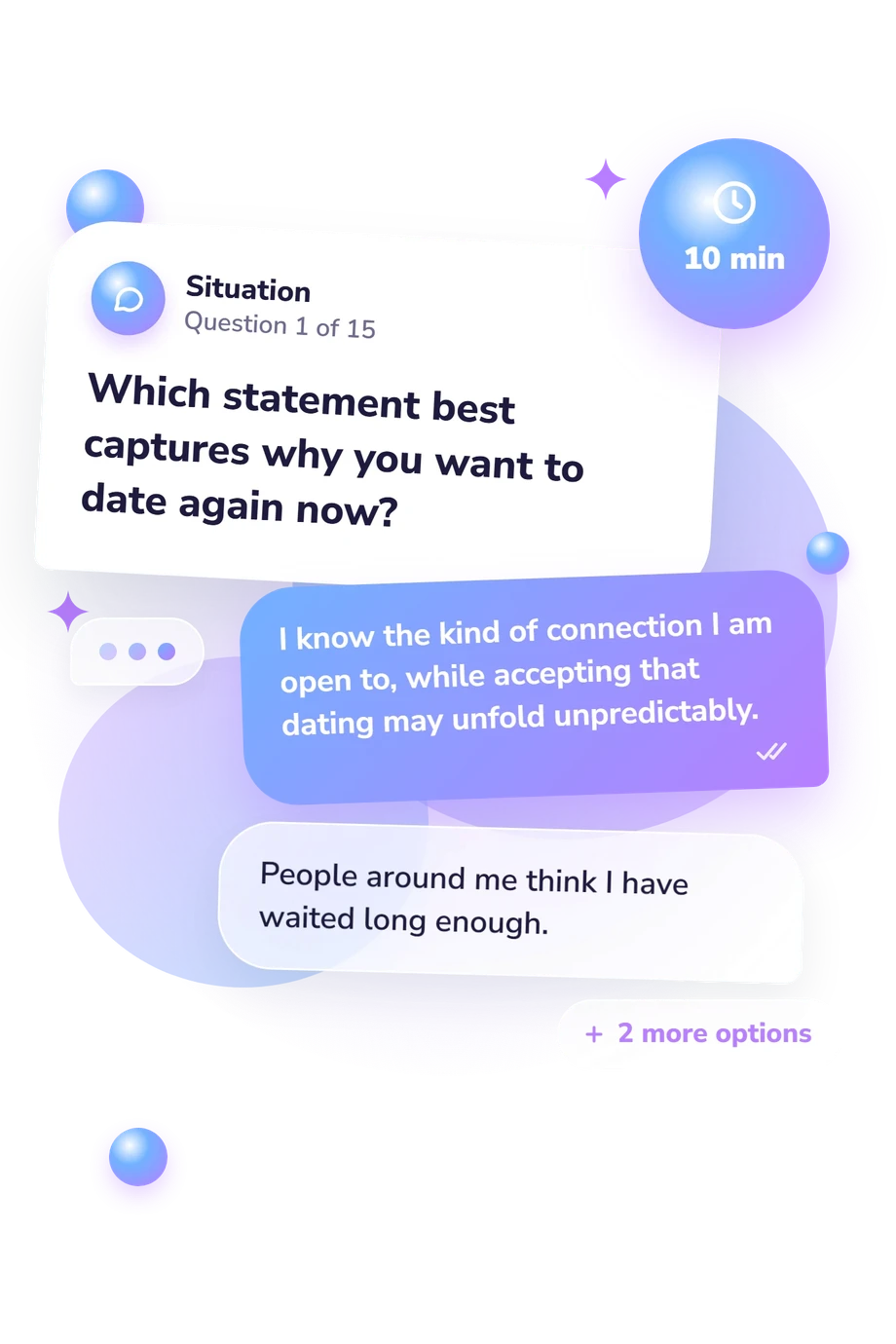
- I know the kind of connection I am open to, while accepting that dating may unfold unpredictably.
- People around me think I have waited long enough.
- I want companionship, although I am still clarifying what form I want it to take.
- I hope dating will provide momentum while other parts of life feel unsettled.
- Tell them my usual availability and continue the conversation at a better time.
- Reply each time because I do not want them to think I have lost interest.
- Answer when convenient, but leave them to infer my communication pattern.
- Let them know that late replies are occasional for me, even if stating it feels awkward.
- Agree for now and hope the pace naturally slows down.
- Say I am interested and suggest a frequency that feels sustainable to me.
- Accept one plan, then decide later whether to explain my preferred pace.
- Mention that I prefer moving more slowly and ask what pace they had in mind.
Am I Ready to Date Again Quiz - Description and methodology of the test
People considering a return to romantic life may want a pause that separates genuine interest from pressure or unfinished attachment. The Am I Ready to Date Again Quiz offers that pause through situations involving communication, pace, capacity, and emotional openness. For anyone weighing a return to romantic life, the results of this should i start dating again quiz organize uncertainty into practical areas to consider.
What This Assessment Explores
Readiness is presented as a profile rather than a yes-or-no feeling. The situations cover boundaries, pace, time, motives, former-partner comparisons, and reactions to disappointment. The result shows where interest is supported by capacity and perspective.
The result presents three dimensions:
- Boundary Communication (0-15) shows how clearly you identify, express, and maintain your relationship boundaries, preferred pace, limits, and expectations. Bands: Boundaries Need Attention (0-5), Developing Your Voice (6-10), and Clear and Flexible (11-15).
- Dating Capacity and Intentionality (0-15) shows whether dating fits your motives, time, energy, and desired direction. Bands: Capacity Is Limited (0-5), Conditions Are Taking Shape (6-10), and Purposeful Capacity (11-15).
- Emotional Availability (0-15) shows whether you can approach someone with curiosity rather than mainly through unfinished attachment or comparison. Bands: More Time May Help (0-5), Mixed but Emerging (6-10), and Emotionally Open (11-15).
Methodology and Scientific Basis
Each item is a self-report situation with four response options. The choices distinguish direct boundary-setting from appeasement, sustainable engagement from overextension, and present-moment curiosity from being pulled into old patterns. The questionnaire reports separate scores for the three dimensions, allowing the profile to show strength in one area alongside uncertainty in another. Considered together, the dimensions can clarify whether interest, capacity, and openness are moving in the same direction.
The closest conceptual anchor is the Commitment Readiness work by Agnew, Hadden, and Tan, which links readiness with decisions about entering and sustaining close relationships. This questionnaire is conceptually consistent with that work, not an adaptation of it. Brumbaugh and Fraley's findings make timing and rebound dynamics relevant to interpreting unfinished attachment, while Tran and colleagues highlight emotional adjustment after relationship dissolution, relevant to dating after a breakup.
The displayed bands are catalogue-defined interpretations, and self-report scores may shift with current mood, social pressure, self-awareness, or a wish to appear ready. The most useful reading is a set of conditions to support before and during dating, rather than a fixed verdict.
- Agnew, Christopher R., Benjamin W. Hadden, and Kenneth Tan. “It’s About Time: Readiness, Commitment, and Stability in Close Relationships.” Social Psychological and Personality Science, vol. 10, no. 8, 2019, pp. 1046-1055. 10.1177/1948550619829060
- Brumbaugh, Claudia C., and R. Chris Fraley. “Too Fast, Too Soon? An Empirical Investigation into Rebound Relationships.” Journal of Social and Personal Relationships, vol. 32, no. 1, 2015, pp. 99-118. 10.1177/0265407514525086
- Tran, Kien, Laura Castiglioni, Sabine Walper, and Ulrike Lux. “Resolving Relationship Dissolution-What Predicts Emotional Adjustment After Breakup?” Family Process, vol. 63, no. 3, 2024, pp. 1157-1170. 10.1111/famp.12914
Updated: