
What Is Your Elf Name Quiz
How the Scales are Structured
Who Usually Takes This Test?
See How You Compare
Below is a preview of how scores are typically distributed across each scale.
Example Questions From the Test
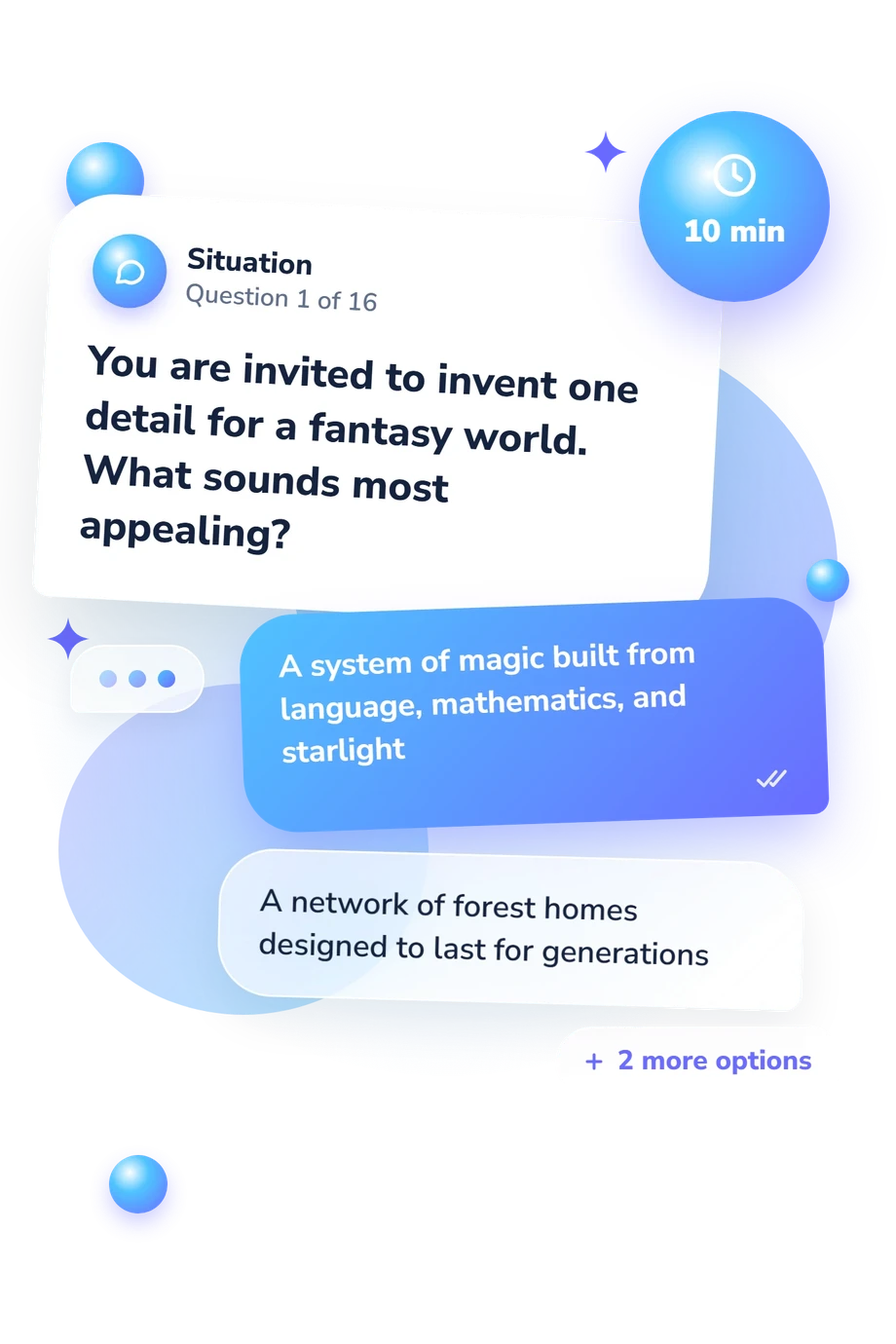
- A system of magic built from language, mathematics, and starlight
- A network of forest homes designed to last for generations
- A moonlit ritual that reveals a character’s hidden feelings
- A daring contest celebrated with music and flame
- Toward the lively fire-dancing circle at the center
- To the craft stalls to see how everything was made
- Along a lantern path where small groups are sharing stories
- To a quiet moonlit pool where music drifts through the trees
- Offer to take the first visible step and invite others to join
- Test the idea quietly before encouraging a larger commitment
- Ask whether the idea genuinely reflects what everyone wants
- Add an inventive twist that makes the possibility more compelling
What Is Your Elf Name Quiz - Description and methodology of the test
Readers who enjoy fantasy, symbolic choices, and light self-reflection can use the What Is Your Elf Name Quiz to see which elf-name affinity best fits their instincts. As an elf name quiz, it turns preferences about atmosphere, action, curiosity, and steadiness into a themed profile. The result helps visitors notice which style feels most resonant while keeping the interpretation playful rather than treating an invented name as a fixed identity.
What This Assessment Explores
Scenarios touch atmosphere, emotional sensitivity, social energy, curiosity, action, and reliability; results read these themes through serene, quietly expressive; spirited, adventure-seeking; imaginative, celestial; or grounded, woodland-rooted affinities. For anyone wondering what their elf name might be, this fantasy personality quiz offers a symbolic preference pattern, not folklore knowledge or a fixed personality type. The four displayed affinities are:
- Aeloria Moonwhisper (0-12) reflects serene, intuitive, quietly expressive affinity: Daylight Spirit (0-4), Twilight Echo (5-8), or Moonwhisper Affinity (9-12).
- Caelen Emberglade (0-12) reflects spirited, warm, adventure-seeking affinity: Quiet Flame (0-4), Rising Ember (5-8), or Emberglade Affinity (9-12).
- Nymera Starweaver (0-12) reflects imaginative, curious, celestial affinity: Earthbound Focus (0-4), Starlit Curiosity (5-8), or Starweaver Affinity (9-12).
- Thalion Greenbough (0-12) reflects grounded, dependable, woodland-rooted affinity: Wandering Branch (0-4), Forest Kinship (5-8), or Greenbough Affinity (9-12).
The leading affinity describes your strongest style; a one-point difference can blend names.
Methodology and Scoring
Each item presents four answers to a fantasy situation. You select the response that feels natural, so the questionnaire captures preference through forced choice rather than agreement ratings.
The scoring logic is defined by the questionnaire's four comparative scale totals: the highest total is the strongest affinity, and totals within one point can form a blended result. The displayed bands are descriptive labels for each range; they are not population norms and do not establish diagnostic cutoffs.
Rather than adapting a published personality instrument, this themed fantasy name quiz is a self-reflection questionnaire whose four affinities and bands are defined by its own displayed scales.
Your outcome reflects the pattern across your choices, not a single item. The result shows which elf-name affinity is strongest overall.
Because self-perception and current context affect answers, the profile may shift with mood or situation and is best read as a playful snapshot.
- Jorgenson, Eric. “Development of the Statistical ‘Which Character’ Personality Quiz.” Open-Source Psychometrics Project, 2020, updated 2026.
- Waskul, Dennis, and Matt Lust. “Role-Playing and Playing Roles: The Person, Player, and Persona in Fantasy Role-Playing.” Symbolic Interaction, vol. 27, no. 3, 2004, pp. 333-356. 10.1525/si.2004.27.3.333
- Cohen, Jonathan. “Defining Identification: A Theoretical Look at the Identification of Audiences With Media Characters.” Mass Communication & Society, vol. 4, no. 3, 2001, pp. 245-264. 10.1207/S15327825MCS0403_01
- Kaufman, Geoff F., and Lisa K. Libby. “Changing Beliefs and Behavior Through Experience-Taking.” Journal of Personality and Social Psychology, vol. 103, no. 1, 2012, pp. 1-19. 10.1037/a0027525
Updated: