
Characteristics of Life Quiz
How the Scales are Structured
Who Usually Takes This Test?
See How You Compare
Below is a preview of how scores are typically distributed across each scale.
Example Questions From the Test
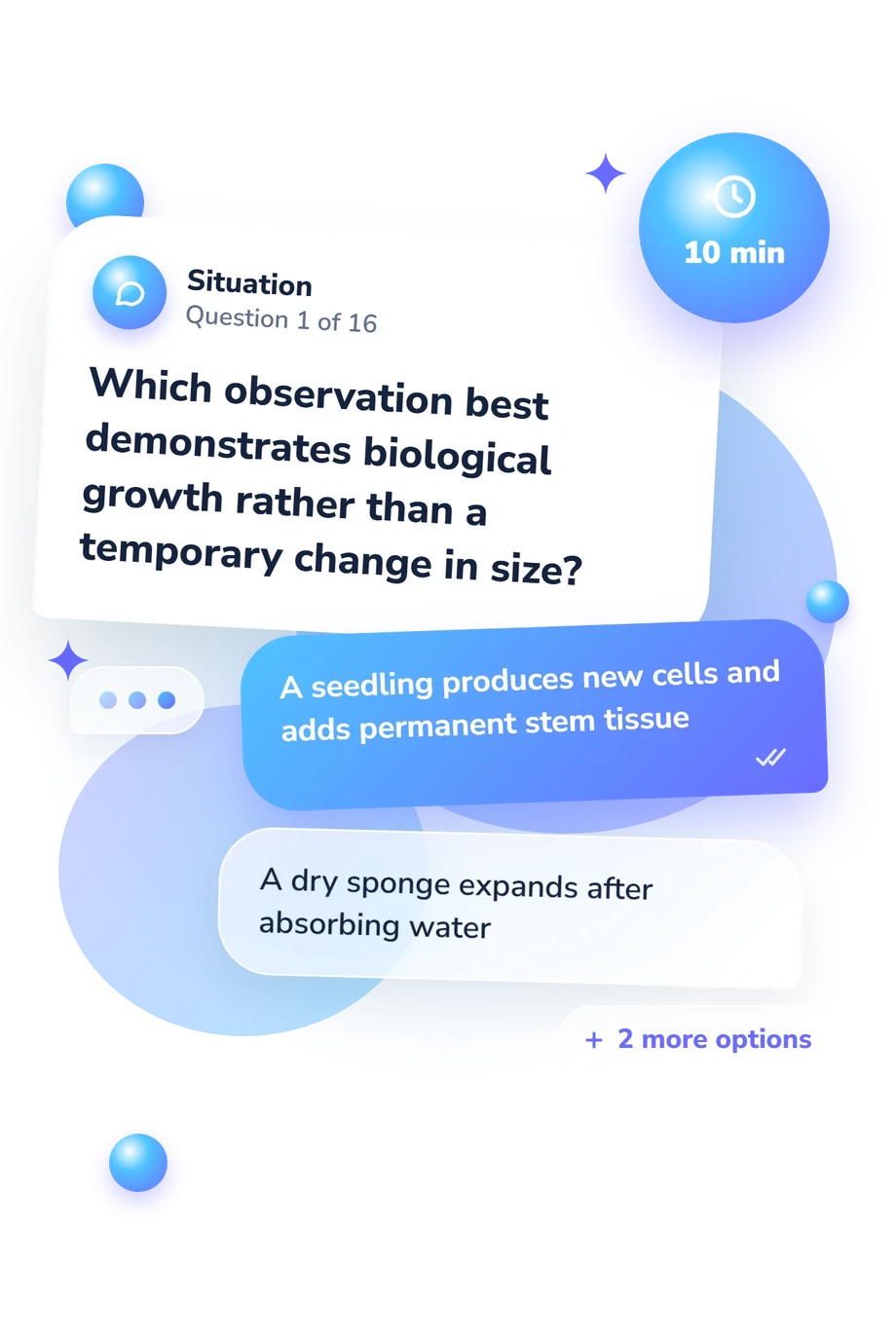
- A seedling produces new cells and adds permanent stem tissue
- A dry sponge expands after absorbing water
- A balloon enlarges when air is added
- A metal lid expands while being heated
- Response to a stimulus
- Reproduction
- Hereditary variation
- Cellular respiration
- Growth through an increase in cell number
- Evolution through natural selection
- Homeostasis through temperature regulation
- Reproduction through cell division
Characteristics of Life Quiz - Description and methodology of the test
For learners reviewing introductory biology, this Characteristics of Life Quiz offers a focused way to connect familiar examples with the defining processes of living systems. It suits students who want to check conceptual understanding through a biology quiz on characteristics of life before moving into more detailed study. Because many items ask for explanation rather than isolated recall, the result points toward ideas that deserve another look.
What This Assessment Explores
The questionnaire applies core biology concepts to a seedling, lizard, yeast, bacteria, and crystals. As an assessment of the characteristics of life, it distinguishes biological processes from changes that merely look similar, such as expansion or heat release.
The result appears on the Characteristics of Life Knowledge scale (0-16). It is one overall knowledge score showing how well the respondent recognizes and applies features of living systems. The bands are Foundations to build (0-6), Developing knowledge (7-12), and Strong knowledge (13-16).
The main thematic areas are:
- Cellular organization and growth show how living structures are built and develop.
- Energy use, regulation, and response show how organisms process resources and maintain internal conditions.
- Heredity, reproduction, and evolution show how biological information continues and populations change.
The overall result helps learners choose broad topics for review; it does not measure general intelligence.
Methodology and Scientific Basis
Each question uses a four-option multiple-choice format and presents a concept or biological situation, asking for the best answer; many items test explanation and distinction rather than only recall. The alternatives test distinctions such as biological growth versus temporary enlargement, metabolism versus simple heat release, and individual change versus population evolution. The displayed total is matched to the listed band; no additional scoring rule is assumed.
As a test of the characteristics of life, the questionnaire is conceptually consistent with Hsu, Dorner, and Hill (2026), who examine how learners connect cellular organization, metabolism, regulation, heredity, growth, reproduction, and evolution when identifying living systems. MacKenzie (2006) supports comparison and explanation through a learning-cycle approach, while Clark, Douglas, and Choi (2018) provide an introductory framework for cells, energy, homeostasis, heredity, and evolution. It is conceptually consistent with these sources, not a standardized adaptation of them.
The band reflects conceptual knowledge; vocabulary, attention, confidence, and context may affect performance. The cited works support conceptual alignment but do not establish validation or norms for this questionnaire, so use the result to guide broad review.
- Hsu, Jeremy L., Meredith A. Dorner, and Kate M. Hill. "What is alive? Students' conceptions of the traits that unite living organisms." Advances in Physiology Education 50, no. 2 (2026): 518-524. 10.1152/advan.00139.2025
- MacKenzie, Ann Haley. "Learning Cycle: What Is the Biological Definition of Life?" American Biology Teacher 68, no. 6 (2006): 330-331.
- Clark, Mary Ann, Matthew Douglas, and Jung Choi. Biology 2e. Houston, TX: OpenStax, 2018.
Updated: