
Dance Quiz
How the Scales are Structured
Who Usually Takes This Test?
See How You Compare
Below is a preview of how scores are typically distributed across each scale.
Example Questions From the Test
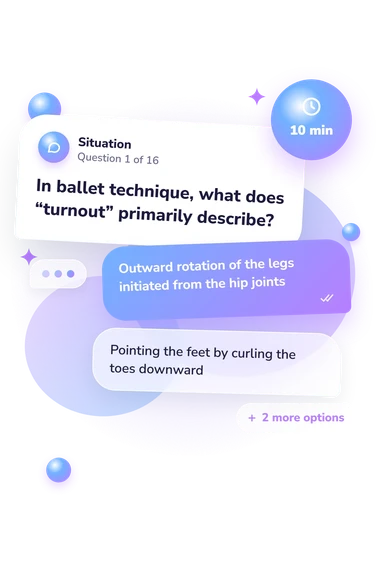
- Outward rotation of the legs initiated from the hip joints
- Pointing the feet by curling the toes downward
- Turning the torso away from the audience
- Completing a full spin on one supporting leg
- House-music clubs in Chicago
- Dancehall events in Kingston
- Hip-hop block parties in the South Bronx
- Punk venues in London
- Managing ticket sales and front-of-house operations
- Conducting the musicians during every performance
- Creating and organizing movement for the performance
- Designing and constructing the stage scenery
Dance Quiz - Description and methodology of the test
People who want to connect classroom concepts with what happens in rehearsal can use this online dance assessment as a focused starting point. It suits students, performers, teachers, and curious newcomers seeking a clearer picture of their current understanding. The dance quiz links factual recall with practical judgment rather than treating dance as a single style. Its result provides a broad knowledge profile across the tested dance concepts.
What This Assessment Explores
Across the items, the assessment checks whether a respondent can recognize dance vocabulary and apply basic ideas to movement, rehearsal, and stage situations. It suits participants, teachers, viewers, and curious newcomers building general dance literacy.
The sole result is Dance Knowledge, scored 0-16. Bands are Foundations to build (0-6), Developing dance literacy (7-12), and Strong dance knowledge (13-16). This dance knowledge test reflects breadth of recognition, not physical ability or artistic originality.
The questions cover these areas:
- Technique checks recognition of turnout, barre work, spotting, warm-up, and safe landing.
- Choreography shows understanding of unison, canon, counterbalance, and improvisation.
- Musicality connects meter, counting, rhythm, and percussive sound with movement.
- Stagecraft covers direction, pathway, level, and relation to the audience.
- History addresses origins, styles, and cultural settings.
Methodology and Evidence Base
Each item presents a prompt and four answer choices. The questions about dancing ask the respondent to select the option that best fits a term, situation, or principle; each correct response adds one point. The total is interpreted through descriptive bands. The format rewards applying concepts rather than physical demonstration.
McCutchen’s dance-education work connects vocabulary, technique, context, and application, and this questionnaire is conceptually consistent with that approach. Choreographic relationships in the items are conceptually consistent with Blom and Chaplin’s discussion of movement relationships, while Kassing and Kirschenbaum’s 2021 curriculum text offers a broader educational perspective. These works did not produce the questionnaire, which is not an adaptation of them. No standardized norms or validation data have been established for this online questionnaire, so its score bands are descriptive.
Read the result as a snapshot of selected knowledge. A higher band suggests stronger performance across sampled concepts; a lower band points to review topics. The score does not measure physical skill, creativity, professional readiness, or complete knowledge of every tradition. Multiple-choice recognition may differ from what someone can explain or perform spontaneously, so use the result to direct further learning.
- McCutchen, Brenda Pugh. Teaching Dance as Art in Education. Human Kinetics, 2006. ISBN 9780736051880.
- Blom, Lynne Anne, and L. Tarin Chaplin. The Intimate Act of Choreography. University of Pittsburgh Press, 1982. 10.2307/j.ctt5hjqp1.
- Kassing, Gayle, and Danielle Jay Kirschenbaum. Dance Teaching Methods and Curriculum Design, 2nd ed. Human Kinetics, 2021. ISBN 9781492572398.