
Is Santa Real Yes or No Quiz
How the Scales are Structured
Who Usually Takes This Test?
See How You Compare
Below is a preview of how scores are typically distributed across each scale.
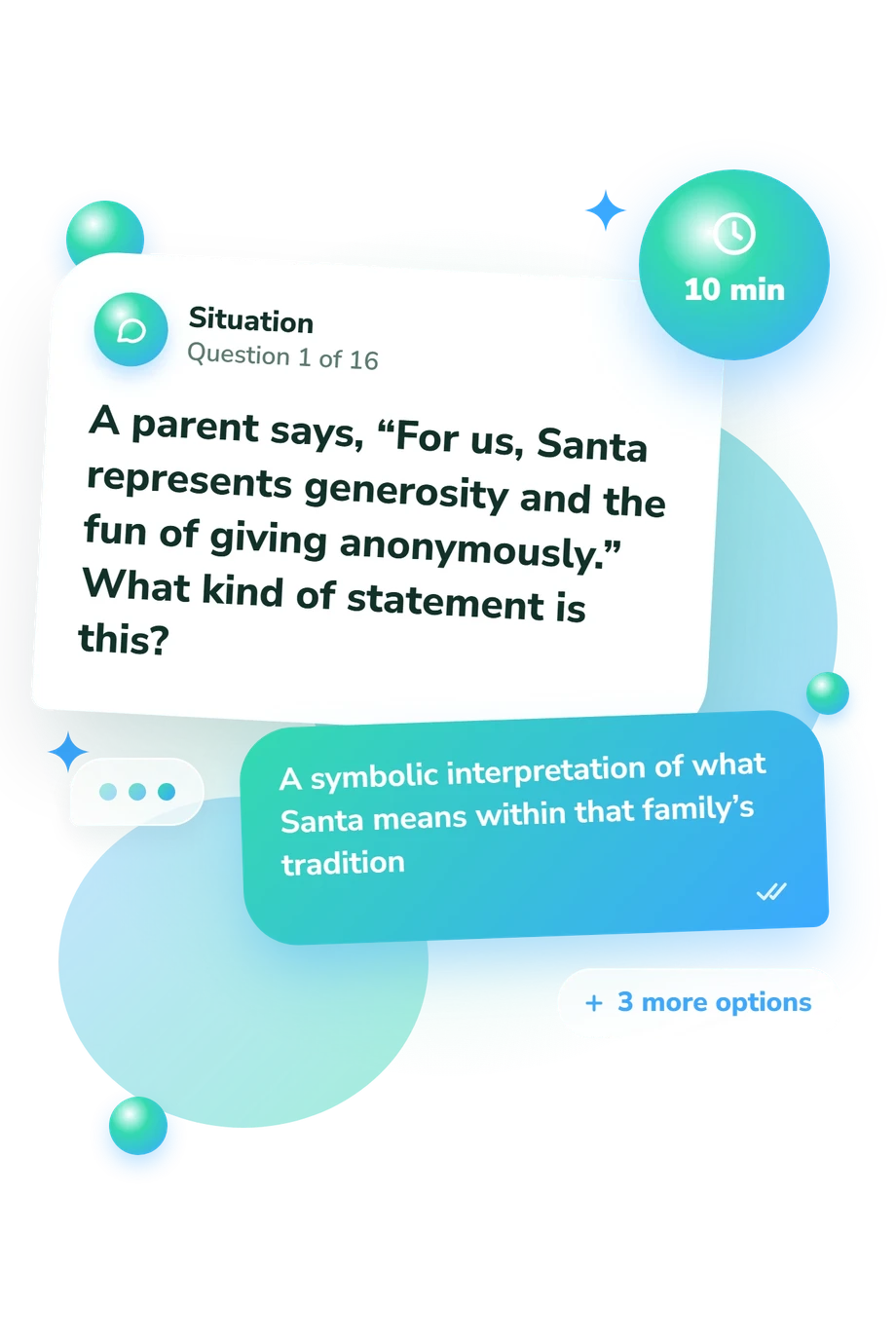
Example Questions From the Test
- The Dutch tradition of Sinterklaas
- The German tradition of the Christkind
- The Italian tradition of La Befana
- The French tradition of Père Noël
- That the artist personally observed a magical gift delivery
- How Santa was portrayed in that place and period
- That every modern Santa detail was already fixed worldwide
- That the drawing is a photograph of the historical Saint Nicholas
- John Tenniel
- Beatrix Potter
- Norman Rockwell
- Thomas Nast
Is Santa Real Yes or No Quiz - Description and methodology of the test
Visitors who want to examine the boundary between cultural tradition, historical evidence, and literal belief can use the Is Santa Real Yes or No Quiz as a guided self-reflection exercise. It suits readers curious about how Santa developed and about the knowledge needed to distinguish symbolic meaning from claims of supernatural events. Its Santa history quiz format makes that distinction concrete without turning the result into a verdict on personal beliefs.
What This Assessment Explores
The assessment asks readers to distinguish the historical Saint Nicholas from the later cultural character of Santa Claus. Its themes include folklore, literature, advertising, family symbolism, and the difference between observation and evidence for a supernatural claim. Readers can approach it as a Santa knowledge test that uses evidence-based reasoning to assess historical and cultural knowledge rather than private belief.
The result appears on one scale, Santa Knowledge (0-16), which reflects knowledge of Santa’s history, cultural development, and the difference between tradition and verifiable evidence. The bands are:
- Starting Out (0-6) indicates that familiar ideas may be mixed with historical facts and suggests reviewing how the modern character developed.
- Developing (7-12) shows that many traditions and evidence types are distinguished, although some gaps remain.
- Strong Knowledge (13-16) indicates consistent separation of historical, symbolic, and supernatural claims alongside recognition of Santa’s cultural significance.
Methodology and Evidence Base
Each item presents four answer options and asks the reader to choose the strongest historical, cultural, or evidence-based interpretation. Within the Is Santa Real Quiz, each question compares claims, sources, and explanations rather than inviting a vote about personal preference.
The result is reported through the displayed bands and describes performance on this questionnaire rather than a universal measure of belief or expertise; seasonal familiarity, cultural background, current knowledge, and careful reading can influence it.
Adam English’s historical account separates the historical Nicholas tradition from later Santa development. Okleshen, Baker, and Mittelstaedt explain how advertising can shape collective cultural memory, while the 1823 poem supports the early literary history of sleigh, reindeer, and chimney imagery. Together, these sources are conceptually consistent with the questionnaire’s themes; they do not make it an adaptation of those works.
The items ask readers to connect historical sources, cultural practices, and literal claims, so interpretation should stay close to what the questions actually examine.
- English, Adam C. "St Nicholas to Santa Claus." In The Oxford Handbook of Christmas, edited by Timothy Larsen, 252-264. Oxford University Press, 2020. 10.1093/oxfordhb/9780198831464.013.22
- Okleshen, Cara, Stacey Menzel Baker, and Robert Mittelstaedt. "Santa Claus does more than deliver toys: Advertising's commercialization of the collective memory of Americans." Consumption, Markets & Culture 4, no. 3 (2000): 207-240. 10.1080/10253866.2000.9670357
- Anonymous. "A Visit from St. Nicholas." Troy Sentinel, December 23, 1823.
Updated: