
AP Human Geography Quiz
How the Scales are Structured
Who Usually Takes This Test?
See How You Compare
Below is a preview of how scores are typically distributed across each scale.
Example Questions From the Test
- 7,200 people per square kilometer
- 125 people per square kilometer
- 800 people per square kilometer
- 80 people per square kilometer
- Thailand
- Cambodia
- Myanmar
- Laos
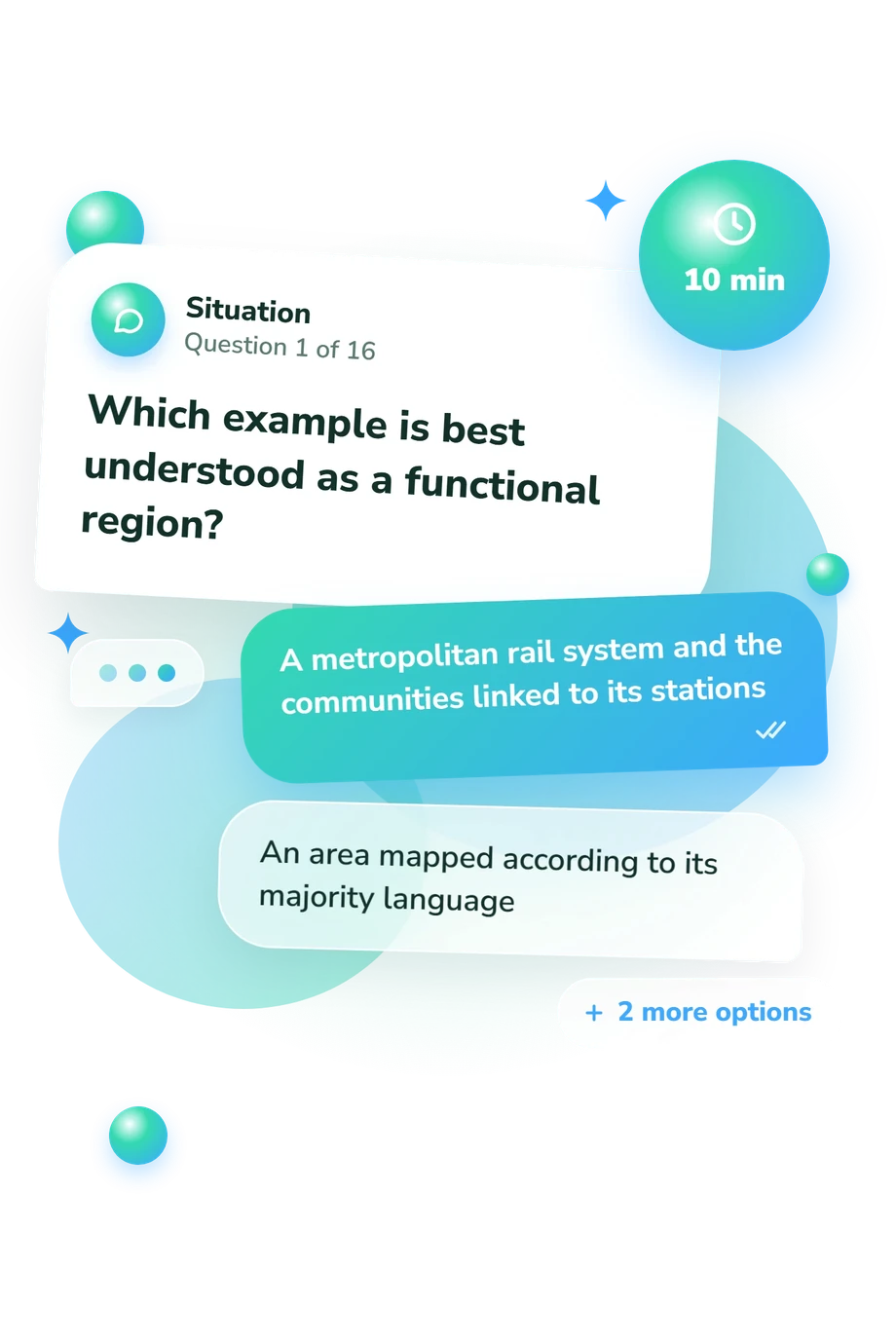
- A downtown area that residents informally call the arts district
- A state whose legally defined borders establish its jurisdiction
- A commuter shed connected to a central city by daily travel
- An area that fans associate with a particular sports team
AP Human Geography Quiz - Description and methodology of the test
Students preparing for classwork, an AP course, or a unit review can use the AP Human Geography Quiz to see how accurately they handle the material covered here. The result offers a snapshot of demonstrated command, with higher bands indicating stronger performance on this set rather than complete course readiness. As an AP human geography practice quiz, it gives learners a bounded result to interpret alongside broader preparation.
What This Assessment Explores
Introductory AP knowledge is tested through short spatial scenarios in this human geography quiz. It connects definitions with examples involving density, migration, demographic transition, political organization, boundaries, regions, cities, agriculture, diffusion, and location.
Several items require application of von Thünen’s agricultural land-use model or Burgess’s concentric-zone model. The result therefore reflects vocabulary recognition and the ability to choose an explanation that fits a geographic situation.
It is intended for learners reviewing course content, not for measuring a single isolated fact.
Your displayed result uses one scale:
- AP Human Geography Knowledge: 0-16 measures the number of correct answers. Foundations to strengthen (0-6) identifies a need to review major regions and analytical vocabulary; Developing command (7-12) shows recognition of many core ideas with more practice needed for comparison and application; Strong command (13-16) indicates consistent location identification and accurate use of central concepts.
Methodology and Scientific Basis
Each item uses a multiple-choice format with four alternatives, asking you to identify the best concept, calculation, location, or explanation. The score is the number of correct responses, so the bands describe demonstrated performance on this set of items rather than a percentile or probability estimate. Learners can use the quiz for AP Human Geography practice while revisiting the concepts tested by missed items.
Its content framing is conceptually consistent with the College Board AP Human Geography framework. The regional, cultural, population, urban, agricultural, and political concepts represented here correspond to established course areas, but this online questionnaire is not an adaptation of a published instrument.
The displayed bands are catalogue-defined study guidance, not evidence of national norms, established reliability, or a validated placement standard. Because answers depend on attention, prior instruction, and the particular items encountered, the result reflects performance on this content set and cannot represent every AP Human Geography topic.
- College Board. AP Human Geography Course and Exam Description. Version 1. New York, NY: College Board, 2020.
- Hildebrant, Barbara S., Max Lu, Kenneth H. Keller, and Roderick P. Neumann. Human Geography for the AP Course. 1st ed. New York, NY: Bedford, Freeman & Worth, 2021.
- Rubenstein, James M. The Cultural Landscape: An Introduction to Human Geography. AP Edition, 13th ed. Hoboken, NJ: Pearson, 2020.
- Newbold, K. Bruce. "Population Geography." In International Encyclopedia of Geography: People, the Earth, Environment and Technology, edited by Douglas Richardson, Noel Castree, Michael F. Goodchild, Audrey Kobayashi, Weidong Liu, and R. A. Marston. Wiley, 2017. 10.1002/9781118786352.wbieg1040.
Updated: