
Semicolon Quiz
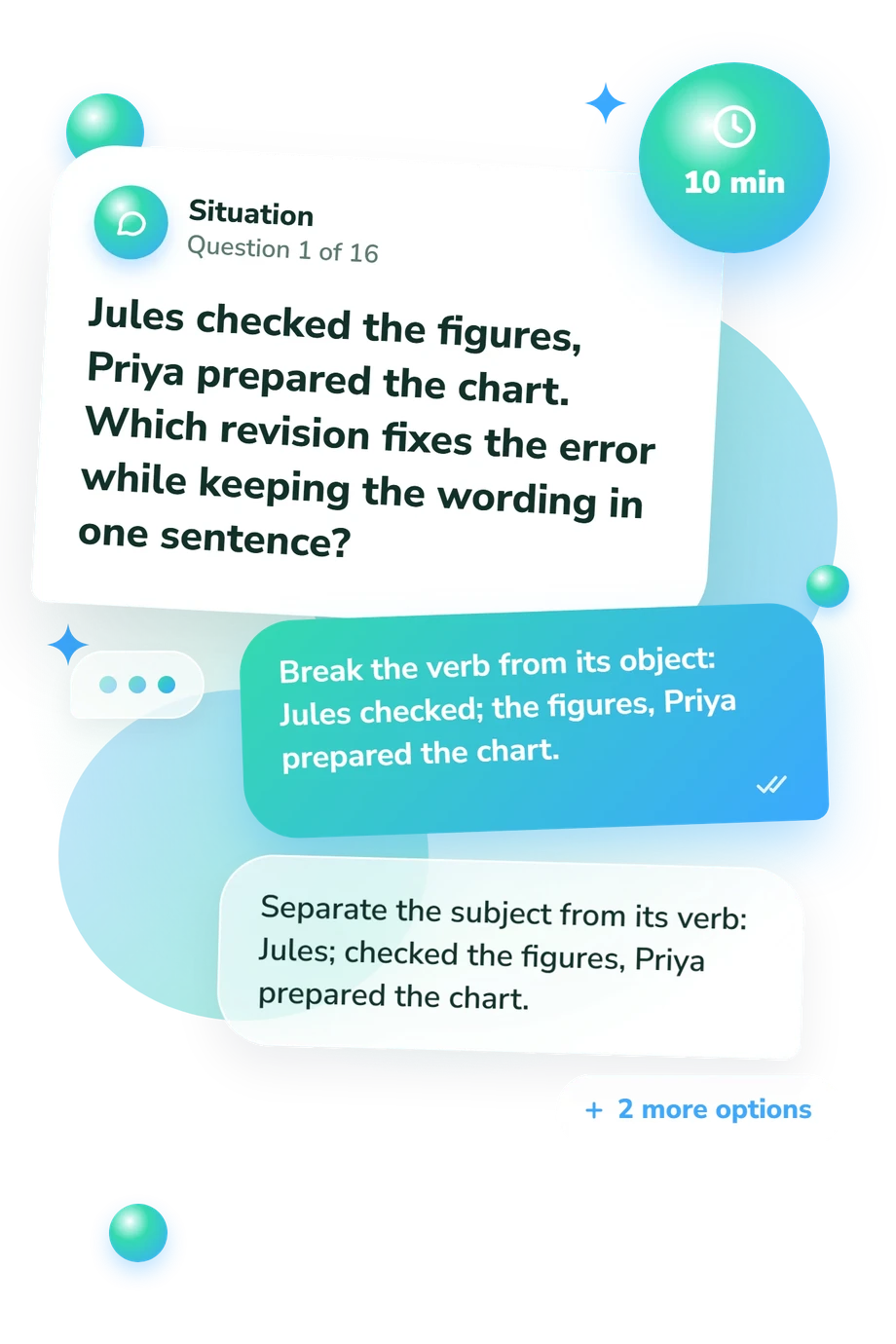
How the Scales are Structured
Who Usually Takes This Test?
See How You Compare
Below is a preview of how scores are typically distributed across each scale.
Example Questions From the Test
- Because the forecast changed; we postponed the picnic.
- The forecast; changed before the picnic.
- We postponed the picnic; because the forecast changed.
- The forecast changed; we postponed the picnic.
- The storm; arrived before sunset.
- We stayed inside because the storm was severe.
- We brought; flashlights in case the power failed.
- Although the storm ended; the roads remained flooded.
- The museum closes at six; our tour begins at four.
- The museum closes at six; and our tour begins at four.
- When the museum closes at six; our tour will be over.
- The museum guide scheduled; our tour for four.
Semicolon Quiz - Description and methodology of the test
For readers deciding whether to review formal sentence punctuation, this semicolon quiz offers a bounded way to judge whether its question format matches their needs. As a semicolon practice quiz, it gives people working on writing, editing, or study a direct self-check; the result can help them choose between reviewing core constructions and attempting more varied exercises.
What This Assessment Explores
This questionnaire focuses on semicolon usage in independent clauses, transitions, complicated lists, and places where a semicolon is wrong or unnecessary. Items also use quotation marks, dependent clauses, and contrasts between complete thoughts. Some choices contrast a semicolon with a colon, but the reported result concerns semicolon decisions.
The result is reported as Semicolon Knowledge (0-16), with one point for each correct answer. The visitor sees Foundations to build (0-6), Developing control (7-12), or Strong command (13-16). The tested areas are:
- Independent-clause use shows whether you can join two complete thoughts without creating a comma splice.
- Transition use shows whether you can place a semicolon before however, instead, or for example and a comma after the transition.
- Complex-list use shows whether you can separate entries containing internal commas while preserving the structure.
Methodology and Evidence Base
Each item tests semicolon punctuation through a sentence or brief context with four answer choices. You select the version that applies the rule rather than writing a revision. The displayed scoring assigns one point for each correct answer, so the result reflects the number of correct responses.
Questions cover clause joining, transitions such as however and instead, complex lists, quotation placement, dependent clauses, and contrasts where a colon may be tempting. Four choices make the task one of recognition: you identify the acceptable construction rather than produce one from scratch.
The questionnaire is conceptually consistent with explanations of semicolon use by Geoffrey Nunberg and colleagues and by Kaufman and Straus. It presents comparable distinctions without claiming to reproduce or adapt either publication.
The result may vary with familiarity with formal written English and attention at the time; the displayed bands describe performance on this questionnaire and should not be generalized to overall writing ability.
- Nunberg, Geoffrey, Ted Briscoe, and Rodney Huddleston. “Punctuation.” In The Cambridge Grammar of the English Language, edited by Rodney Huddleston and Geoffrey K. Pullum, pp. 1723-1764. Cambridge University Press, 2002. 10.1017/9781316423530.021
- Kaufman, Lester, and Jane Straus. The Blue Book of Grammar and Punctuation: An Easy-to-Use Guide with Clear Rules, Real-World Examples, and Reproducible Quizzes. 12th ed. John Wiley & Sons, 2021. ISBN 978-1-119-65302-8
Updated: