
Climate Change Quiz
How the Scales are Structured
Who Usually Takes This Test?
See How You Compare
Below is a preview of how scores are typically distributed across each scale.
Example Questions From the Test
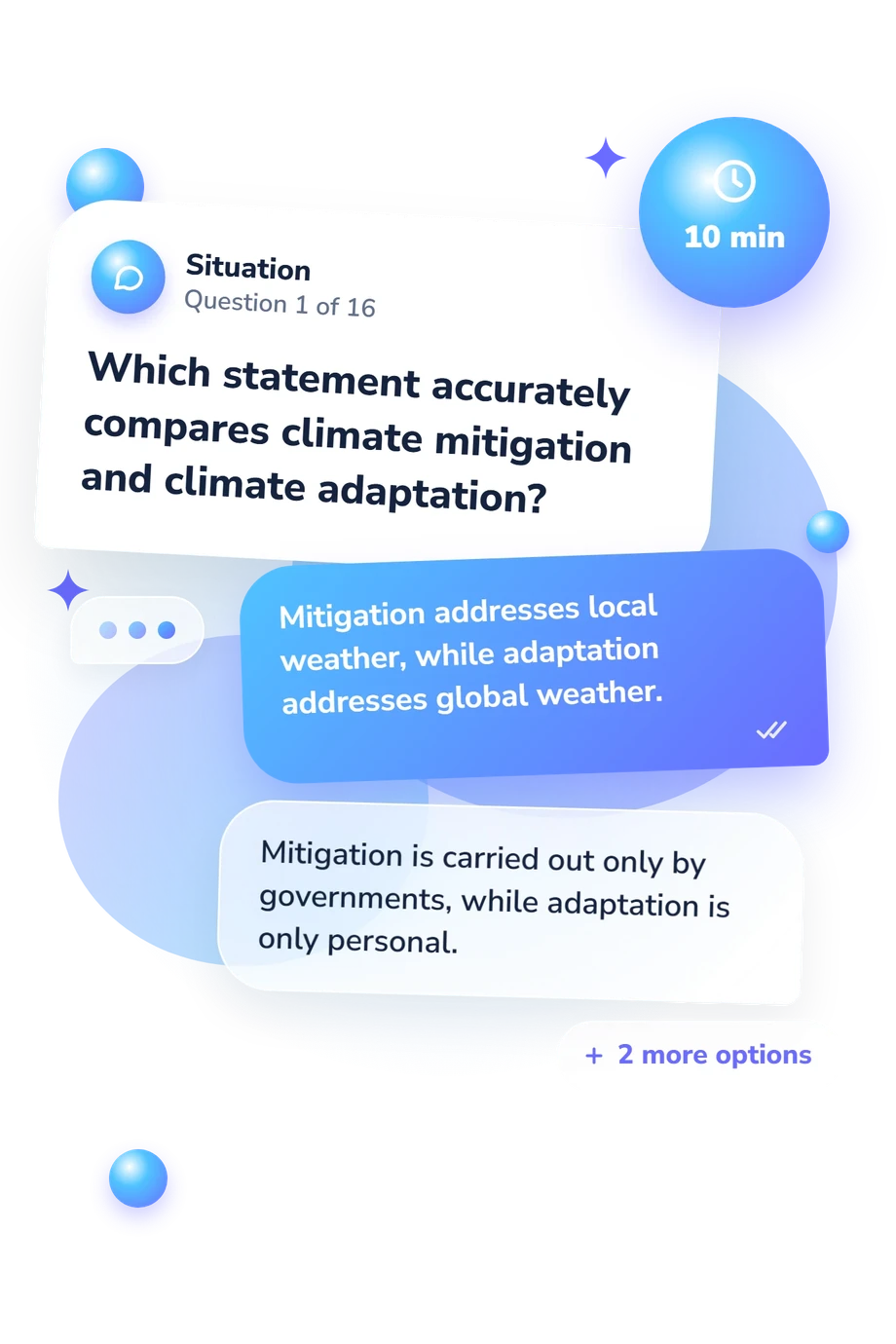
- Mitigation addresses local weather, while adaptation addresses global weather.
- Mitigation is carried out only by governments, while adaptation is only personal.
- Mitigation limits climate change; adaptation reduces vulnerability to its effects.
- Mitigation begins after impacts occur, while adaptation must happen beforehand.
- Wetlands can absorb wave energy and floodwater while also storing carbon.
- Wetlands permanently stop tropical storms from reaching land.
- Wetlands prevent all future sea-level rise near the community.
- Wetlands cause seawater to evaporate before it reaches buildings.
- A building code requiring stronger flood protection
- A ban on construction within an erosion zone
- A grant for monitoring endangered species
- A carbon tax based on the amount of emissions produced
Climate Change Quiz - Description and methodology of the test
For learners, educators, and curious adults, this assessment offers a focused way to check whether climate information can guide everyday and policy decisions. The climate change quiz asks readers to reason about causes, evidence, impacts, mitigation, and adaptation rather than report personal habits. Each answer choice gives the quiz on climate a practical purpose by requiring each respondent to distinguish a scientifically supported explanation from plausible alternatives.
What This Assessment Explores
Rather than measuring personal emissions, the questionnaire checks whether a respondent can use climate concepts accurately. The scenarios cover greenhouse gases, observed changes, land use, energy, resilience, mitigation, and adaptation. The scenarios in this global warming quiz connect evidence about causes with choices for responding to impacts.
The following themes describe what the questions test:
- Greenhouse science tests whether the respondent understands the greenhouse effect and heat-trapping gases.
- Evidence and trends test whether long-term indicators are distinguished from isolated weather.
- Impacts and resilience test whether protective actions are recognized as ways to reduce vulnerability.
- Mitigation and adaptation test whether emissions cuts are separated from preparing for effects.
Climate Change Knowledge (0-16) is banded as Foundations to build (0-6), Developing knowledge (7-12), or Strong knowledge (13-16). It reflects educational understanding, not personal environmental impact or scientific expertise.
Methodology and Scientific Basis
Each item presents a short statement or practical scenario with four answer choices. Selecting the option that best matches climate science tests recognition and application across everyday and policy contexts. The format of this global warming questions and answers quiz requires the respondent to connect climate concepts with evidence, impacts, and responses.
The output is one educational score, and its three bands summarize overall climate knowledge rather than separate topic scores. A correct choice can support review, yet it does not by itself demonstrate complete mastery.
Its content is conceptually consistent with the Climate Change Concept Inventory, a published measure of climate-change understanding, while this questionnaire remains a separate online assessment. Research by Tobler and colleagues also addresses climate knowledge, and the IPCC 2023 synthesis supports distinctions among causes, impacts, mitigation, and adaptation.
Results can be influenced by guessing, wording, current context, and self-awareness, so the overall score is best read as a focused learning signal and guide to topics for further study.
- Libarkin, Julie C., Anne U. Gold, Sara E. Harris, Karen S. McNeal, and Ryan P. Bowles. "A new, valid measure of climate change understanding: associations with risk perception." Climatic Change, vol. 150, nos. 3-4, 2018, pp. 403-416. 10.1007/s10584-018-2279-y
- Tobler, Christina, Vivianne H. M. Visschers, and Michael Siegrist. "Consumers’ knowledge about climate change." Climatic Change, vol. 114, no. 2, 2012, pp. 189-209. 10.1007/s10584-011-0393-1
- Intergovernmental Panel on Climate Change. IPCC, 2023: Climate Change 2023: Synthesis Report. Contribution of Working Groups I, II and III to the Sixth Assessment Report of the Intergovernmental Panel on Climate Change [Core Writing Team, H. Lee and J. Romero, eds.]. Intergovernmental Panel on Climate Change, Geneva, Switzerland, 184 pp. 10.59327/IPCC/AR6-9789291691647
Updated: