
AP World Unit 1 Quiz
How the Scales are Structured
Who Usually Takes This Test?
See How You Compare
Below is a preview of how scores are typically distributed across each scale.
Example Questions From the Test
- Centralized rule by scholar-officials
- Decentralized feudal relationships and manorial organization
- Administration through the Inca mit’a
- Government by urban merchant republics across medieval Europe
- Conversion imposed uniformly by an Abbasid army
- Migration of European Christian peasants into the region
- Isolation from Indian Ocean commercial connections
- Gradual diffusion through trade networks and Sufi activity
- Training European knights in mounted warfare
- Creating the first Confucian civil service examinations
- Organizing Atlantic voyages to the Americas
- Translating and extending Greek, Persian, and Indian scholarship
AP World Unit 1 Quiz - Description and methodology of the test
Students preparing for early-course global history assessments can use the AP World Unit 1 Quiz to check whether they recognize major institutions, belief systems, trade connections, and state-building strategies. As an AP World history unit 1 quiz, it suits learners whose courses call the opening material Chapter 1 and who want a focused review of Unit 1 content.
What This Assessment Measures
The questions examine how societies organized power, justified authority, connected across regions, and managed labor, resources, and belief. Scenarios move among Europe, Africa, Asia, and the Americas, asking learners to identify historical patterns rather than isolated names. The result shows how securely institutions are connected with broader developments.
These result bands appear on the AP World Unit 1 Knowledge scale (0-16):
- Foundation to Build (0-6) indicates that core Unit 1 institutions, states, and regional patterns need structured review.
- Developing Command (7-12) shows recognition of many central developments, with more practice needed in comparison and causation.
- Strong Unit 1 Command (13-16) reflects knowledge that transfers across regions and historical situations.
For courses that call the opening material Chapter 1, this AP World history quiz for that chapter indicates whether general Unit 1 review may be useful; its single total does not identify separate needs in political organization, cultural exchange, economic networks, or technology and population growth.
Methodology and Evidence Base
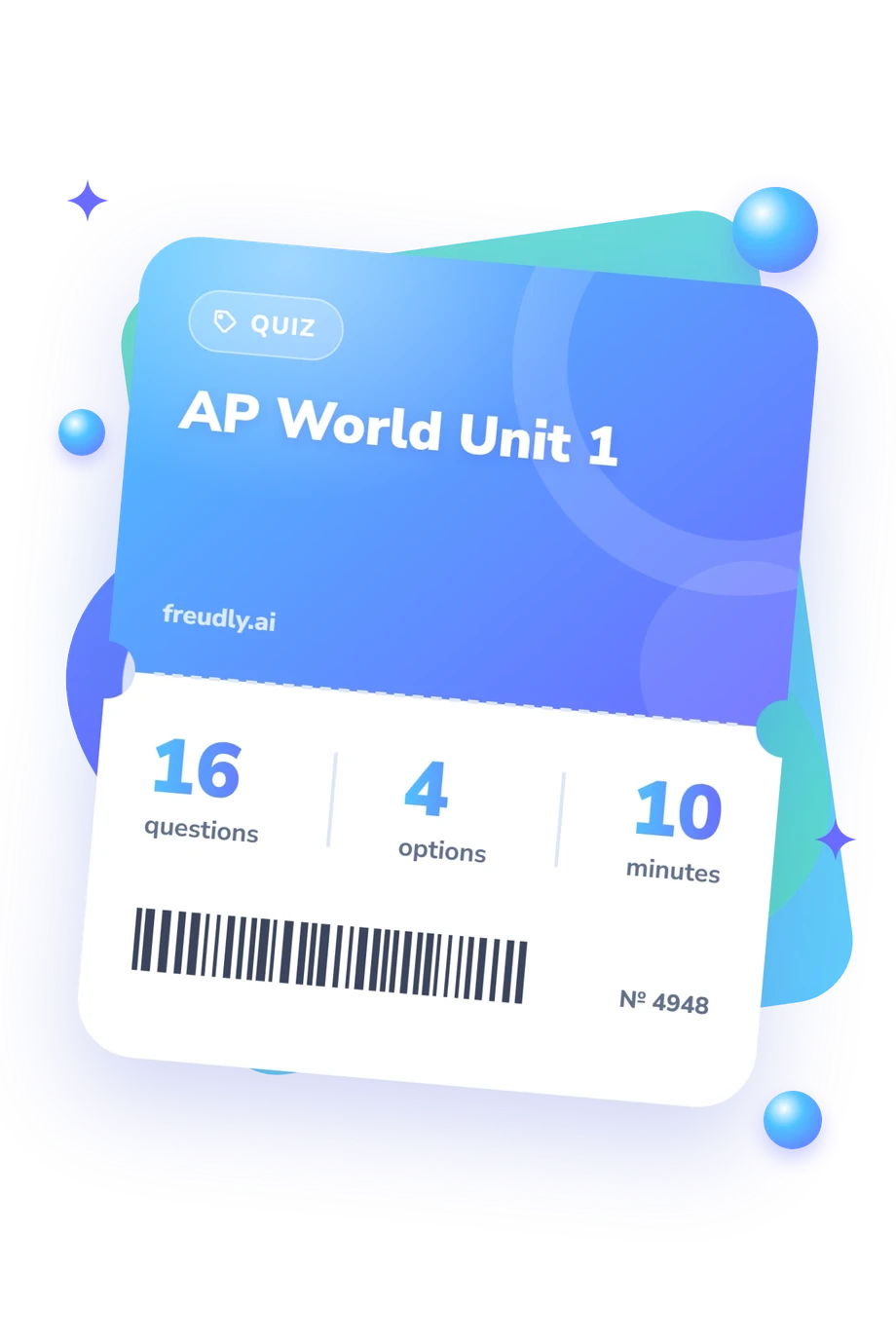
Each item presents a historical scenario or description followed by four answer choices. The respondent chooses the option that best explains the evidence, process, institution, or comparison. This selected-response approach tests application of course concepts, not merely vocabulary. As an AP World Unit 1 practice quiz, it offers practice recalling and applying Unit 1 content; an incorrect response alone cannot show whether misunderstanding or haste caused it.
Scoring is additive: every correct answer contributes one point, producing the displayed total. The result is a curriculum-aligned snapshot of current knowledge, not a normed psychological score; no population norms or clinical interpretation are attached to it.
The content is consistent with the College Board course description for AP World History: Modern, emphasizing regional interaction, state building, belief systems, exchange, and causation. Strayer and Nelson’s global-history textbook and Fromherz’s study of Gulf and Indian Ocean trade are curricular and content references, not validation evidence for the online quiz. This quiz is not an adaptation of a published instrument.
Study, memory, and familiarity with wording can affect performance, so one result should guide review, not define ability.
- College Board. AP World History: Modern Course and Exam Description, Effective Fall 2026. College Board, 2026.
- Strayer, Robert W., and Eric W. Nelson. Ways of the World for the AP World History Modern Course Since 1200 C.E.: A Global History with Sources. 5th ed. Macmillan Learning, 2023. ISBN 9781319409302.
- Fromherz, Allen. "Towards a World History of the Medieval Gulf: Distinctive Cosmopolitanism and Trade." Journal of Medieval Worlds, vol. 2, nos. 1-2, 2020, pp. 1-10. 10.1525/jmw.2020.2.1-2.1.
Updated: