
Am I Punk Quiz
How the Scales are Structured
Who Usually Takes This Test?
See How You Compare
Below is a preview of how scores are typically distributed across each scale.
Example Questions From the Test
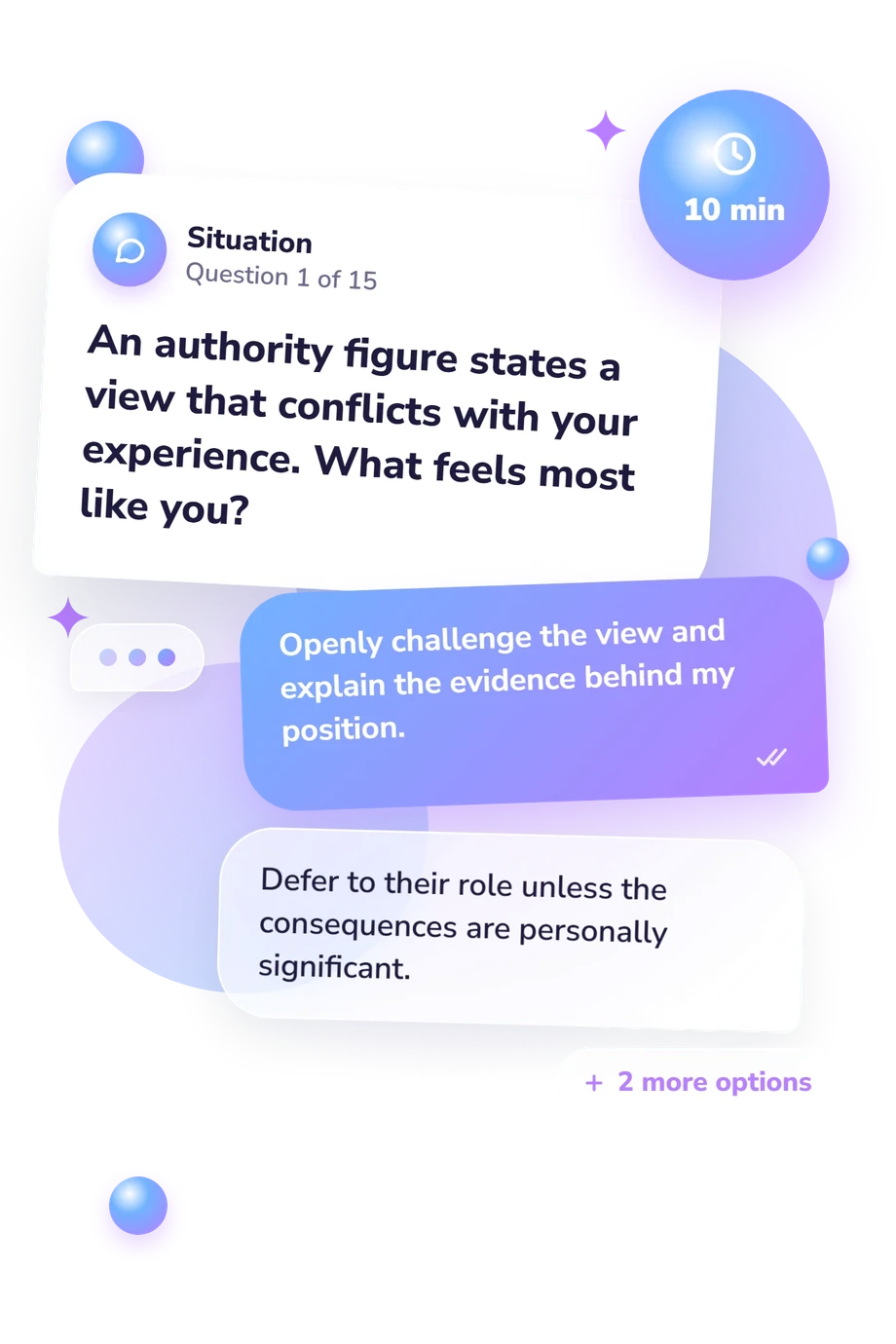
- Openly challenge the view and explain the evidence behind my position.
- Defer to their role unless the consequences are personally significant.
- Keep my disagreement mostly private while reflecting on both views.
- Ask direct questions and test the reasoning before deciding.
- Collaborate with friends and learn a few design skills together.
- Commission someone experienced to produce a polished flyer.
- Make it from scratch and embrace the rough edges as part of it.
- Customize a ready-made template so it feels more personal.
- Wait for a sale or secondhand version that fits my budget.
- Make or organize an alternative, possibly sharing it with others.
- Adapt an inexpensive substitute so it serves the same purpose.
- Buy the commercial version if the quality makes it worthwhile.
Am I Punk Quiz - Description and methodology of the test
People who are curious about punk as more than a music label can use the Am I Punk Quiz to examine how everyday choices relate to autonomy, expression, community, and questioning conventions. It suits anyone reflecting on their relationship with punk culture, whether they participate actively or simply want a clearer picture of the values and habits behind their affinity. This punk quiz makes that reflection more concrete.
What This Assessment Explores
Rather than reducing punk to a yes-or-no identity, the assessment separates connected forms of involvement. Its scenarios cover authority, making, public action, music, clothing, events, and ideas about success. Read as a punk ideology quiz, it focuses on lived choices rather than style alone. The result presents three dimensions:
- DIY Autonomy (0-15) shows how much you favour making or adapting beyond established channels: Established Routes (0-5), Selective DIY (6-10), and DIY-Led (11-15).
- Punk Expression and Community (0-15) shows connection with music, style, participation, and inclusive culture: Casual Connection (0-5), Active Affinity (6-10), and Scene-Centered Expression (11-15).
- Questioning Conventions (0-15) shows readiness to examine authority, expectations, and inherited success ideals: Convention-Oriented (0-5), Selective Challenger (6-10), and Independent Dissenter (11-15).
Methodology and Evidence Base
Each item presents a situation with four response choices. The options distinguish deference, independence, participation, adaptation, or challenge, so you select what feels typical rather than what sounds most rebellious. Rather than giving a single yes-or-no identity, the assessment interprets patterns across the three dimensions.
Each displayed dimension receives a score, but the questionnaire does not state how individual answers contribute to those scores. Results describe the orientation represented by your answers, not a pass/fail status. Honest responses are more useful than choosing an idealized identity.
The questionnaire’s DIY and community themes are conceptually consistent with Culton and Holtzman’s (2010) study of a punk scene. Hebdige links style with social expression, while McKay discusses autonomous activity and participation in punk culture. These works provide context for the themes, but the questionnaire is not an adaptation of them.
Rather than reducing the outcome to a quiz about what kind of punk you are, the result clarifies which punk-related tendencies are more prominent in your profile. Because answers are self-reported, scores may shift with current experiences, self-awareness, and interpretation of each situation.
- Culton, Kenneth R., and Ben Holtzman. “The Growth and Disruption of a ‘Free Space’: Examining a Suburban Do It Yourself (DIY) Punk Scene.” Space and Culture 13, no. 3 (2010): 270-284. 10.1177/1206331210365258
- Hebdige, Dick. Subculture: The Meaning of Style. London: Methuen, 1979.
- McKay, George. “Was punk DIY? Is DIY punk? Interrogating the DIY/punk nexus, with particular reference to the early UK punk scene, c. 1976-1984.” DIY, Alternative Cultures & Society 2, no. 1 (2024): 94-109. 10.1177/27538702231216190
Updated: