
Should I Be a PA or NP Quiz
How the Scales are Structured
Who Usually Takes This Test?
See How You Compare
Below is a preview of how scores are typically distributed across each scale.
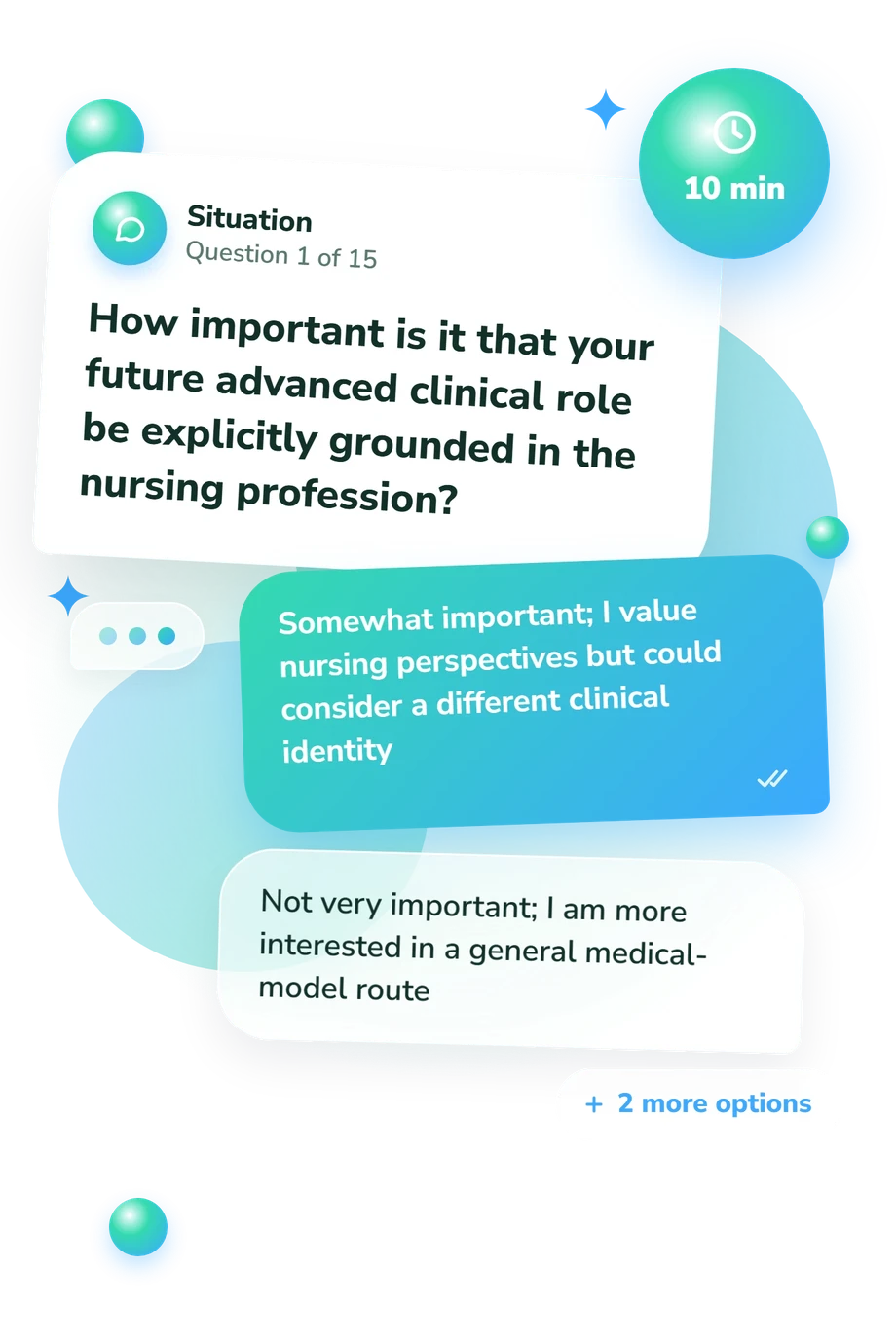
Example Questions From the Test
- Broad medical rotations across several specialties, followed by choosing where to begin practice
- Broad rotations sound useful, but I would still want substantial emphasis on one patient population
- Training rooted specifically in nursing practice and an established nursing population focus
- A clinical role with a narrower technical or therapeutic focus from the outset
- Keep both routes open and compare what graduates can actually do in the settings I prefer
- Reassess both routes, while retaining a modest preference for one
- Continue with my chosen professional route unless the new information makes it impractical
- Prioritize preserving my chosen PA or nursing identity, even if that narrows the available programs
- Somewhat important, although I would accept meaningful retraining or added credentials
- Very important; the possibility of changing specialties is a major attraction
- Not central; I would rather build depth in a population focus selected during training
- Useful, but less important than location, schedule, or employer culture
Should I Be a PA or NP Quiz - Description and methodology of the test
People considering a physician assistant or nurse practitioner route can use the Should I Be a PA or NP Quiz to compare professional identity, educational structure, and preferred clinical work. It is intended for prospective students asking whether to become a physician assistant while keeping the NP route visible.
What This Assessment Explores
This assessment explores fit rather than choosing a career for you. Its items consider nursing identity, medical-model education, population focus, rotations, specialty movement, and program differences. It suits people comparing both pathways who want clearer priorities for a PA or NP career choice.
The result separates a pull toward one route from flexibility between both. A higher score signals alignment with that dimension, not admission. The displayed dimensions are:
- NP Path Affinity (0-15) shows alignment with advanced nursing identity, nursing-based care, and population- or specialty-focused preparation: Limited NP pull (0-5), Possible NP fit (6-10), Strong NP affinity (11-15).
- PA-NP Flexible Fit (0-15) reflects openness to either preparation when both could support broader goals: Defined direction (0-5), Conditional flexibility (6-10), Strong dual-path fit (11-15).
- PA Path Affinity (0-15) shows alignment with generalist medical training, team care, and specialty movement: Limited PA pull (0-5), Possible PA fit (6-10), Strong PA affinity (11-15).
Methodology and Scientific Basis
Each question presents a training or career scenario with four response options. Choices cover broad or population-focused preparation, nursing or medical identity, specialty mobility, program comparison, and local scope rules. Selections are aggregated into the three displayed scores; read the shown band rather than guessing point values for an individual answer. Scores within one point indicate a blended affinity.
The framework is conceptually consistent with Gillette et al. (2022), which examined valued job attributes among physicians, PAs, and NPs. That study supports the relevance of work priorities, not validation of this questionnaire. Kozikowski et al. (2024) is a close reference for PA specialty flexibility, while Gillette et al. (2026) addresses training and employment factors in health-profession choices. These sources support construct relevance, not norms, reliability, or clinical cutoffs for this online tool.
Self-report means current expectations, incomplete information, and response bias may shape the profile. Use it to frame questions about prerequisites, scope, cost, and specialty options along a physician assistant or nurse practitioner career path, then verify requirements with current programs and regulators.
- Gillette C, Everett C, Ostermann J, Garvick S, Momen J, Boles G, Crandall S. Job attributes valued by physicians, PAs, and NPs: A cross-sectional survey. Journal of the American Academy of Physician Assistants. 2022;35(9):46-50. 10.1097/01.JAA.0000854532.13833.74
- Gillette C, Ostermann J, Aguilar AA, O’Neal S, Everett C, Caviness D, Patel E, Steele L, Goel D, Tabassum QM. What factors influence health professions trainees’ preferences for employment in rural Appalachia? A qualitative study to inform the design of a discrete choice experiment. Medical Education Online. 2026;31(1):2649666. 10.1080/10872981.2026.2649666
- Kozikowski A, Bruza-Augatis M, Morton-Rias D, Puckett K, Jeffery C, Cawley JF, Hooker RS, Quella A, Mauldin S, Goodman J. Physician assistant/associate career flexibility: factors associated with specialty transitions. BMC Health Services Research. 2024;24:1660. 10.1186/s12913-024-12158-7
Updated: