
Carbon Cycle Quiz
How the Scales are Structured
Who Usually Takes This Test?
See How You Compare
Below is a preview of how scores are typically distributed across each scale.
Example Questions From the Test
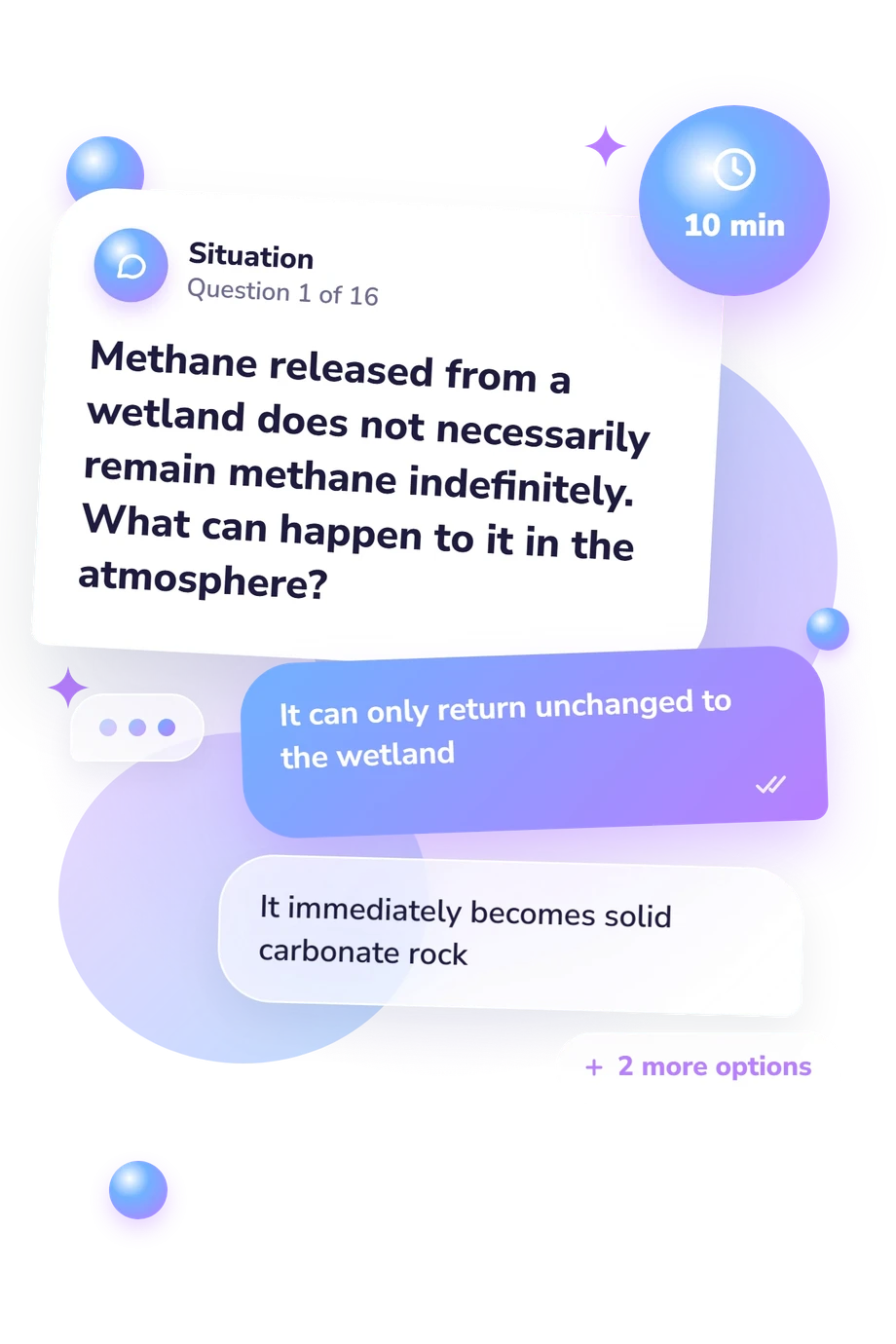
- It can only return unchanged to the wetland
- It immediately becomes solid carbonate rock
- It is converted into nitrogen through photosynthesis
- It can be oxidized, eventually producing carbon dioxide
- Freshwater rivers
- Living land animals
- Clouds
- The oceans
- Atmosphere to biosphere
- Ocean to soil
- Geosphere to atmosphere
- Biosphere to hydrosphere
Carbon Cycle Quiz - Description and methodology of the test
For students, teachers, and curious readers, the carbon cycle quiz offers a focused way to check whether major carbon movements make sense as connected processes rather than isolated facts. It suits anyone preparing to study ecology, climate science, Earth systems, or environmental change. A carbon cycle knowledge test can show which relationships are secure and which deserve review.
What This Assessment Measures
This assessment checks whether you can track carbon among the atmosphere, biosphere, hydrosphere, and geosphere, linking reservoirs to the fluxes that move carbon through them. The items include carbon-cycle quiz questions on feeding, respiration, decomposition, photosynthesis, combustion, weathering, ocean chemistry, and long-term storage. They ask you to connect biological, oceanic, geological, and atmospheric pathways rather than recall definitions.
Results use Carbon Cycle Knowledge (0-16): Foundations to build (0-6), Developing knowledge (7-12), or Strong knowledge (13-16). The band shows how consistently you identify major carbon-cycle relationships and human effects.
The main themes represented by the items are:
- Reservoirs and fluxes show whether you distinguish storage locations from transfer processes.
- Biological cycling reveals whether you connect plants, animals, microbes, and decay.
- Earth-system pathways show how you follow oceanic, geological, and atmospheric exchange.
- Human impacts indicate whether you recognize effects of burning, land use, and tillage.
Methodology and Evidence Base
Methodologically, this is a selected-response knowledge check. Each item describes a situation and offers four alternatives, with one point for each correct answer. The total therefore counts correct responses; it does not measure confidence, attitudes, or personal experience.
The framework is conceptually consistent with ISACC (You et al., 2018), which emphasizes disciplinary and interdisciplinary understanding of carbon cycling. Its diagnostic-question approach also aligns with Cordero Maskiewicz et al. (2012), where linked questions can reveal relationships learners do not coordinate. Falkowski et al. (2000) provides the broader Earth-system context for reservoirs, exchanges, and human influence. This questionnaire is not presented as an adaptation or revalidation of any of those published works.
In this carbon cycle assessment, interpretation is best treated as a snapshot of performance on the concepts represented here. No norm group, reliability estimate, or external cutoff is stated, so the displayed bands describe levels within this scoring system rather than population percentiles. Individual performance can vary with prior coursework, attention, wording interpretation, and familiarity with climate terminology; reviewing missed concepts makes the result more useful for further study.
- Hye Sun You, Jill Ann Marshall, and Cesar Delgado. “Assessing students' disciplinary and interdisciplinary understanding of global carbon cycling.” Journal of Research in Science Teaching, 55(3), 377-398, 2018. 10.1002/tea.21423
- April Cordero Maskiewicz, Heather Peckham Griscom, and Nicole Turrill Welch. “Using targeted active-learning exercises and diagnostic question clusters to improve students' understanding of carbon cycling in ecosystems.” CBE-Life Sciences Education, 11(1), 58-67, 2012. 10.1187/cbe.11-02-0011
- Paul G. Falkowski, Robert J. Scholes, Edward Boyle, Josep Canadell, Donald E. Canfield, James J. Elser, Nicolas Gruber, K. Hibbard, Peter Högberg, Stefan Linder, Francis T. Mackenzie, Bruce Moore III, Thomas Pedersen, Yair Rosenthal, S. Seitzinger, Victor Smetacek, and Will Steffen. “The global carbon cycle: A test of our knowledge of Earth as a system.” Science, 290(5490), 291-296, 2000. 10.1126/science.290.5490.291
Updated: