
When Will I Have My First Kiss Quiz
How the Scales are Structured
Who Usually Takes This Test?
See How You Compare
Below is a preview of how scores are typically distributed across each scale.
Example Questions From the Test
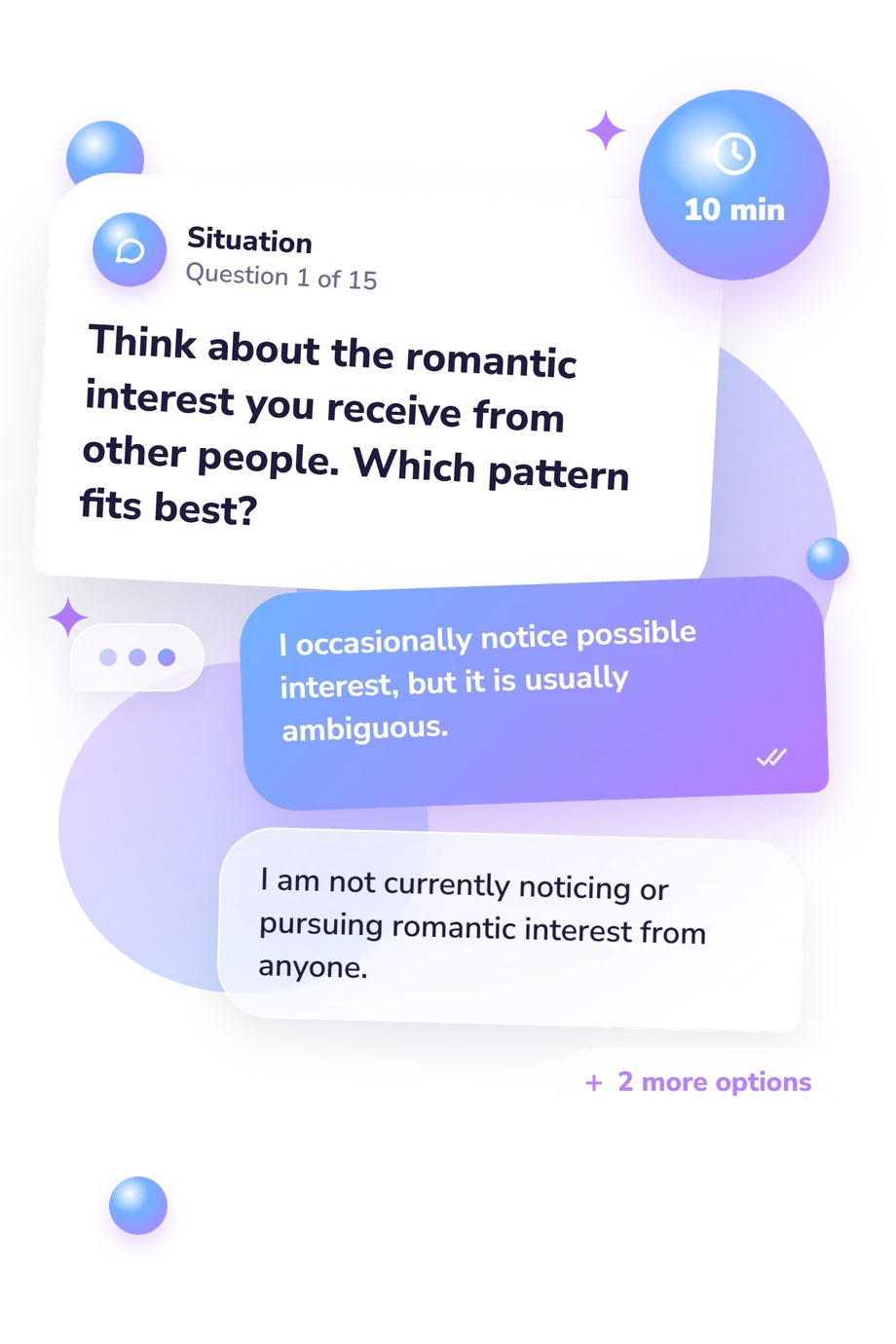
- I occasionally notice possible interest, but it is usually ambiguous.
- I am not currently noticing or pursuing romantic interest from anyone.
- Interest appears mutual with someone, but we are still learning what each person wants.
- Someone and I have clearly acknowledged mutual interest and respect each other’s pace.
- Interested, but I would want time to check how I felt in the moment.
- Excited because it is something I personally want—not just something I feel expected to do.
- Relieved if the possibility disappeared because I do not want it yet.
- Curious and nervous, with uncertainty outweighing my interest.
- I could probably decide, though I might need a quiet moment to sort out mixed feelings.
- I would likely default to avoiding the situation because kissing is not something I want now.
- I could identify my preference and answer honestly, including changing my mind if needed.
- I would have trouble separating my curiosity from nervousness or outside expectations.
When Will I Have My First Kiss Quiz - Description and methodology of the test
If you are curious about romantic timing but want more than a date prediction, the When Will I Have My First Kiss Quiz offers a structured way to reflect on readiness, mutual interest, communication, and opportunity. It is designed for people who want to understand their present feelings without comparing themselves with someone else’s timeline. As a first kiss quiz, it turns that reflection into a practical personal profile.
What This Assessment Explores
Questions cover attraction, boundaries, mutual interest, desire, and opportunities to connect. As a quiz about when my first kiss will be, it describes present conditions rather than promising a date.
The result contains three dimensions:
- Mutual Connection and Communication (0-15) shows whether reciprocal interest and boundary conversations are clear; its bands are No Clear Mutual Context (0-5), Connection Emerging (6-10), and Mutuality Established (11-15).
- Personal Comfort and Desire (0-15) shows whether desire feels absent, tentative, or self-directed; its bands are Waiting Feels Right (0-5), Curious but Selective (6-10), and Personally Ready (11-15).
- Social Opportunity and Intentionality (0-15) shows how routine and initiative create openings; its bands are Few Current Openings (0-5), Occasional Openings (6-10), and Active Openings (11-15).
Methodology and Scientific Basis
Each item presents four statements covering interest, uncertainty, comfort, communication, or opportunity. It is a structured self-report format. Choosing the closest statement creates a profile across the dimensions; scoring remains within the displayed ranges and uses the three result bands rather than converting answers into a date. The practical question behind a quiz about when I will get my first kiss is therefore approached through readiness and context.
Content is conceptually consistent with the First Kiss Beliefs Scale (Thompson et al., 2023), the Sexual Communication Self-Efficacy Scale (Quinn-Nilas et al., 2016), and Sprecher’s (2011) social-network perspective on romantic opportunity. These sources support the selected themes; they do not make this questionnaire an adaptation or standardized version of those instruments.
Read the profile as a current snapshot. New relationships, priorities, confidence, or social access may change responses, while mood, memory, and candor affect self-report. This quiz about when you will get your first kiss can encourage reflection, but it cannot determine timing or serve as a diagnosis.
- Thompson, A. E., Hill, M. R., & Record, J. M. (2023). Can a kiss conquer all? The predictive utility of idealized first kiss beliefs on reports of romantic love among U.S. adults. Frontiers in Psychology, 14, Article 1256423. 10.3389/fpsyg.2023.1256423
- Quinn-Nilas, C., Milhausen, R. R., Breuer, R., Bailey, J., Pavlou, M., DiClemente, R. J., & Wingood, G. M. (2016). Validation of the Sexual Communication Self-Efficacy Scale. Health Education & Behavior, 43(2), 165-171. 10.1177/1090198115598986
- Sprecher, S. (2011). The influence of social networks on romantic relationships: Through the lens of the social network. Personal Relationships, 18(4), 630-644. 10.1111/j.1475-6811.2010.01330.x
Updated: