
Demigirl Quiz
How the Scales are Structured
Who Usually Takes This Test?
See How You Compare
Below is a preview of how scores are typically distributed across each scale.
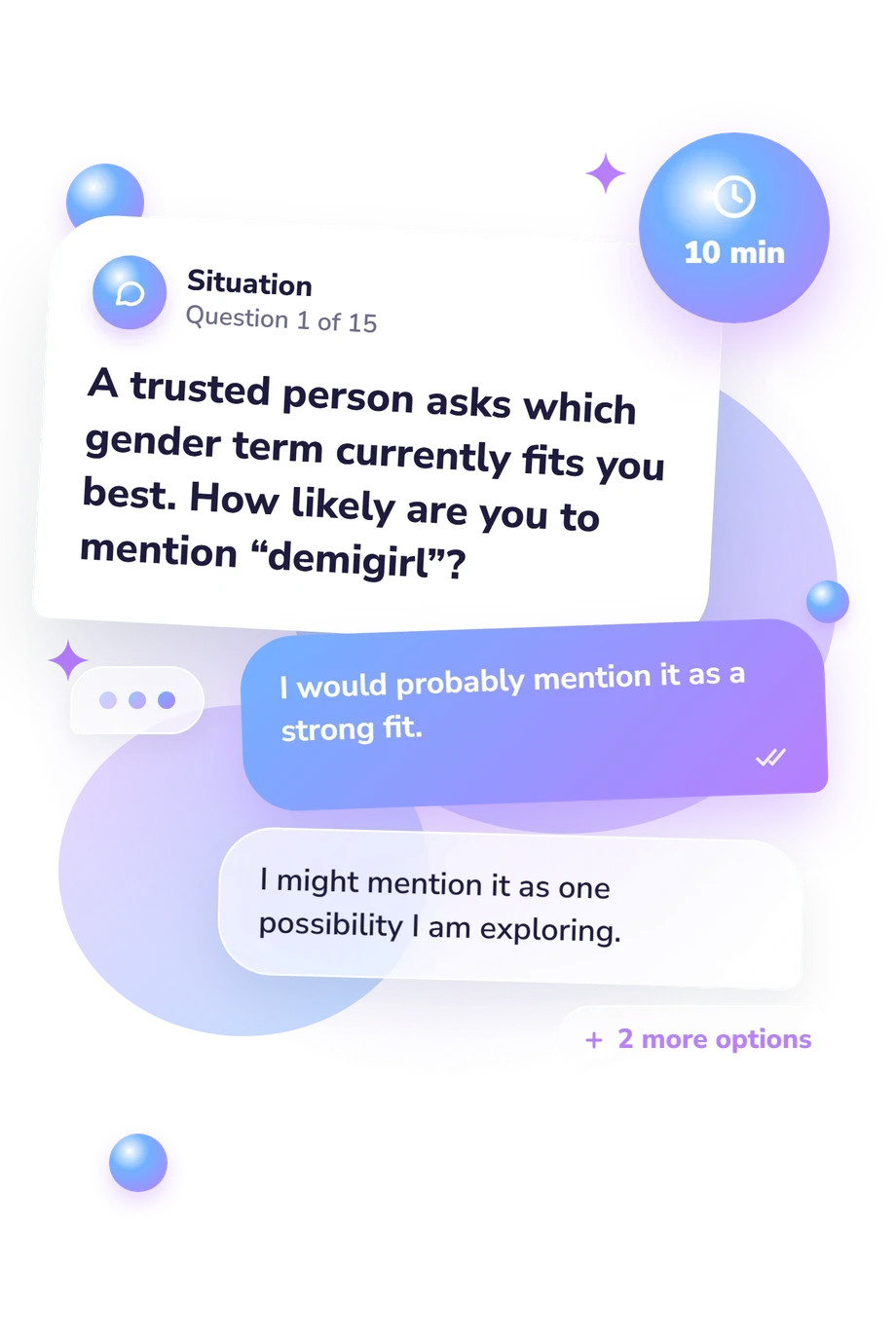
Example Questions From the Test
- Yes, it is a consistent and meaningful part of my gender.
- I am considering the possibility, but I cannot yet describe it.
- No; one gender description feels complete for me.
- Sometimes, although its presence or form varies.
- It would probably have no place in those words.
- It would describe the whole of my gender clearly.
- It would have a steady but deliberately partial place.
- Its place would remain changeable or difficult to define.
- Interesting as an idea, but not especially personal.
- Incorrect or noticeably disconnected from me.
- Relieving, clarifying, or quietly familiar.
- Promising in some moments and uncertain in others.
Demigirl Quiz - Description and methodology of the test
People considering whether the demigirl label fits can use this questionnaire to explore the experience behind the word rather than pursue a yes-or-no verdict. The demigirl quiz is intended for anyone reflecting on a partial connection with girl or womanhood, possible gender beyond it, or uncertainty that changes with context. It turns the question am I demigirl into a structured quiz for private reflection.
What This Assessment Explores
Three dimensions are considered separately, because a label can resonate even while parts of its meaning remain uncertain. The questionnaire explores connection to girl or womanhood, space beyond it, and the usefulness of the word demigirl. The broader-gender dimension in this am i demigender quiz is separate from label choice.
The displayed scales are:
- Demigirl Label Resonance (0-15) shows label fit: Limited label resonance (0-5), Tentative label resonance (6-10), or Strong label resonance (11-15).
- Gender Beyond the Girl/Woman Connection (0-15) shows broader-gender resonance: Little additional-gender resonance (0-5), Exploring broader space (6-10), or Strong broader-gender resonance (11-15).
- Partial Connection to Girl/Womanhood (0-15) shows whether the connection is limited, emerging/contextual, or strong: Limited partial resonance (0-5), Emerging/contextual resonance (6-10), or Strong partial resonance (11-15).
The result describes current patterns, not a required identity formula.
Methodology and Scientific Basis
Items use self-report: each presents a situation, imagined future, internal reaction, or wording choice with four answer options. The alternatives distinguish recognition, exploration, lack of fit, and context-dependent experience, so uncertainty is not forced into a binary response.
Scoring combines responses into the three dimensions, but the questionnaire does not state how many points each option contributes. The bands indicate degrees of resonance, not validated cutoffs or norms. This demigirl identity test is therefore a structured snapshot of current self-understanding.
Conceptually, the content is closest to Sorrels (2016), which describes demigirl experience as a partial relation to girlhood or womanhood. Coburn et al. (2024) adds context about navigating binary gender norms, while Strang et al. (2023) treats gender as multidimensional. These sources offer conceptual context; this questionnaire is not an adaptation or validation of their instruments.
Mood, context, self-awareness, and available language can influence answers, so scores may change as understanding develops. The test cannot decide whether someone should adopt a label or establish a diagnosis.
- Sorrels, Jack. (2016). Aren’t you just practically cis? The case of the demigirl. Undergraduate thesis, University of Florida, Department of Linguistics. 10.13140/RG.2.2.14401.66400
- Coburn, Katelyn O., Amber Vennum, Christi R. McGeorge, Melinda Stafford Markham, and Chelsea M. Spencer. (2024). “It’s like a happy little affirmation circle”: A grounded theory study of nonbinary peoples’ internal processes for navigating binary gender norms. International Journal of Transgender Health, 25(4), 751-769. 10.1080/26895269.2023.2268052
- Strang, John F., Gregory L. Wallace, Jacob J. Michaelson, et al. (2023). The Gender Self-Report: A Multidimensional Gender Characterization Tool for Gender-Diverse and Cisgender Youth and Adults. American Psychologist, 78(7), 886-900. 10.1037/amp0001117
Updated: