
Am I Handsome Quiz
How the Scales are Structured
Who Usually Takes This Test?
See How You Compare
Below is a preview of how scores are typically distributed across each scale.
Example Questions From the Test
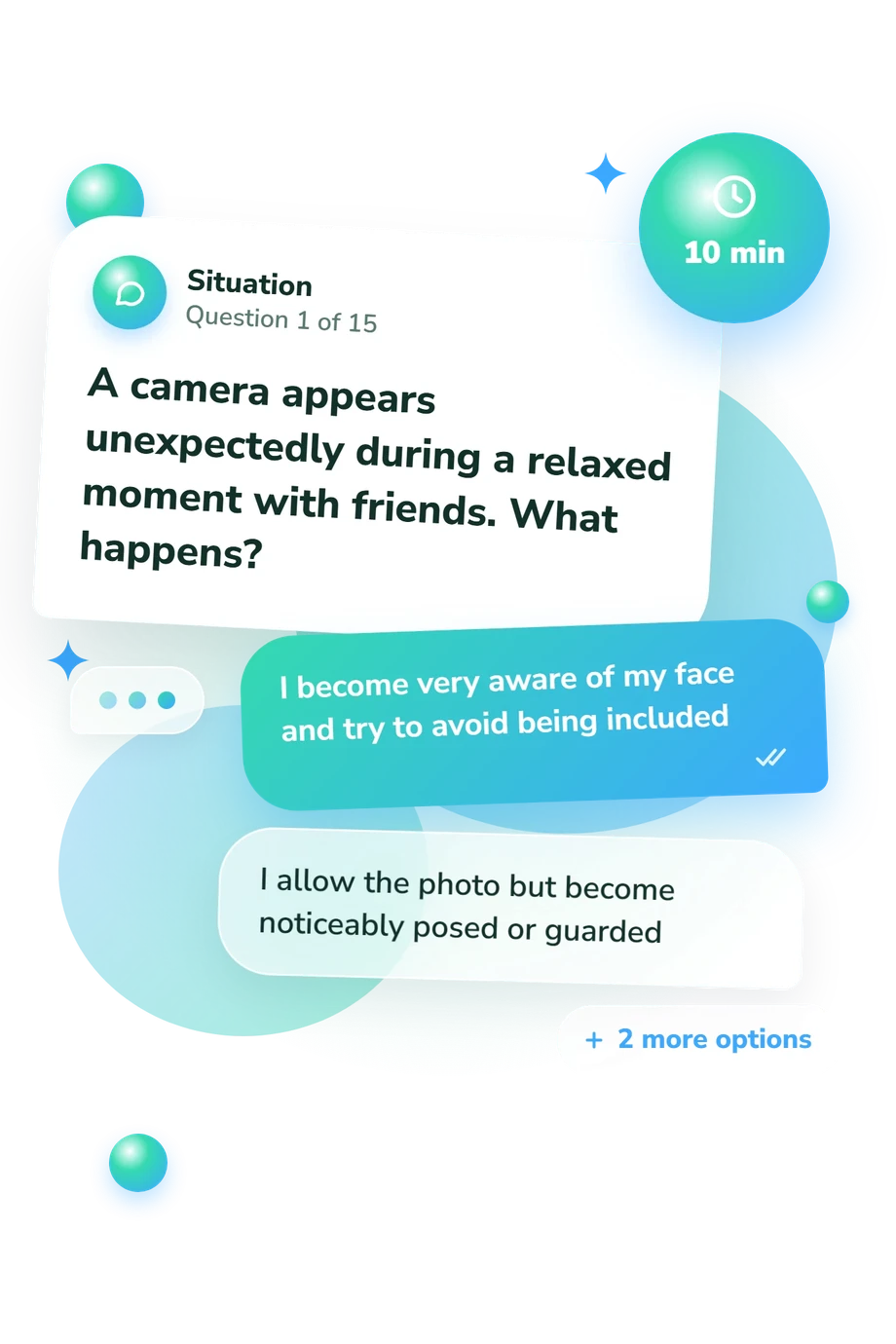
- I become very aware of my face and try to avoid being included
- I allow the photo but become noticeably posed or guarded
- I briefly adjust and then return to the moment
- I stay engaged and let my natural expression carry the image
- Rarely; finding one usually feels forced
- Sometimes, especially after someone else points it out
- Often; a few features come to mind fairly easily
- Very often; I clearly recognize several features I value
- The details I would most like to change
- Practical details, such as whether I look awake or presentable
- A mixture of appealing and less appealing features
- The features that give my face its distinctive appeal
Am I Handsome Quiz - Description and methodology of the test
For anyone wondering how appearance confidence is shaped by self-view, expression, and everyday styling, the Am I Handsome Quiz offers a structured self-reflection exercise. Rather than reducing appearance to fixed features, it considers how you interpret your visible qualities, respond to being seen, and make presentation choices. The result can help you notice patterns in your self-assessment of your appearance without turning them into a verdict.
What This Assessment Explores
This quiz explores how you see yourself as handsome, not how attractive you objectively are. It examines how you recognize appealing features, how expression and posture shape visible presence, and how grooming or clothing support a fitting look. It suits people exploring appearance-related confidence in social situations.
The three result dimensions are:
- Appearance Self-Perception (0-15) measures recognition of valued features: Critical lens (0-5) centers disliked details, Mixed lens (6-10) notices some strengths, and Appreciative lens (11-15) readily identifies liked qualities.
- Expression and Presence (0-15) shows how comfort, posture, and expression shape visibility: Reserved presence (0-5) limits expression, Situational presence (6-10) varies by setting, and Expressive presence (11-15) supports animated engagement.
- Personal Presentation (0-15) shows how deliberately styling communicates your preferred look: Function-led (0-5) favors convenience, Selectively intentional (6-10) reflects chosen details, and Strongly intentional (11-15) consistently supports a fitting style.
Methodology and Scientific Basis
As a quiz about looking handsome, this questionnaire presents situations such as an unexpected photograph, a compliment, a mirror check, social contact, or a grooming choice. Four ordered response options move from self-consciousness, restraint, or convenience toward ease, appreciation, and intention. The format captures self-report patterns rather than facial symmetry or social popularity.
Results are reported separately for the three dimensions, and each result appears in its stated band; the questionnaire does not specify how individual answers contribute points.
Its framework is conceptually consistent with the Appearance Schemas Inventory-Revised, which examines the importance people attach to appearance, and with the Body Appreciation Scale-2, which emphasizes an accepting view of the body. This questionnaire is not an adaptation of either instrument. No population norms or clinical standardization are stated for this questionnaire.
As a self-report tool, the result can shift with mood, current social experiences, cultural ideals, and self-awareness; it describes a current perspective on appearance rather than objective attractiveness, and broader assessment is needed for clinical conclusions.
- Cash, Thomas F., Susan E. Melnyk, and Joshua I. Hrabosky. "The assessment of body image investment: An extensive revision of the Appearance Schemas Inventory." International Journal of Eating Disorders, 35(3), 305-316, 2004. 10.1002/eat.10264
- Tylka, Tracy L., and Nichole L. Wood-Barcalow. "The Body Appreciation Scale-2: Item refinement and psychometric evaluation." Body Image, 12, 53-67, 2015. 10.1016/j.bodyim.2014.09.006
Updated: