
Pre-Calc Quiz
How the Scales are Structured
Who Usually Takes This Test?
See How You Compare
Below is a preview of how scores are typically distributed across each scale.
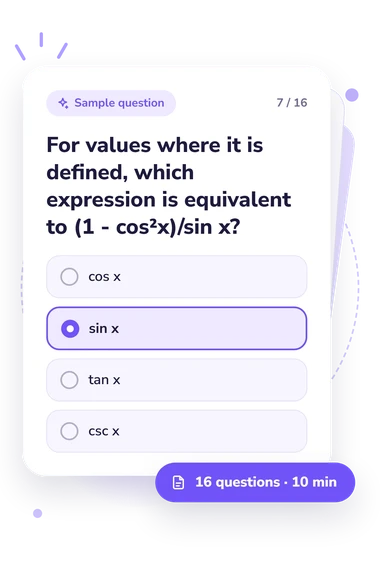
Example Questions From the Test
- -30
- -23
- -20
- 34
- Every real number is in the domain
- Values greater than or equal to 5/2
- Values strictly less than 5
- Values less than or equal to 5/2
- 48
- 189
- 96
- 93
Pre-Calc Quiz - Description and methodology of the test
Students preparing for calculus or checking foundational mathematics can use this assessment to connect what they know with the demands of further study. Learners can use the pre calc quiz to identify secure skills and gaps, then let the result guide a practical review plan. The pre calculus quiz gives readers a clear starting point for choosing what to practise next.
What This Assessment Measures
These questions connect symbolic rules with graphs, patterns, and applied situations. They suit learners reviewing precalculus foundations, checking readiness for further study, or selecting topics for targeted practice. The four groups are:
- Functions and transformations show how you handle domains, inverses, asymptotes, vertices, and graph changes.
- Algebraic structure indicates how you manipulate expressions, solve equations, use factors, and interpret polynomial forms.
- Sequences and models reveal how you recognize arithmetic, geometric, exponential, and periodic relationships.
- Trigonometry measures how you use identities, unit-circle values, and interval conditions to select solutions.
Together, these groups make the precalculus quiz a focused knowledge check, not a complete course survey. Results appear on the Precalculus Knowledge scale (0-16): 0-6 Foundation Review, 7-12 Developing Knowledge, and 13-16 Strong Knowledge. The bands describe the concepts sampled and suggest where to direct review next.
Methodology and Evidence Base
Each item presents four answer choices, and scoring is direct: one point is awarded for each correct response. The total is easy to interpret, but it reflects selected answers rather than the written reasoning behind them. For this precalc quiz, the score can guide practice with domains, transformations, sequences, logarithms, and angle values.
The online questionnaire is conceptually consistent with the Precalculus Concept Assessment, which emphasizes functions, rate of change, and covariational reasoning, but it is not an adaptation of that published instrument. OpenStax and the content frameworks of AP Precalculus and CLEP Precalculus are curriculum references for its topic coverage, not evidence that establishes measurement quality.
The quiz has no test-specific published norms or validation estimates. As a precalculus review quiz, it organizes performance on included items rather than determining placement or overall mathematical ability. Recent study, time pressure, test anxiety, and self-awareness may affect results, and multiple-choice answers cannot show every step of reasoning.
- Carlson, Marilyn, Michael Oehrtman, and Nicole Engelke. The Precalculus Concept Assessment: A Tool for Assessing Students' Reasoning Abilities and Understandings. Cognition and Instruction, 28(1), 113-145, 2010. 10.1080/07370001003676587.
- Abramson, Jay, Valeree Falduto, Rachael Gross, David Lippman, Melonie Rasmussen, Rick Norwood, Nicholas Belloit, Jean-Marie Magnier, Harold Whipple, and Christina Fernandez. Precalculus 2e. OpenStax, 2021.
- College Board. AP Precalculus Course and Exam Description. College Board, 2023.
- College Board. Precalculus: CLEP Exam Description. College Board, n.d.