
Are We Friends Quiz
How the Scales are Structured
Who Usually Takes This Test?
See How You Compare
Below is a preview of how scores are typically distributed across each scale.
Example Questions From the Test
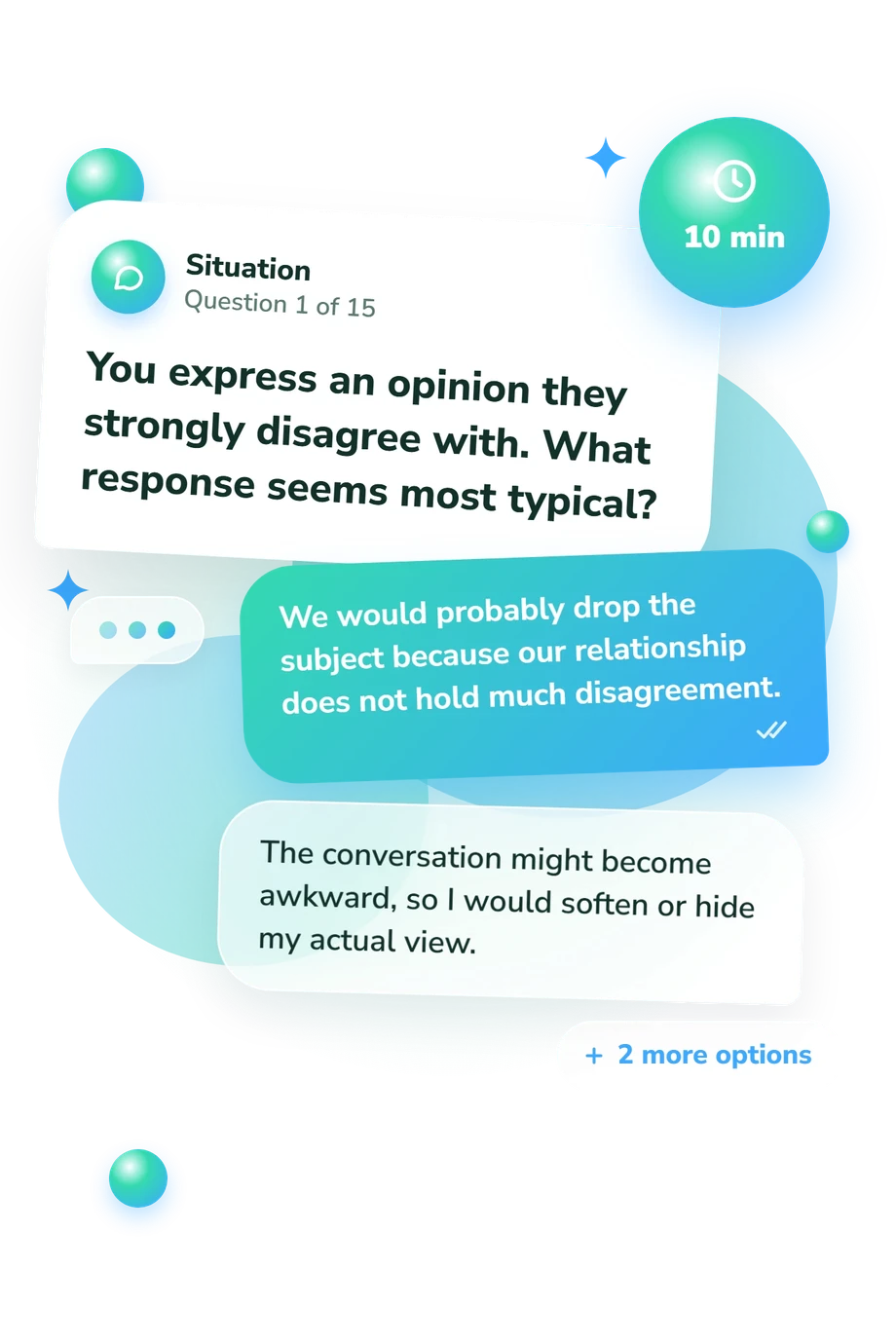
- We would probably drop the subject because our relationship does not hold much disagreement.
- The conversation might become awkward, so I would soften or hide my actual view.
- We could disagree respectfully, although some tension might linger.
- We could explore the disagreement honestly without treating it as a threat to the friendship.
- I would not expect them to remember or ask about it.
- They might ask if something reminds them.
- They would probably check in, especially if we had discussed it recently.
- They would remember and genuinely want to know how it went.
- We would need a specific task or group activity to avoid running out of things to do.
- It could be pleasant, though I would prefer having a plan or other people around.
- We would probably enjoy ourselves once we chose what to do.
- Time together would feel easy, whether we talked, did something spontaneous, or simply relaxed.
Are We Friends Quiz - Description and methodology of the test
For anyone reflecting on whether one friendship feels mutual, meaningful, and safe, this questionnaire offers a structured way to examine a specific relationship. The Are We Friends Quiz helps you examine that connection without reducing it to a single label. It is especially useful for the question behind this quiz: are my friends really my friends? The resulting profile highlights patterns that may support honest self-reflection and a clearer conversation.
What This Assessment Explores
The assessment examines closeness beyond convenience, mutual effort, and trust expressed through openness, respect, repair, and emotional security. Items involving candidness and discretion illustrate these themes. It suits anyone using this quiz to ask: are they a real friend, or is the connection tied to a setting, activity, or social circle?
The three dimensions are:
- Closeness and Shared Connection (0-15) measures familiarity and shared meaning beyond convenience; its bands are Context-based connection (0-5), Growing closeness (6-10), and Strong personal bond (11-15).
- Reciprocity and Reliability (0-15) measures mutual initiative and follow-through; its bands are Uneven rhythm (0-5), Emerging mutuality (6-10), and Strong mutual investment (11-15).
- Trust and Emotional Safety (0-15) measures openness, respect, repair, and emotional security; its bands are Guarded connection (0-5), Selective trust (6-10), and Deep trust (11-15).
Dimensions may align or diverge, showing whether strengths are shared.
Methodology and Scientific Basis
Each item describes a social situation involving disagreement, memory, help, disclosure, plans, or repair. Four response options move from conditional connection toward stronger closeness, reciprocity, trust, and emotional safety. Choose what usually fits, not what you wish were true.
The 15 items form three five-item groups corresponding to the displayed dimensions. Because each response option's contribution is unspecified, read the overall pattern rather than infer scoring from the ranges. The profile frames the are they my friend quiz question and shows whether uneven results point to stronger connection in some dimensions than others.
Its structure is conceptually consistent with the McGill Friendship Questionnaires (Mendelson & Aboud, 1999), the Friendship Qualities Scale (Bukowski, Hoza, & Boivin, 1994), and friendship-quality research by Parker and Asher (1993). It has no stated standardization or validation data. These sources cover companionship, help, intimacy, trust, conflict, and security.
Self-report answers can shift with memory, mood, recent events, expectations, and willingness to disclose. The profile supports reflection and conversation, but one relationship cannot settle the do i have real friends quiz question or establish the other person’s intentions.
- Mendelson, Morton J., & Aboud, Frances E. (1999). Measuring friendship quality in late adolescents and young adults: McGill friendship questionnaires. Canadian Journal of Behavioural Science, 31(2), 130-132. 10.1037/h0087080
- Bukowski, William M., Hoza, Betsy, & Boivin, Michel. (1994). Measuring friendship quality during pre- and early adolescence: The development and psychometric properties of the Friendship Qualities Scale. Journal of Social and Personal Relationships, 11(3), 471-484. 10.1177/0265407594113011
- Parker, Jeffrey G., & Asher, Steven R. (1993). Friendship and friendship quality in middle childhood: Links with peer group acceptance and feelings of loneliness and social dissatisfaction. Developmental Psychology, 29(4), 611-621. 10.1037/0012-1649.29.4.611
Updated: