
Hyperfixation Quiz
How the Scales are Structured
Who Usually Takes This Test?
See How You Compare
Below is a preview of how scores are typically distributed across each scale.
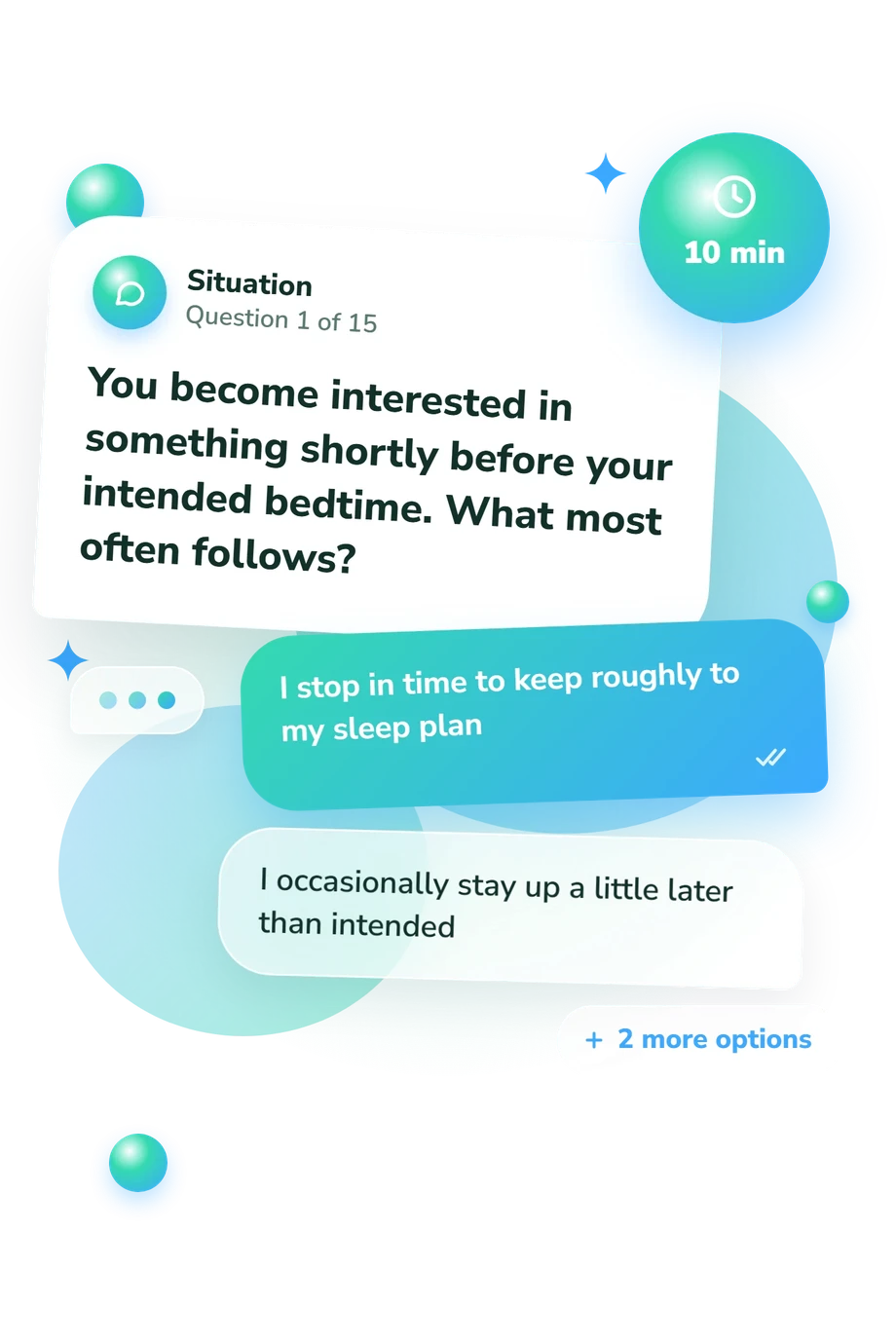
Example Questions From the Test
- I usually finish close to the planned time
- I sometimes continue a little longer than planned
- I often continue for much longer without noticing
- I regularly become absorbed for hours before realizing it
- Rarely or never
- Occasionally, within consequences I can readily manage
- Often enough to create stress or require later adjustments
- Repeatedly, with significant practical or financial consequences
- It generally moves on to whatever I am doing next
- The activity crosses my mind occasionally
- Thoughts about it repeatedly interrupt other activities
- It dominates my thoughts until I can return to it
Hyperfixation Quiz - Description and methodology of the test
People who lose track of time in absorbing interests, struggle to stop, or notice costs to sleep and responsibilities may use the Hyperfixation Quiz to organize those experiences. It is useful for self-reflection around whether you experience hyperfixation, especially when a compelling interest feels different from ordinary enthusiasm. The result brings attention, shifting, and everyday impact into one readable profile.
What This Assessment Explores
These items examine three linked dimensions of intense engagement: how narrowly attention becomes absorbed, how hard it is to shift away, and whether consequences reach daily life. Situations include sleep, basic needs, interruptions, time loss, commitments, responsibilities, spending, and relationships. The focus suits anyone reflecting on recurring, unusually compelling interests.
The result is divided into these scales:
- Attentional Absorption (0-15) shows reported immersion: Occasional immersion (0-5), Noticeable immersion (6-10), or Strong immersion (11-15).
- Attention-Shifting Flexibility (0-15) shows redirecting difficulty: Generally flexible shifting (0-5), Noticeable shifting difficulty (6-10), or Strong shifting difficulty (11-15).
- Everyday-Life Impact (0-15) shows effects on routines and connections: Limited impact (0-5), Noticeable impact (6-10), or Strong impact (11-15).
Together, these dimensions help you consider whether you are hyperfixating without assuming that intense interest is harmful.
Methodology and Evidence Base
Each prompt presents a familiar situation with four ordered response choices, moving from manageable attention toward greater absorption or disruption. Responses are summarized into scale scores; the choices concern typical patterns rather than one exceptional day, so current context and honest self-observation matter.
The closest conceptual reference is the Adult Hyperfocus Questionnaire (Hupfeld et al., 2019). Groen et al. (2020) examined links between ADHD and hyperfocus, while Hupfeld et al. (2024) validated the dispositional adult hyperfocus questionnaire. Ashinoff and Abu-Akel (2021) offer a broader account of hyperfocus as unusually sustained attention around engaging activity. This questionnaire is conceptually consistent with those works, not an adaptation of them.
Scores are unvalidated reflective summaries, not standardized norms, severity ratings, or clinical cutoffs, and they cannot establish ADHD or explain why shifting feels difficult. Self-report varies with memory, mood, environment, and self-awareness, so effects on sleep, health, work, study, or relationships may need fuller consideration. The result can help distinguish whether the pattern is hyperfixation or a special interest from whether it is manageable in daily life.
- Hupfeld, K. E., Abagis, T. R., & Shah, P. (2019). Living “in the zone”: hyperfocus in adult ADHD. ADHD Attention Deficit and Hyperactivity Disorders, 11(2), 191-208. 10.1007/s12402-018-0272-y
- Groen, Y., Priegnitz, U., Fuermaier, A. B. M., Tucha, L., Tucha, O., Aschenbrenner, S., Weisbrod, M., & Garcia Pimenta, M. (2020). Testing the relation between ADHD and hyperfocus experiences. Research in Developmental Disabilities, 107, 103789. 10.1016/j.ridd.2020.103789
- Hupfeld, K. E., Osborne, J. B., Tran, Q. T., Hyatt, H. W., Abagis, T. R., & Shah, P. (2024). Validation of the dispositional adult hyperfocus questionnaire (AHQ-D). Scientific Reports, 14(1), 19460. 10.1038/s41598-024-70028-y
- Ashinoff, B. K., & Abu-Akel, A. (2021). Hyperfocus: the forgotten frontier of attention. Psychological Research, 85(1), 1-19. 10.1007/s00426-019-01245-8
Updated: