
Do I Need Diapers Quiz
How the Scales are Structured
Who Usually Takes This Test?
See How You Compare
Below is a preview of how scores are typically distributed across each scale.
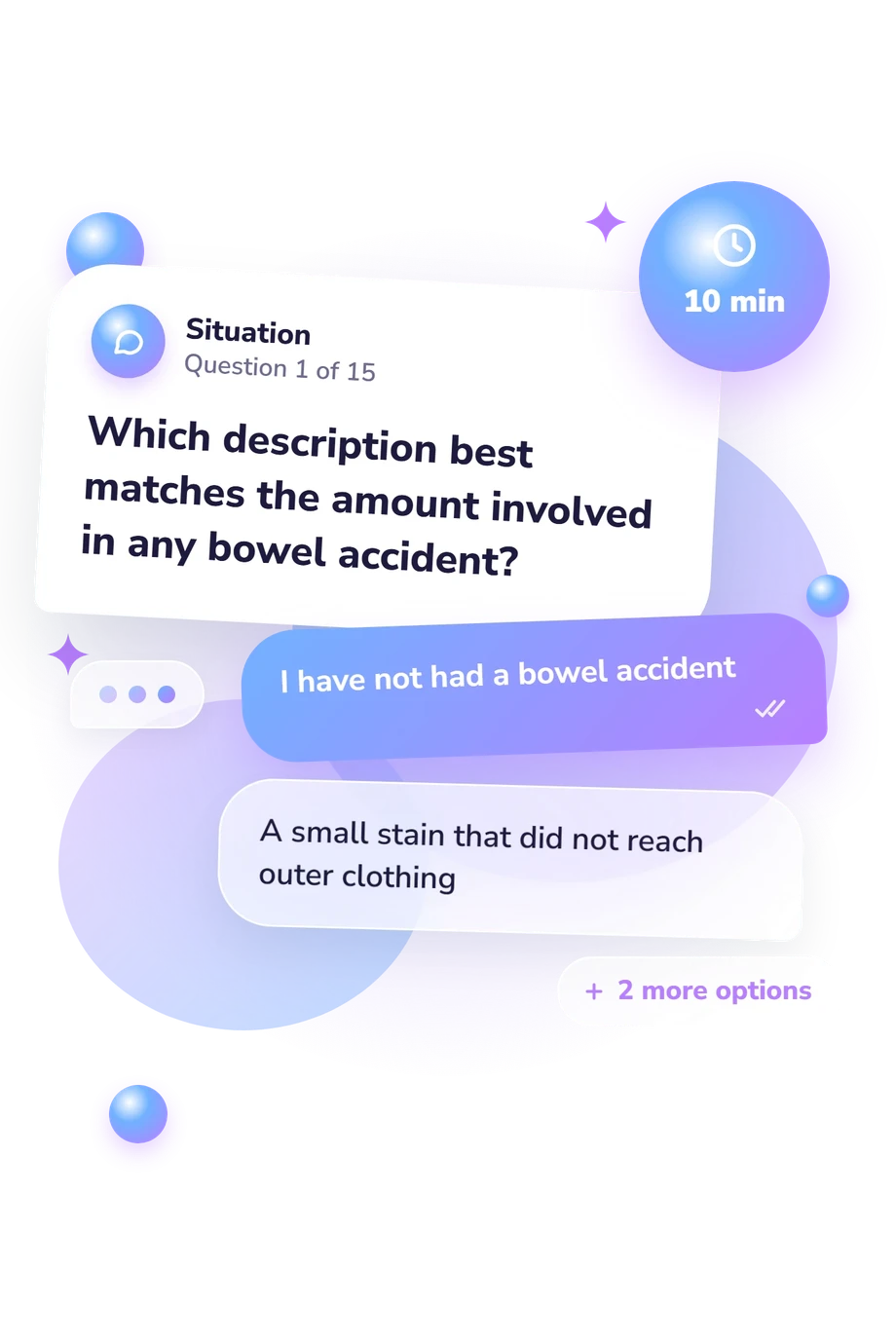
Example Questions From the Test
- I have not had a bowel accident
- A small stain that did not reach outer clothing
- Enough to require changing underwear or cleaning thoroughly
- A larger release that affected clothing, bedding, or furniture
- Not at all
- Once
- On a few separate occasions
- Weekly or more often
- I normally have enough warning to find a toilet without leaking
- I occasionally need to hurry, but leakage is unusual
- The warning is often brief and I sometimes leak on the way
- Urine may release with almost no warning or before I can respond
Do I Need Diapers Quiz - Description and methodology of the test
People considering absorbent protection, or trying to make sense of leakage, urgency, accidents, or changing routines, can use this questionnaire as a focused starting point. For anyone who finds taking the Do I Need Diapers Quiz embarrassing, it connects current experiences with practical protection needs and can be completed privately without discussing answers aloud. This bladder and bowel protection quiz keeps attention on continence concerns rather than shame.
What This Assessment Explores
This questionnaire examines whether bladder or bowel leakage affects containment, routines, skin, confidence, or health. It suits people noticing urgency, accidents, staining, nighttime events, or difficulty reaching a toilet. As a diaper need assessment, it connects these experiences with practical preparation and support.
The result has three dimensions:
- Bladder Protection Needs (0-15) reflects urine leakage, warning time, nighttime wetting, and protection needed. Bands: No current need indicated (0); Monitor and prepare (1-2); Consider protection and support (3-15).
- Bowel Protection Needs (0-15) reflects stool leakage, staining, urgency, accident size, and containment needs. Bands: No indicated need (0); Monitor & prepare (1-2); Consider containment & care (3-15).
- Impact, Skin, and Health Signals (0-15) captures soreness, skin damage, changing demands, daily disruption, and illness signals. Bands: No items endorsed (0-0); Make adjustments (1-2); Seek support (3-15).
Methodology and Evidence Base
Each item offers four choices, moving from no current problem toward greater frequency, urgency, amount, disruption, or need for help. Prompts cover bladder and bowel events, nighttime leakage, skin reactions, changing logistics, daily impact, and warning symptoms.
Responses produce three displayed scores rather than one overall label; individual answer weights are not specified. The displayed bands are reflective summaries rather than norm-based clinical cutoffs, so they do not establish severity, cause, or diagnosis.
Domains are conceptually consistent with ICIQ-B (Cotterill et al., 2011) for anal incontinence impact and the ICIQ urinary incontinence measure described by Avery et al. (2004). Uren et al. (2020) explains the wider ICIQ family. These sources support the domains, not authorship or validation of this tool.
When taking this continence protection quiz, answer from recent experience. Memory, embarrassment, changing symptoms, and self-awareness can affect self-report. A concerning symptom overrides the total, especially sudden loss with severe back pain, leg weakness, groin numbness, bleeding, black stool, severe pain, fever, confusion, or inability to keep fluids down.
- Cotterill N, Norton C, Avery KNL, Abrams P, Donovan JL. Psychometric evaluation of a new patient-completed questionnaire for evaluating anal incontinence symptoms and impact on quality of life: the ICIQ-B. Diseases of the Colon & Rectum. 2011;54(10):1235-1250. 10.1097/DCR.0b013e3182272128
- Avery K, Donovan J, Peters TJ, Shaw C, Gotoh M, Abrams P. ICIQ: a brief and robust measure for evaluating the symptoms and impact of urinary incontinence. Neurourology and Urodynamics. 2004;23(4):322-330. 10.1002/nau.20041
- Uren AD, Cotterill N, Pardoe M, Abrams P. The International Consultation on Incontinence Questionnaires (ICIQ): An update on status and direction. Neurourology and Urodynamics. 2020;39(6):1889-1896. 10.1002/nau.24437
Updated: