
Puzzle Quiz
How the Scales are Structured
Who Usually Takes This Test?
See How You Compare
Below is a preview of how scores are typically distributed across each scale.
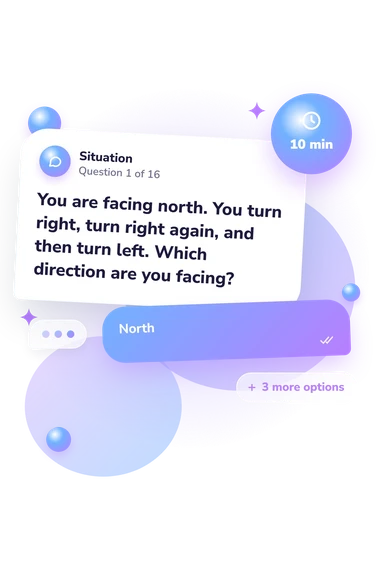
Example Questions From the Test
- North
- South
- East
- West
- NBO
- OCR
- OCS
- KYN
- Some Rens are blue
- No Rens are blue
- All blue things are Rens
- No Rens exist
Puzzle Quiz - Description and methodology of the test
Readers who enjoy reasoning challenges can use this puzzle quiz to measure accuracy in solving varied problems and applying stated rules rather than recalling a particular fact. It suits anyone who wants a broad snapshot across logic, patterns, codes, language, probability, and strategy. The quiz and puzzle format can make strengths and practice needs easier to discuss.
What This Assessment Explores
The items sample puzzle-solving skills across direction, sequences, rules, language, probability, and strategy. Magic squares, Sudoku, codes, anagrams, and set problems test rule application, while rope, switch, box, and guard problems add planning under constraints.
The questions examine several complementary ways of solving unfamiliar problems rather than one narrow skill. The main thematic groups are:
- Logic and numeracy show how you apply sequences, totals, probability, and deduction.
- Language and symbols show how you manipulate words and follow stated codes.
- Strategy and spatial reasoning show how you plan actions and track changing positions.
A single overall result is reported as Puzzle Knowledge, scored from 0-16 correct. Starting Foundation (0-6) describes emerging familiarity; Developing Solver (7-12) indicates growing command; Strong Puzzle Knowledge (13-16) reflects accurate use of varied techniques. It is a snapshot of current performance, not a fixed ability label.
Methodology and Scientific Basis
Each item presents a short problem with several answer choices, and the respondent selects the option that best solves it. This online puzzle-based quiz uses a direct correct-answer count: the displayed score is the number of correct answers across the 16 items on one overall scale.
Its content is conceptually consistent with the Logical Intelligence Enhancement Test (Di Martino & Pellegrini, 2019), which uses varied tasks to examine logical skill. It also resembles the multidimensional reasoning approach represented by SAFRAN (Mussel et al., 2025) and the broader problem-solving tradition associated with Raven’s Progressive Matrices (Raven, 2000). These sources provide conceptual context; this questionnaire is not an administration, adaptation, or validation of those instruments.
No normative sample, reliability estimates, or clinical cutoffs are provided for this questionnaire, so the result bands are descriptive rather than population-based judgments. Performance can shift with concentration, familiarity with puzzle conventions, language, and willingness to check assumptions. Reviewing individual answers adds context to the single score and can help identify which puzzle conventions or solution methods deserve practice.
- Di Martino, V., & Pellegrini, M. (2019). Logical Intelligence Enhancement Test: A measure for the evaluation of logical skills in primary school. Giornale Italiano della Ricerca Educativa, 23, 122-141. 10.7346/SIRD-022019-P122
- Mussel, P., Schäpers, P., Schulte, N., Hewig, J., & Krumm, S. (2025). The Short And Free Reasoning Ability assessmeNt (SAFRAN): Multidimensional, publicly available and only 15 minutes testing time. Intelligence, 112, 101947. 10.1016/j.intell.2025.101947
- Raven, J. (2000). The Raven's Progressive Matrices: Change and Stability over Culture and Time. Cognitive Psychology, 41(1), 1-48. 10.1006/cogp.1999.0735