
How Much Water Should I Drink a Day Quiz
How the Scales are Structured
Who Usually Takes This Test?
See How You Compare
Below is a preview of how scores are typically distributed across each scale.
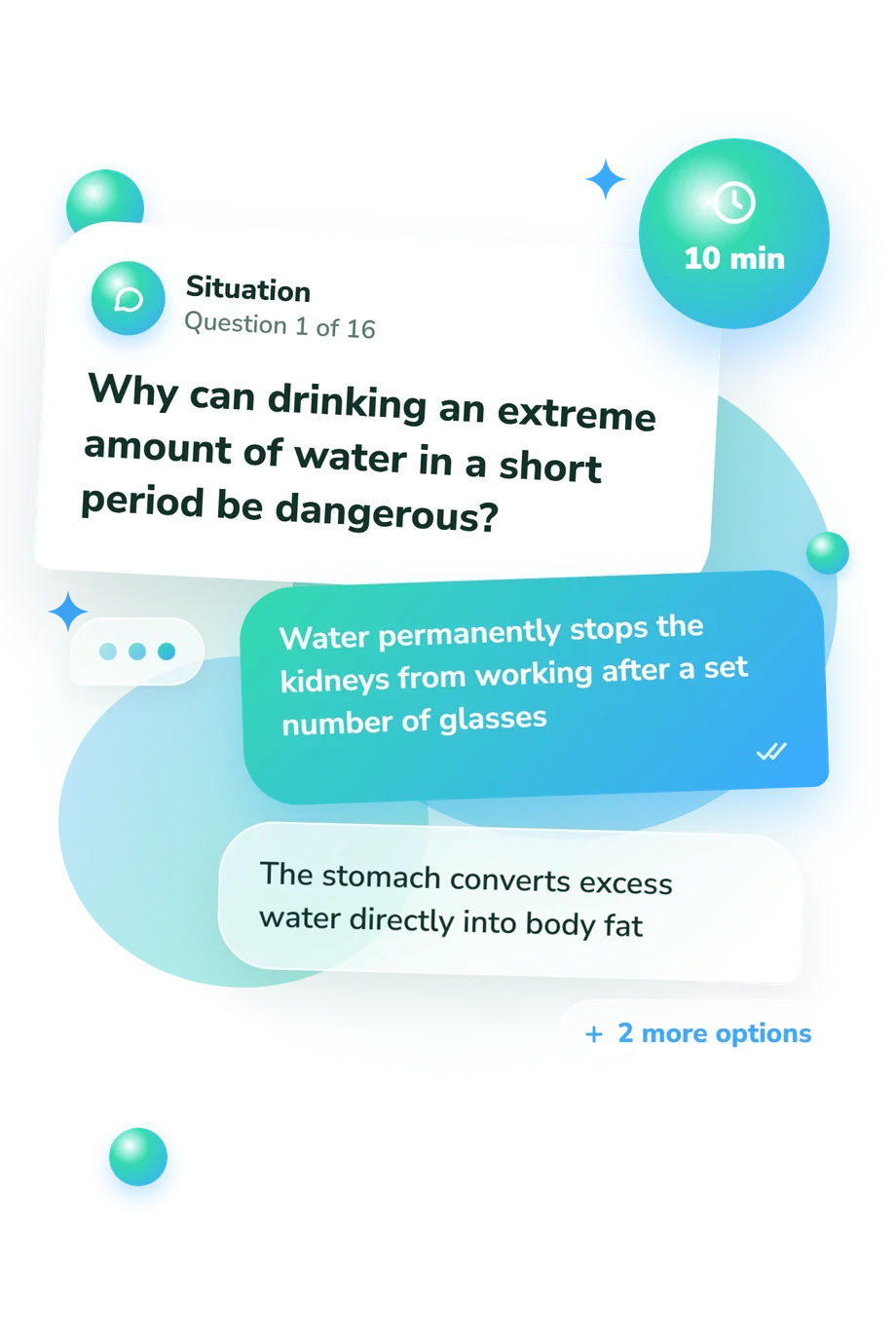
Example Questions From the Test
- Stop forcing fluids and seek prompt medical advice, using urgent care if symptoms are severe or worsening
- Add coffee and continue the same water-drinking pace
- Keep drinking until the urine becomes completely colorless
- Assume the symptoms prove they were dehydrated and need even more water
- Food moisture does not enter the body's fluid balance
- Their water counts only if no beverage is consumed with the meal
- Their water content contributes to total intake
- Only the soup contributes because solid foods cannot supply water
- Water from plain water, other beverages, and moisture-rich foods
- Only glasses of plain, still water
- Plain water and unsweetened drinks, but never food
- Any beverage, but only if consumed between meals
How Much Water Should I Drink a Day Quiz - Description and methodology of the test
For readers who want a practical way to check everyday hydration knowledge, the How Much Water Should I Drink a Day Quiz offers a look at how well they recognize safe, flexible fluid guidance. As a quiz about how much water I should drink, it focuses on ordinary decisions involving exercise, heat, illness, food, caffeine, and alcohol. The result places overall hydration knowledge in one educational band.
What This Assessment Measures
Rather than prescribing a universal number, the questionnaire examines knowledge of factors that change daily hydration needs. Scenarios cover activity, weather, diet, reduced thirst, illness, fluid loss, caffeine, alcohol, and clinician-set limits. It suits readers who want to examine everyday guidance without treating one rule as universal.
Daily Hydration Knowledge is the displayed scale, with a 0-16 range. Results appear as Foundations to build (0-6), Developing understanding (7-12), or Strong understanding (13-16). These are educational, unvalidated bands about knowledge, not hydration status or a prescribed intake.
The questions examine these practical areas:
- Changing needs means the result shows whether you recognize how context alters fluid requirements.
- Interpreting signals reflects whether you use thirst, urine patterns, and total intake cautiously rather than as exact measurements.
- Responding safely shows how well you handle exercise, heat, vomiting, diarrhea, alcohol, and individualized medical limits.
Methodology and Scientific Basis
Each item presents a practical situation with four answer choices. Options contrast context-sensitive decisions with misconceptions such as fixed targets, rapid overdrinking, or treating one sign as definitive. The respondent chooses the best answer; the displayed result summarizes performance on the knowledge scale and does not prescribe personal fluid intake.
The questionnaire is conceptually consistent with work by Veilleux (2020) on hydration knowledge, attitudes, and behavior, but it is not an adaptation of that published instrument. A 2024 study by McDermott and colleagues provides context on knowledge, health habits, and physiological hydration, while Popkin’s 2010 work supports viewing fluid needs as dependent on biological and environmental factors.
Interpretation remains educational: a higher result indicates stronger recognition of the tested principles, not adequate current intake or a safe amount. The bands are educational, unvalidated, and not clinical cutoffs. Answers may reflect guessing, attention, or current memory, while medical fluid restrictions and urgent symptoms take priority over any quiz result. Its practical value is helping readers think through how much water to drink daily without turning general guidance into a fixed prescription.
- Veilleux, J. C., Caldwell, A. R., Johnson, E. C., Kavouras, S., McDermott, B. P., & Ganio, M. S. Examining the links between hydration knowledge, attitudes and behavior. European Journal of Nutrition, 59(3), 991-1000, 2020. 10.1007/s00394-019-01958-x
- McDermott, B. P., Zhao, X., & Veilleux, J. C. Association of Knowledge and Health Habits with Physiological Hydration Status. Nutrients, 16(11), 1541, 2024. 10.3390/nu16111541
- Popkin, B. M., D’Anci, K. E., & Rosenberg, I. H. Water, hydration, and health. Nutrition Reviews, 68(8), 439-458, 2010. 10.1111/j.1753-4887.2010.00304.x
Updated: